
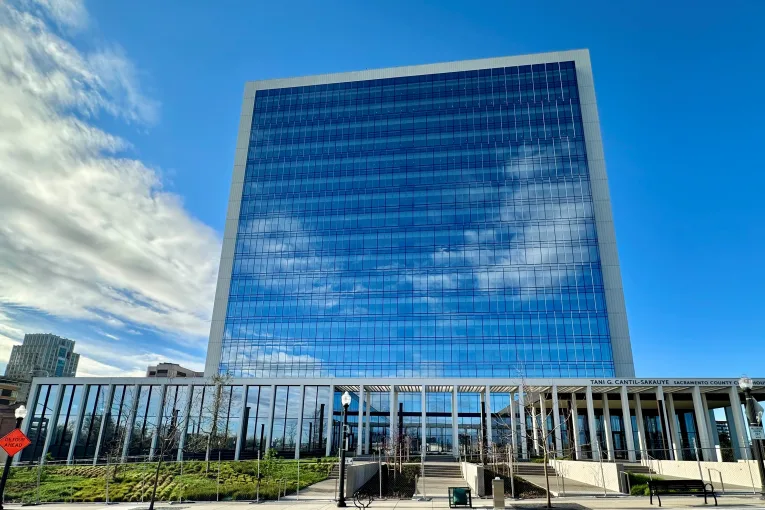
SACRAMENTO, Calif. – During a judgment and sentencing hearing Friday at Sacramento County Superior Court, an accused man was sentenced to four years in state prison for violating California Penal Code Section 69, which prohibits using threats or violence to deter or resist an executive officer performing official duties.
The case stemmed from an incident earlier this year in which the accused allegedly attempted to fight employees at a Safeway store around 2 a.m.
During the confrontation, one employee used pepper spray on the accused. According to the account presented in court, the accused continued approaching the employees, prompting a call to 911.
When police arrived, officers reportedly used a Taser on the accused more than 10 times as he continued resisting arrest.
Deputy District Attorney Madison Cloke discussed the accused’s criminal history, arguing that he had demonstrated a pattern of unlawful conduct dating back to his youth.
Cloke cited a Nov. 25, 2003, incident in which the accused, then 17, was adjudicated in juvenile court on six counts of second-degree robbery.
She also cited a probation violation in 2018, which occurred 30 days after his release from custody, and a 2021 prison sentence stemming from an assault on police officers while he was under the influence of methamphetamine and fentanyl.
In 2026, the accused was arrested again on allegations of using violence to resist arrest.
Judge Bunmi O. Awoniyi noted that the defense had not presented evidence of childhood trauma but acknowledged that the accused had experienced homelessness and drug use during his youth.
Throughout the sentencing hearing, neither Cloke, Deputy Public Defender William Dittmann nor Awoniyi discussed specific programs addressing substance use, mental health or housing instability.
Cloke argued that the accused’s conduct demonstrated an inability to comply with the law. She maintained that his continued resistance to arrest endangered others in the area, as well as himself.
Dittmann disputed the prosecution’s characterization of the incident, arguing that the Safeway employee did not need to use pepper spray against the accused.
He also argued that responding officers failed to identify themselves before using what he characterized as excessive force.
Awoniyi sentenced the accused to four years in state prison. The court also prohibited him from possessing firearms or ammunition.
Before concluding the hearing, Awoniyi expressed hope that she would never see the accused in court again, not because she wanted him to remain incarcerated, but because she hoped he would make positive changes after his release.
Restorative justice offers one approach to addressing criminal conduct by emphasizing accountability, repairing harm and reintegration into the community.
According to the University of Wisconsin Law School’s Restorative Justice Project, restorative justice focuses on the harm caused by criminal acts, the needs of those affected and the responsibilities of those who caused the harm.
The California Department of Corrections and Rehabilitation provides educational, rehabilitative and prerelease programs for incarcerated people.
These include academic and vocational education, rehabilitative interventions, activities designed to develop life skills and prerelease assistance with obtaining identification and preparing for reentry into the community.
To comment please go to one of these social media platforms:
Facebook: https://www.facebook.com/DavisVanguard
LinkedIn: https://www.linkedin.com/company/peoples-vanguard-of-davis-inc/
Instagram: https://www.instagram.com/davisvanguard/
X: https://x.com/davisvanguard
Bluesky: https://bsky.app/profile/vanguardnewsgroup.bsky.social
Subscribe to the Vanguard News letters. To make a tax-deductible donation, please visit davisvanguard.org/donate or give directly through ActBlue. Your support will ensure that the vital work of the Vanguard continues.
