
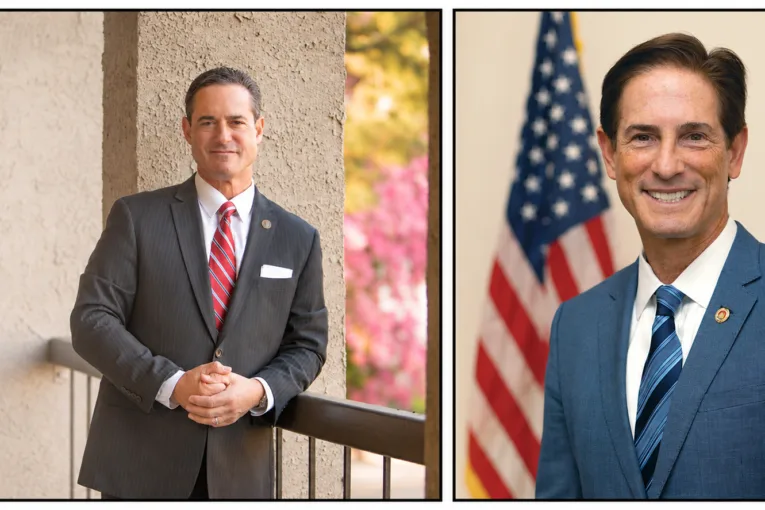
The two district attorneys are challenging the governor’s plan to commute 548 death sentences, while legal scholars and crime survivors defend his constitutional authority and point to longstanding failures in California’s capital punishment system.
SACRAMENTO, Calif. — Orange County District Attorney Todd Spitzer and Los Angeles County District Attorney Nathan Hochman, two prosecutors taking hard-line positions in defense of capital punishment, are leading opposition to Gov. Gavin Newsom’s proposed commutation of 548 death sentences to life without the possibility of parole, setting up a confrontation over executive clemency, victims’ rights and the future of California’s death penalty.
Spitzer announced plans to file a challenge with the California Supreme Court on Monday, Nov. 16, while Hochman has aligned himself with a separate legal challenge by the Criminal Justice Legal Foundation.
Both prosecutors argue that Newsom has disregarded victims’ families, jury verdicts and California voters, who rejected ballot measures to repeal the death penalty in 2012 and 2016.
But the governor’s supporters, including constitutional scholars and crime survivors, counter that executive clemency is a longstanding constitutional safeguard, particularly when a punishment has been administered through a system marked by racial disparities, wrongful convictions and arbitrary sentencing.
The dispute comes as the California Supreme Court considers Newsom’s request for approval of commutations involving people convicted of multiple felonies, a constitutional requirement affecting 382 of the 548 individuals currently sentenced to death.
At a Nov. 12 news conference, Spitzer appeared alongside relatives of murder victims, including Steve Herr, whose son Samuel was murdered by Daniel Wozniak.
Spitzer accused the governor of overriding the judgments of juries and judges, disregarding victims’ families and circumventing voters who had repeatedly supported retaining capital punishment.
“The reason the governor feels he can get away with this is because he doesn’t believe there are any consequences,” Spitzer said, according to City News Service.
Spitzer argued that the state Supreme Court should resist the governor’s effort to commute sentences in cases where the justices had previously upheld death judgments.
“Doesn’t this go against everything the Supreme Court stands for?” he asked.
Spitzer also suggested that Newsom’s decision was motivated by national political ambitions, accusing the governor of moving leftward to position himself for a possible presidential campaign.
That assertion reflects Spitzer’s political interpretation of the governor’s motives rather than an established explanation for the commutations.
Newsom has opposed capital punishment for decades and imposed a moratorium on executions shortly after taking office in 2019.
Spitzer’s announced filing is separate from the challenge supported by Hochman. As of this report, the precise legal arguments and relief sought in Spitzer’s anticipated Nov. 16 submission had not been independently verified through the court record.
Hochman, meanwhile, announced his office’s support for the Criminal Justice Legal Foundation, which is challenging what it characterizes as the governor’s blanket exercise of clemency.
“We stand firmly with the Criminal Justice Legal Foundation in challenging this arbitrary commutation that sidelines victims’ families and disregards the will of California voters, juries and judges,” Hochman said in a Nov. 12 statement.
The Los Angeles district attorney argued that the governor had failed to conduct the individualized assessments traditionally associated with executive clemency.
“Blanket commutations represent an abdication of the Governor’s responsibility to evaluate each case on its merits,” Hochman said.
Hochman said he has personally reviewed more than 50 death-penalty-eligible cases during his approximately 20 months in office, examining the circumstances of each case and consulting with victims’ families before deciding whether to seek capital punishment.
According to his office, none of those reviews has resulted in a decision to pursue the death penalty.
Nevertheless, Hochman maintains that prosecutors should retain the ability to seek executions in appropriate cases and that the governor should not replace hundreds of death sentences through a single exercise of clemency.
Hochman also pointed to notorious murder cases, including those involving Chester Turner and Michael Gargiulo, arguing that the governor’s decision fails to account for the severity of individual crimes.
More than 150 of the affected individuals were prosecuted in Los Angeles County, according to Hochman’s office.
Both prosecutors have also argued that replacing death sentences with life without parole could eventually allow some incarcerated people to become eligible for release if sentencing laws change.
Hochman cited the Menendez brothers, whose original life-without-parole sentences were later modified through resentencing, as an example of how changes in California law can affect sentences that once appeared permanent.
“Contrary to the Governor’s assertion, life without the possibility of parole no longer guarantees that you will spend your life in prison,” Hochman said.
But that argument rests on the possibility of future changes to the law rather than the immediate consequences of Newsom’s action.
The proposed commutations do not make anyone eligible for parole or authorize anyone’s release from prison. They replace execution with life imprisonment without the possibility of parole.
The governor’s action also does not repeal California’s death penalty statute or eliminate prosecutors’ legal authority to seek capital punishment in future cases.
Newsom Defends Clemency as a Matter of Justice
In his Nov. 5 announcement, Newsom framed the commutations as the culmination of decades of opposition to state-sanctioned executions and his conclusion that California cannot administer the death penalty fairly.
“After nearly 30 years in public office, I have come to understand the limits of what government can justly accomplish,” Newsom wrote in an open letter to Californians.
“I take this action because I firmly believe that state-sanctioned killing is incompatible with California’s values, undermines the foundations of our legal system, and diminishes each of us.”
Newsom argued that the death penalty is incompatible with a criminal justice system that cannot eliminate the risk of wrongful convictions or the influence of race and geography on sentencing outcomes.
California has not carried out an execution since 2006, and Newsom imposed a formal moratorium in 2019.
His proposed commutations would go further by eliminating existing death sentences while leaving the underlying convictions and life imprisonment intact.
The governor has also challenged the notion that he should distinguish between murder victims by determining which crimes warrant continued death sentences and which do not.
In explaining his decision, Newsom argued that making such distinctions would effectively create different classes of victims based on whether the state continued to seek the execution of the person responsible for their deaths.
That position stands in direct conflict with Spitzer and Hochman, who maintain that individualized consideration is essential to justice.
At the center of the dispute is the constitutional role of clemency itself.
Article V, Section 8 of the California Constitution gives the governor authority to commute sentences, but requires a recommendation supported by four justices of the California Supreme Court before clemency may be granted to someone twice convicted of a felony.
The question now before the court is whether the governor’s proposed categorical commutations satisfy the constitutional standards governing that authority.
On Nov. 9, the Supreme Court invited interested parties to submit legal arguments concerning Newsom’s request, establishing a Nov. 24 deadline for proposed amicus briefs and a Dec. 4 deadline for the governor’s consolidated response.
The court has not determined whether the proposed commutations may proceed.
Legal Scholars Reject the Argument Against Mass Clemency
Jonathan Simon, a professor at UC Berkeley School of Law and an expert on criminal justice, told the Vanguard in an earlier interview that the Supreme Court’s role in reviewing the governor’s request is substantially narrower than the political arguments advanced by opponents of the commutations.
Simon explained that the constitutional review process is intended to guard against abuses of executive discretion, rather than to allow the justices to substitute their own judgments about the appropriate punishment in each case.
Under that framework, the relevant question is not whether the court agrees with the governor’s opposition to capital punishment, but whether his decision represents an improper exercise of clemency authority.
Simon argued that the broad scope of Newsom’s action makes concerns about favoritism or corruption less plausible than they might be in an individual clemency case.
He also pointed to the historical use of categorical commutations by governors who concluded that systemic problems with capital punishment justified relief for entire death row populations.
Those arguments are reinforced by a Nov. 5 letter submitted to the California Supreme Court by 19 scholars of law, history, philosophy and government.
The signatories include Simon, UC Berkeley Law Dean Erwin Chemerinsky, Harvard Law professor Carol Steiker, Stanford Law professor Robert Weisberg and Cornell Law professor Sandra Babcock.
The scholars urged the court to approve Newsom’s request, arguing that universal clemency is deeply rooted in American constitutional history.
Their letter traces executive clemency to the English monarchy’s power of mercy and its incorporation into American constitutional government.
The scholars noted that presidents and governors have repeatedly exercised clemency for groups of people convicted of serious crimes, including those sentenced to death.
They cited examples involving President George Washington’s pardons following the Whiskey Rebellion and numerous governors who commuted entire death row populations.
Among the most significant modern examples was Illinois Gov. George Ryan, who commuted 167 death sentences in 2003 after concluding that the state’s capital punishment system was too unreliable to justify continued executions.
The scholars also cited more recent mass commutations by governors in Oregon, Colorado, Maryland, New Jersey and New Mexico.
Their historical analysis challenges the argument that Newsom’s categorical approach represents an unprecedented departure from established clemency practices.
The academics emphasized that California is unusual because it has maintained the nation’s largest death row population while going approximately half a century without granting capital clemency.
They argued that the governor’s decision falls within a longstanding tradition of executives using their constitutional authority to address concerns about the fairness and reliability of capital punishment.
A separate brief submitted by the California Appellate Project, Habeas Corpus Resource Center and Office of the State Public Defender similarly argues that the court’s review should focus on whether the governor has abused his discretion.
The organizations contend that California’s documented racial disparities, geographic inconsistencies and wrongful convictions provide substantial justification for the proposed commutations.
They argue that these problems are systemic and cannot be adequately resolved through individual appeals or case-by-case review alone.
Crime Survivors Challenge Prosecutors’ Claims
A central argument advanced by Spitzer and Hochman is that Newsom’s decision disregards victims’ families.
But crime survivors are not united in their views about capital punishment, and some have welcomed the governor’s decision as an opportunity to reconsider how California defines accountability and public safety.
Tinisch Hollins, a leader with Crime Survivors for Safety and Justice who has lost two brothers to violence, told the Vanguard in an interview that she supports the commutations.
Hollins recalled meeting with Newsom and other survivors when he was considering the death penalty moratorium.
“And I know it was not an easy decision for him, but I think that I definitely commend him,” Hollins said. “It was a historic move and I think it creates some opportunities in some ways for us to think about when people are being held accountable, what outcomes we want to see from that.”
Hollins said her opposition to capital punishment reflects both the failures of the criminal justice system and her belief that government should not have the authority to take human life as punishment.
“We have seen cases be overturned. We’ve seen innocent people condemned,” she said. “We know that folks who are sentenced, especially Black people and people of color, are disproportionately receiving harsh and extreme sentences.”
She added, “And just morally, I don’t want my tax dollars to be used to put people to death as punishment.”
Hollins challenged the suggestion that victims’ families share a single perspective on capital punishment.
“They do. They do,” she said when asked whether survivors’ views differ. She explained that survivors have different experiences and different ideas about what justice should look like.
What survivors share, she argued, is the experience of navigating a system that frequently fails to provide meaningful support after violence.
“What is consistent across the board for all survivors, regardless of their perspective on the death penalty, is that survivors don’t get the support that they deserve,” Hollins said.
She pointed to inadequate access to victims’ compensation, trauma recovery services, information about criminal proceedings and other resources that could help families rebuild their lives.
Hollins said the criminal justice system frequently compounds the suffering of survivors through its failure to provide those services, regardless of the punishment ultimately imposed.
Her perspective is echoed by Paul Wilson, whose wife, Christy Lynn Wilson, was killed in the 2011 Seal Beach mass shooting.
Wilson, who once supported capital punishment and campaigned for Spitzer, has since changed his position.
He told City News Service that years of court proceedings led him to reconsider whether the death penalty actually serves survivors.
Wilson criticized the political confrontation over Newsom’s decision and questioned whether continued litigation over executions provides meaningful closure.
“I walk in the same shoes as Mr. Herr,” Wilson said, referring to Steve Herr, who appeared alongside Spitzer to oppose the commutations. “We just have a different view.”
Wilson said he found finality in the life-without-parole sentence imposed on Scott Dekraai, who killed his wife and seven other people.
His comments underscore the differences among survivors over whether execution is necessary for accountability.
For Hollins, the debate over the death penalty should not obscure the larger question of what public safety requires.
She argued that California should invest more heavily in rehabilitation, violence prevention and support for survivors rather than relying primarily on increasingly severe punishment.
“The re-entry population is who I’m focused on, the ones who are going to be coming home,” she said.
Hollins emphasized that the individuals receiving life-without-parole sentences under Newsom’s action would remain incarcerated, but would be living alongside others who eventually return to their communities.
She said the state should consider how prison conditions, rehabilitation and accountability affect those future outcomes.
“And I think that is actually in the best interest of survivors as well,” Hollins said. “That is one of the ways that we can have a future guarantee that no one has to go through what we went through.”
A Constitutional Fight Over the Death Penalty
The confrontation between Newsom and the two district attorneys highlights a fundamental disagreement over the purpose of executive clemency.
Spitzer and Hochman argue that the governor’s decision undermines the judgments of juries, courts and voters who have supported capital punishment.
The governor and his supporters maintain that clemency exists independently of those judgments and permits the executive to reduce punishment when broader concerns about justice warrant intervention.
The legal question is particularly important because California voters have retained the death penalty even as the state has effectively ceased carrying out executions.
Newsom’s proposal would not invalidate those votes or remove the death penalty from state law. Instead, it would exercise a separate constitutional authority to reduce existing sentences.
The California Supreme Court must now determine whether the governor’s request satisfies the requirements governing individuals twice convicted of felonies.
For the 382 cases requiring judicial approval, that decision will determine whether Newsom can complete his proposed universal commutation before leaving office.
The court has invited legal submissions by Nov. 24, with the governor’s response due Dec. 4.
To comment please go to one of these social media platforms:
Facebook: https://www.facebook.com/DavisVanguard
LinkedIn: https://www.linkedin.com/company/peoples-vanguard-of-davis-inc/
Instagram: https://www.instagram.com/davisvanguard/
X: https://x.com/davisvanguard
Bluesky: https://bsky.app/profile/vanguardnewsgroup.bsky.social
Subscribe to the Vanguard News letters. To make a tax-deductible donation, please visit davisvanguard.org/donate or give directly through ActBlue. Your support will ensure that the vital work of the Vanguard continues.
