
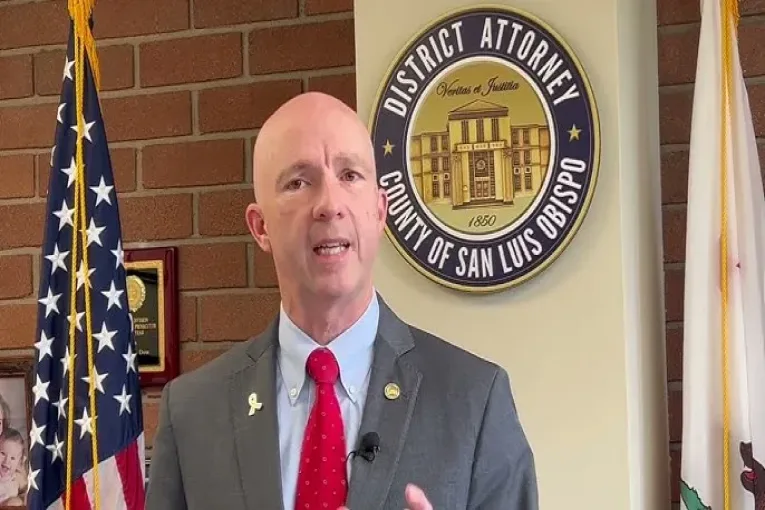
SAN LUIS OBISPO, Calif. — San Luis Obispo County District Attorney Dan Dow announced election-related criminal charges Nov. 2 against a 31-year-old man accused of illegally registering to vote and casting a ballot in California’s 2021 gubernatorial recall election, as his office investigates dozens of voter registrations flagged by federal authorities as potentially involving noncitizens.
The charges come amid a broader dispute between California election officials and the Trump administration over voter eligibility, federal efforts to segregate ballots and the reliability of government records used to identify suspected noncitizens.
According to KEYT, Dow announced the charges during a news conference in Los Angeles alongside federal officials participating in a Justice Department initiative called Operation Protect the Vote.
Prosecutors filed three felony charges against the accused: voter registration fraud, fraudulent voting and perjury by declaration.
The San Luis Obispo Tribune reported that Dow alleged the accused unlawfully registered to vote in August 2016 while knowing he was not eligible.
Prosecutors also allege that the accused falsely declared U.S. citizenship on his registration application and subsequently cast a ballot in California’s Sept. 14, 2021, gubernatorial recall election.
Dow said the alleged violations were discovered Oct. 23, 2026, the same day the Justice Department delivered a letter to the San Luis Obispo County Clerk-Recorder’s Office identifying 63 registered voters whom federal officials suspected of being noncitizens.
The discovery date is significant because prosecutors maintain that California law permits the charges to proceed despite the time that has elapsed since the alleged conduct.
Dow emphasized that filing criminal charges does not establish guilt.
“I want to be clear, Mr. Ambos is legally presumed innocent under California law until proven guilty, either by a plea or a verdict,” Dow said during the news conference, according to KCBX.
“A criminal complaint is an accusation. It’s not final proof.”
The prosecution originated from the federal government’s referral of the 63 voter registrations to San Luis Obispo County authorities.
Dow confirmed that the accused was among those identified in the federal referral and that his office was nearing charging decisions in 16 additional cases arising from the same list.
“This is the first case that my office has filed since we received the list of registrants from our federal partners,” Dow said. “We are close to making filing decisions in sixteen other similar cases.”
According to the Tribune, Dow said the remaining 46 names on the federal list had not been cleared and remained under investigation as of Monday afternoon.
The district attorney’s office is also investigating separate referrals from the county clerk-recorder concerning possible unlawful voting.
During the same federal news conference, officials announced charges against six additional people in Los Angeles County. Those cases were separate from the San Luis Obispo County prosecution, although they were announced as part of the broader federal election enforcement initiative.
The existence of criminal charges against individuals does not independently establish that every person identified in the federal government’s voter database was ineligible to vote.
Dow acknowledged that distinction during the news conference.
“Being named on a referral list is not final proof of a crime,” Dow said, according to the Tribune. “Every case will be decided on the evidence that we review independently, and some investigations may confirm that a person on the list was eligible.”
The prosecution comes amid a dispute over federal efforts to examine voter eligibility and impose additional ballot-processing requirements in California.
On Oct. 22, First Assistant U.S. Attorney Bill Essayli sent a letter to San Luis Obispo County Clerk-Recorder Elaina Cano identifying 63 registered voters whom the Department of Homeland Security considered likely noncitizens.
Federal officials requested that the county segregate any vote-by-mail ballots associated with those individuals and refrain from processing them until their citizenship status could be confirmed.
The county declined the request.
In a written response, County Counsel Jon Ansolabehere and Deputy County Counsel Ann Duggan said the federal list did not provide sufficient individualized evidence to establish that any particular registered voter was ineligible.
“The list you have provided of ‘suspected’ non-citizen voter registrants does not include sufficient individualized evidence to support a determination that any particular registered voter is in fact ineligible,” the county’s response stated, according to KEYT.
County officials explained that the registrar was required to follow established state and federal election procedures and could not treat ballots differently without an adequate legal and factual basis.
The county also indicated that it would review additional individualized evidence if federal authorities provided it.
The disagreement highlighted the distinction between a prosecutor’s authority to investigate suspected criminal conduct and an election administrator’s authority to alter ballot-processing procedures.
A criminal investigation can examine evidence of whether a particular individual was legally eligible to register or vote.
Election administrators, however, must follow laws governing voter eligibility, registration challenges and ballot processing, including protections against improperly rejecting ballots cast by eligible voters.
Cano subsequently said her office would cooperate with the district attorney’s investigation while continuing to administer the election under applicable law.
“The District Attorney and I share a commitment to ensuring that elections in San Luis Obispo County are secure, transparent, lawful, and limited to eligible voters,” Cano said in a Nov. 2 statement.
“While our respective responsibilities, legal authority, and investigative tools differ, we’re united in protecting the integrity of our elections.”
The San Luis Obispo County dispute unfolded alongside federal litigation over similar Justice Department demands involving approximately 20,000 California voter registrations.
Federal courts declined to grant emergency relief requiring California officials to segregate ballots associated with individuals whom federal authorities suspected of being noncitizens.
The U.S. Supreme Court also rejected an emergency request from the Trump administration Nov. 2, leaving existing ballot-processing procedures in place immediately before Election Day.
Those decisions addressed the administration’s efforts to intervene in election administration. They did not determine the guilt or innocence of individuals facing separate criminal charges.
Questions about the reliability of federal voter eligibility data have become central to the broader dispute.
In an interview with KCBX, Cano said the federal government’s list of 63 people included verified U.S. citizens.
That finding raises concerns about relying exclusively on database classifications to determine voter eligibility, particularly when records may be incomplete or fail to reflect changes in citizenship status.
Federal law prohibits noncitizens from voting in elections involving federal offices, and California law criminalizes fraudulent registration and voting.
However, an individual’s appearance on a list of suspected noncitizens does not establish that the person is legally ineligible, knowingly registered unlawfully or cast an illegal ballot.
Those determinations require individualized evidence, and criminal allegations must be proven beyond a reasonable doubt.
The criminal complaint and supporting evidence in the San Luis Obispo County case will be important in determining the factual basis for the prosecution, including the accused’s citizenship status at the time of registration and voting.
The available reporting does not establish whether defense counsel has responded to the charges or intends to challenge the prosecution’s evidence.
Dow’s office has indicated that it is nearing decisions in 16 additional cases arising from the federal referral while continuing to investigate other registrations and separate county election referrals.
To comment please go to one of these social media platforms:
Facebook: https://www.facebook.com/DavisVanguard
LinkedIn: https://www.linkedin.com/company/peoples-vanguard-of-davis-inc/
Instagram: https://www.instagram.com/davisvanguard/
X: https://x.com/davisvanguard
Bluesky: https://bsky.app/profile/vanguardnewsgroup.bsky.social
Subscribe to the Vanguard News letters. To make a tax-deductible donation, please visit davisvanguard.org/donate or give directly through ActBlue. Your support will ensure that the vital work of the Vanguard continues.
