
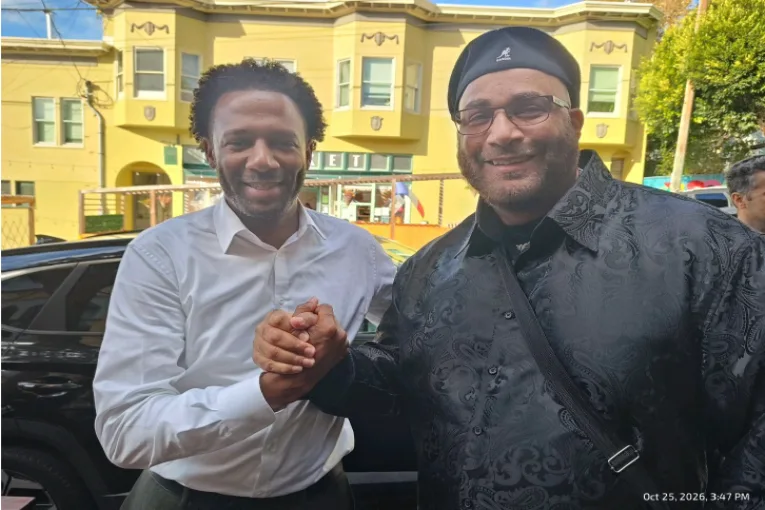
Theo Ellington’s District 10 victory is a moment to celebrate — and an invitation to make City Hall answer the people at its door.
For the Davis Vanguard and Destination Freedom Media Group
Before a victory speech, before the campaign mail and the arguments over endorsements, there was a question about tenants living in conditions no family should have to accept.
And there was a candidate willing to come to the table.
That is where my celebration of Theo Ellington begins — not with a donor’s check, a political label or a prediction vindicated, but with a willingness to listen when the subject was uncomfortable and the people asking for help needed more than another expression of concern.
Theo Ellington has won San Francisco’s District 10 supervisor race. The Bayview native is now the district’s supervisor-elect, preparing to succeed Shamann Walton. The San Francisco Chronicle and The Standard reported his victory Tuesday night.
We can welcome a new chapter without pretending the work is finished.
A Facebook reel shared under the name Shawn Ben’Netti carries a congratulatory caption: “A Big Congratulations to San Francisco’s newly elected Supervisor for District 10……. Theo Ellington!!!” The visible portion also describes Ellington as “A man with principles and values.”
That is one person’s tribute, not a measure of districtwide opinion. But it names a standard I welcome: principles and values that remain visible after the campaign ends.
For me, those words lead back to a practical question. When residents need someone to hear them, will their representative make room? My reason for hope begins with one such request.
One key point that I have kept to myself is this: When I helped arrange a meeting with Special Assistant Attorney General Alex Fisch regarding what tenants described as uninhabitable living conditions and mistreatment by private corporate property managers, the only candidate for District 10 supervisor who expressed a willingness to attend was Theo Ellington.
I also asked current District 10 Supervisor Shamann Walton to attend. As I recall our exchange, he said: “Malik you are a journalist and I am not going to come if you ask me but if a member of the community asks me I will attend.”
At that point, I felt I could not approach Shamann about matters I believed would benefit this community. So I stayed out of his way and continued to quietly do my advocacy in the midst of my journalistic activity.
That was my conclusion from that encounter. It is not a claim to know his motives or a verdict on every part of his public service. But it left me disappointed.
To me, a request about residents’ living conditions should be considered on its substance, regardless of whether the person carrying it is a tenant, an advocate or a journalist.
To be precise, I am describing Ellington’s expressed willingness to attend — not claiming here that he attended, resolved the complaints or secured action from the attorney general’s office. The significance, for me, was that he was willing to engage.
Fisch’s title is documented in California Department of Justice materials. The private exchange and the account of arranging the meeting are my recollection. They are not findings from a government investigation.
A willingness to show up is not the whole of leadership. But it is a place to begin.
Ellington is a third-generation San Franciscan raised in the Bayview. His path to this moment was not uninterrupted success: He ran for the same seat in 2018 and finished third.
This year, he returned with a broader coalition and a campaign centered on housing, transportation and economic opportunity.
There is something worth honoring in persistence. A loss can become a grievance, or it can become preparation. This victory offers Ellington the opportunity to demonstrate what he learned between the two campaigns.
He will succeed Walton, who is termed out. The district stretches across communities including Bayview-Hunters Point, Visitacion Valley, Sunnydale, Potrero Hill and Dogpatch. No single campaign constituency can stand in for all those neighborhoods.
In KQED’s candidate guide, Ellington said every neighborhood deserves the same focus, urgency and resources as the rest of San Francisco.
He also promised to publish what gets funded and delivered, “so every family can measure whether their supervisor is working for them.” That is a commitment worth remembering after the applause.
I think he will serve all the constituents of District 10 equally. That is my expectation, not an accomplishment I can award him in advance.
Equal service must include the resident who opposed him, the tenant without political connections, the elder who needs language assistance and the young person whose first experience of government should not be a closed door.
I do not want to get into how nasty the District 10 campaign got. My assessment is that Theo ran a clean campaign, stuck to his belief system and pressed forward.
That is a personal judgment, not a claim that every advertisement or action by every outside supporter has been independently examined and cleared.
Nor should celebration require selective memory. Ellington benefited from substantial financial support, including a political action committee that received $540,000 from cryptocurrency billionaire Chris Larsen.
His opponents raised legitimate questions about the influence of wealthy interests. Ellington maintained that outside supporters did not speak for his campaign. Those questions about independence do not disappear with a victory.
Neither should they erase the choice voters made.
The fairest test will be the decisions he makes in office: whom he hears, which conditions he investigates, what he funds, and whether residents can see the reasons for his choices.
Brookter, Eppler and the other candidates also brought concerns and commitments into this race. Their voters are not obstacles to governing. They are constituents. The campaign ends; the obligation to represent them does not.
The Hunters Point Shipyard cleanup will demand sustained attention. Ellington has called for independent verification of testing, public tracking of delays and community involvement.
Reporting before the election found agreement among the three leading candidates on the need for independent oversight. That shared commitment should be a foundation to build on, not a position to discard because the contest is over.
Housing will require the same discipline. Ellington campaigned on building homes without displacing existing residents.
The phrase is easy to applaud. Its execution will require scrutiny: who qualifies, what residents can afford, what happens to existing tenants and whether protections arrive before — not after — families are forced to leave.
And then there are the matters that seldom become election-night headlines: a complaint returned, a meeting scheduled, an agency pressed for an answer.
My hope is that Ellington will treat those obligations as the work itself, not interruptions to it.
For Black, Brown, Arab, Asian, Pacific Islander and Hispanic residents, and for every other person who calls District 10 home, the standard should be the same: meaningful access to an office that recognizes their concerns without requiring political loyalty in exchange.
No community should have to prove it supported the winner before asking to be heard.
I am celebrating Theo Ellington today because I see reason for hope. I remember a willingness to engage before there was a victory to celebrate. I see a chance for that willingness to become a habit of government.
Hope does not require me to surrender my notebook. Advocacy does not relieve me of the responsibility to distinguish what I witnessed, what I believe and what the evidence establishes.
I can congratulate Ellington and expect answers from him. I can wish him success and insist that success belong to people beyond his campaign.
Congratulations, Theo.
The most important door is not the one that opens for you at City Hall.
It is the one you keep open for everybody else.
About the Author
Malik Washington is a San Francisco-based journalist and co-founder of Destination Freedom Media Group, an independent nonprofit newsroom dedicated to accountability reporting at the intersection of civil rights, public integrity, disability justice, structural accountability within American institutions and community survival. He has been a published journalist for more than 14 years.
His work, published in partnership with the Davis Vanguard, focuses on government power, criminal justice, environmental justice and the human consequences of policy decisions too often insulated from public scrutiny.
Washington’s reporting amplifies the voices of impacted communities while insisting on documentary evidence, transparency and the unvarnished truth, especially when institutions demand silence. His work appears on platforms such as Muck Rack and Black Voice News, examining the intersection of justice, governance and community.
Contact: mwashington2059@gmail.com
Facebook: facebook.com/destfreedom13
Instagram: @destinationfreedom13
X: @dest_freedom
To comment please go to one of these social media platforms:
Facebook: https://www.facebook.com/DavisVanguard
LinkedIn: https://www.linkedin.com/company/peoples-vanguard-of-davis-inc/
Instagram: https://www.instagram.com/davisvanguard/
X: https://x.com/davisvanguard
Bluesky: https://bsky.app/profile/vanguardnewsgroup.bsky.social
Subscribe to the Vanguard News letters. To make a tax-deductible donation, please visit davisvanguard.org/donate or give directly through ActBlue. Your support will ensure that the vital work of the Vanguard continues.
