
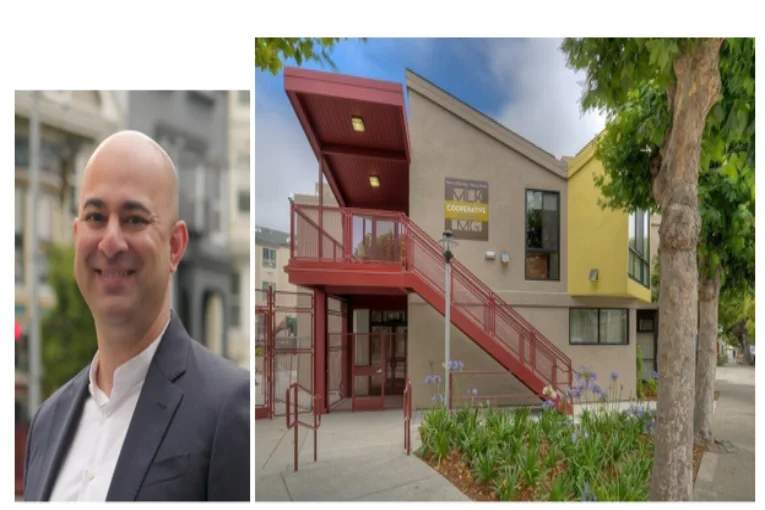
As Supervisor Bilal Mahmood advances oversight ahead of December 3, a board celebration raises an urgent question: what protection accompanies the promise of housing “forever”?
Left: District 5 Supervisor Bilal Mahmood. Right: Martin Luther King–Marcus Garvey Square Cooperative Apartments. Separate photographs placed side by side; not a photograph of a site visit. Photo sources: GrowSF’s Mahmood profile and San Francisco’s DAHLIA housing listing.
SAN FRANCISCO — The invitation was framed in gold stars. The message was triumphant.
“WE’VE SECURED THE BAG!”
The accompanying text credited the Martin Luther King–Marcus Garvey Cooperative Homes Board of Directors with securing affordable housing “for our generations to come.” Its promise was sweeping: “Our cooperative loan will be paid off in 20 years securing our housing forever.”
The invitation advertised a November 7 celebration at Third Baptist Church, from 2 to 6 p.m., honoring the board’s “hard work, dedication, commitment, resilience and faith.” It promised a motivational message, food, music, raffle prizes and good cheer.
For elders confronting the possibility of losing their homes, another question belongs on that program:
Will the King–Garvey board help keep its current seniors housed long enough to share in the future it is celebrating?
The flyer establishes what was advertised, not what happened inside the church. It does not name an individual organizer, identify a lender, disclose a loan amount or explain which protections support its promise of housing “forever.” It does not establish that board president Linda Yoakum personally organized the gathering.
But the document does establish a public claim of achievement. That claim deserves a public explanation.
Sources: November 7 invitation supplied for this article; accompanying celebration program. The official Board hearing file spells the president’s surname “Yoakum.”

The invitation for this past weekend’s celebration advertised Saturday, November 7, 2026, from 2 to 6 p.m., at Third Baptist Church, 1399 McAllister Street, San Francisco. Supplied event material.

The accompanying program prominently declares “WE’VE SECURED THE BAG!” and celebrates the board. It refers to a cooperative loan but contains no dollar amount and identifies no grant award. Supplied event material; not independent verification of the financing claims.
A celebration is not an accounting
There is nothing inherently wrong with celebrating a financing milestone. Refinancing may help preserve a property, address repairs or replace existing obligations. Whether this transaction accomplishes those goals depends on terms and records the flyer does not supply.
Nor is the phrase “secured the bag” proof of unrestricted cash, a grant, a windfall or money available to pay residents’ arrears. The program itself speaks of a loan. The distinction matters: the question is not simply how much money was obtained, but what obligations came with it and who benefits.
Calling the gathering a deliberate distraction would require evidence of intent that is not presently established. Timing and celebratory language alone do not prove a public-relations scheme.
The fairer—and harder—question is whether the celebration is accompanied by information and protection residents can use. A ceremony cannot answer a ledger dispute. A promise about 20 years from now does not explain what happens to a household facing a notice today.
Hewitt’s challenge: whose future was secured?

Dede Hewitt, S.H.E.R.O. founder and executive director, whose written statement is discussed below. Photograph previously published in “A Quiet Removal in the Fillmore” and Part 15. Original photographer not identified in the published caption.
In a written statement supplied for this article, Dede Hewitt, a longtime resident, community organizer and S.H.E.R.O. leader, raises concerns about what she describes as a $59 million refinancing authorized by the board without approval from the required 66.6 percent of shareholders.
Neither the financing amount nor the claimed approval threshold has been independently established from executed loan documents, governing instruments or voting records. Those are precisely the records needed to test her allegation.
Hewitt also questions whether the transaction encumbered residents’ interests, what happened to earlier financing, and why shareholders have not received financial information she says they previously received monthly or quarterly.
“We want to know if this happened again and we want to take action if it did,” she writes of her concern that residents’ equity was used without their consent.
Her statement describes plumbing, electrical and asbestos concerns, alleges open building-inspection complaints and calls for a forensic financial investigation. Those allegations have not been independently resolved through current inspection records, expert assessments or the cooperative’s financial documents. An allegation of unsafe conditions is not, by itself, a finding of a regulatory violation.
Still, her central demand is unmistakable: residents want to understand a transaction that may shape their housing for decades.
That demand should not be reduced to whether residents are sufficiently grateful for preservation. Shareholders can welcome affordable housing and still ask what was borrowed, what was pledged and what they authorized.
Source: Hewitt’s written statement supplied by Washington with the flyers. Loan figures, voting requirements, equity claims, contract signatures and current habitability allegations remain attributed claims pending primary records.
The financing history is more complicated than $113 million
Hewitt describes an earlier $54 million loan and a new $59 million transaction, asking why the cooperative would need $113 million. That is an understandable demand for explanation, but the sum cannot responsibly be presented as the cooperative’s current debt.
Even if both amounts are verified, the new financing may have repaid some prior debt rather than simply adding to it. The closing statement and debt schedule must show the actual outstanding principal, any cash-out proceeds, fees and reserves.
The historical public record also contains figures that differ from Hewitt’s account. In 2011, Multifamily Executive described a $41 million renovation financed with a $5 million San Francisco Redevelopment Agency loan and a $36 million Citi Community Capital construction loan backed by Freddie Mac as permanent lender. Citi’s own account described more than $40 million in project funding.
A 2012 San Francisco Business Times account republished by project architect Gelfand Partners described a $45.45 million renovation and identified the same $5 million and $36 million loans.
Those accounts do not corroborate a single $54 million loan. Neither do they necessarily identify every obligation or later modification. Different figures may describe different costs, dates or layers of financing. An audit should reconcile them—not select the largest number for rhetorical effect.
The historical reporting matters for another reason: the earlier rehabilitation was promoted as a preservation success, undertaken after serious deterioration threatened the property’s subsidies and financing. Today’s celebration should therefore come with a maintenance plan, funding commitments and a way for shareholders to monitor performance.
If preservation has again required a major financial reset, what will prevent the same cycle of deteriorating conditions, emergency borrowing and resident uncertainty from returning?
“Total Co-Operation,” 2011; Citi’s 2011 project account; 2012 Business Times account republished by Gelfand Partners.
What does “our housing forever” mean?
The flyer’s strongest sentence is also the one most in need of explanation.
What does paying off a loan in 20 years guarantee? Continued affordability? Corporate ownership of the property? A particular shareholder benefit? Protection against displacement? Those are not interchangeable promises.
The record describes King–Garvey as a limited-equity cooperative. It would be misleading to assume each shareholder’s interest automatically equals a proportional share of San Francisco market value. The applicable bylaws, occupancy agreements, financing restrictions and subsidy documents must establish the actual rights and valuation rules.
Hewitt’s concern about equity deserves an answer in those terms: what interest does each household hold, how is it calculated, what information is provided to shareholders, and what happens to that interest when a resident leaves or is removed?
The board should explain the limits of its promise as clearly as its aspirations. Seniors cannot plan their lives around the word “forever” without knowing what it means.
Limited-equity description: 2011 project reporting. The current shareholder agreements and valuation formula were not obtained for this article.
Which seniors—and what does the evidence actually establish?
The concern behind these questions predates the celebration. It has names, dates and documentary support. It also has gaps that responsible reporting must not conceal.
Alveries Harper: In its May 7 report, The San Francisco Standard identified Harper as 85 and confirmed that King–Garvey filed an unlawful-detainer suit against her on May 1. The Standard also confirmed suits against eight other residents. Its reporting described eviction notices delivered to 16 Black residents, most seniors, and sharply differing balances. Harper said she had first been told she owed $93,000; the notice described in the story demanded roughly $10,000.
Lula Jackson: The same report identified Jackson as 78, described her uncertainty about her payments and recertification, and documented her concern for Harper. It did not individually confirm an unlawful-detainer filing against Jackson. Her presence in reporting about the crisis is not enough to say that Gavin is currently prosecuting a case against her.
The November limit: I have not obtained a current docket identifying a named senior, Gavin as the plaintiff’s attorney in that particular case, and the latest procedural activity. I therefore cannot establish that Gavin is presently pursuing Harper, Jackson or another specifically identified senior as of November 9. That is an unresolved reporting question—not evidence that earlier cases have ended or that every household is safe.
October reporting adds a more recent checkpoint. Mission Local’s account of the October 1 oversight hearing identified an Eviction Defense Collaborative attorney representing two King–Garvey residents. Neither resident was named in that account. Hewitt’s October reports of renewed notices remain attributed accounts, not substitutes for current court records.
A notice, a filed case, a settlement and a scheduled sheriff’s eviction are different stages. California Courts’ public guide describes the separate steps; none should be collapsed into a claim that a particular elder is about to be locked out.
The Standard, May 7; Mission Local, October hearing report; California Courts: eviction process; Part 15.
Gavin’s documented role—and the board’s responsibility to answer
A redacted settlement document published by Destination Freedom supplies a concrete connection. Its first page names Mercedes A. Gavin as attorney for the plaintiff, Martin Luther King-Marcus Garvey Square Apartments Inc. It does not identify Domus as her client in that action.
The document sets out a claimed $64,053 balance, a $13,999 payment within seven days of signing, repayment of another $25,027, and a conditional waiver of the remaining $25,027. It states a term extending from May 2026 into January 2035 and prohibits prepayment. It also contains language about entry of a possession judgment after default and waivers of procedural protections.
Those are the document’s terms, not independently verified debts or a legal conclusion about their enforceability. The public copy does not reveal the defendants’ names or case number, and its signature lines are blank. It cannot establish that a named senior signed it, that a court approved it, or that it remains operative today.
But the document makes it fair to ask the board about the terms advanced in litigation bearing the cooperative corporation’s name. Ms. Yoakum and fellow directors: what instructions have you given counsel to preserve occupancy, reconcile disputed balances and avoid preventable displacement?
Will you seek a written, counsel-reviewed pause where cases remain active while records and assistance options are evaluated? Will you provide each affected household and its lawyer a comprehensible ledger, payment credits and recertification history? Will you explain whether repayment terms can protect occupancy without unnecessarily prolonging the threat of displacement?
Gavin should likewise be asked to clarify her present representation and the status of cases she can discuss consistently with her duties and residents’ privacy. No adverse inference should be drawn from a lawyer’s inability to disclose protected information.
The goal is not a blank check for unexplained debt. It is verified relief that protects a home without making surrender of a legitimate dispute the price of help.
Redacted stipulation and settlement document, especially pages 1 and 3–7. This article does not determine execution, approval, enforceability or current case status.
Questions the board should answer before December 3
Yoakum need not answer insinuation. She should be invited to answer specific questions about decisions made under her leadership:
- What financing actually closed, on what date, with which lender and at what interest rate and maturity?
- How much replaced prior debt, and how much funded repairs, fees, reserves or other purposes?
- Which approvals were required, which were obtained, and what documents establish the shareholder-vote requirement?
- What restrictions govern shareholder equity and the use of loan proceeds?
- What records will shareholders receive, and when?
- What repair timetable and household-preservation measures accompany the financing?
These questions should accompany, not displace, a household-preservation plan. Shareholders deserve both an accounting of the building’s future and practical help with the risks confronting them now.
Mahmood deserves credit for moving the questions into the public record
District 5 Supervisor Bilal Mahmood’s work deserves recognition. In May, he publicly acknowledged that eviction filings contradicted what management had told his office. He did not simply repeat management’s assurances. His statement to The Standard committed to working toward a resolution that keeps residents safely housed, especially seniors and people with disabilities.
In October, he helped bring residents’ complaints into a public oversight hearing. Mission Local reported his demand for subpoenas after representatives failed to appear, and his commitment to tackle the systems allowing such conditions to persist. That hearing covered multiple properties; allegations specific to Thomas Paine Square must not be automatically assigned to King–Garvey.
Now there are official documents. Subpoenas dated October 14 command both Yoakum and Gavin to appear at 10 a.m. December 3, 2026, in City Hall’s Legislative Chamber, Room 250. File No. 260799 identifies King–Garvey and other properties in an inquiry into evictions, habitability, recertification, payment processing and resident safety. The file remains marked “Pending Committee Action”; the Clerk should confirm the final agenda and any scheduling changes.
Issuance does not establish service, a refusal to comply or a finding of wrongdoing. The subpoenas are Board process, not a personal court order issued by Mahmood. Nevertheless, moving from unanswered complaints to a formal demand for testimony is consequential work. Residents and advocates should recognize it.
His office has also kept a door open to collaboration. In a November 6 email, Pacific time, aide Raynell Cooper responded to my coalition-meeting request on proposed state housing legislation: “Happy to join this meeting as this gets scheduled and looking forward to learning how to support.” That is a meaningful opening—not a promise of funding, enacted legislation or a stay of proceedings.
Supervisor Mahmood, thank you for advancing this oversight. The next opportunity is to pair December 3’s demand for answers with immediate, voluntary work to protect households while those answers are gathered.
A privacy-protective case inventory, with residents’ consent and counsel’s participation, could distinguish pending notices, filed cases, agreements and resolved matters. A public summary could report progress without exposing residents’ private finances. The financing records and shareholder approvals should be sought alongside that work.
Mahmood’s May statement; October oversight reporting; official hearing file; Yoakum subpoena; Gavin subpoena; Cooper correspondence reviewed in Washington’s mailbox.
A direct appeal to David Chiu, Alex Fisch and Rob Bonta
City Attorney David Chiu: Please assess the King–Garvey record, advise the Board on appropriate oversight steps and identify which concerns warrant review or referral by agencies with jurisdiction. The subpoenas copy Deputy City Attorney Brad Russi; that does not establish that your office has opened a separate investigation.
Your office’s 2023 work securing changes to Veritas tenant-organizing rules shows that engagement can produce concrete changes. It does not establish that the same ordinance governs King–Garvey’s circumstances. The request here is for a careful, fact-specific assessment—and coordination that does not leave residents navigating an institutional maze alone.
Special Assistant Attorney General Alex Fisch and Attorney General Rob Bonta: Please have the appropriate Department of Justice team assess whether the King–Garvey evidence raises systemic housing, consumer-protection or civil-rights concerns within its authority, and coordinate any necessary referrals with local and federal partners. Please distinguish verified records from resident allegations while treating both the urgency and the need for evidence seriously.
DOJ’s own housing materials identify Fisch as Special Assistant Attorney General; a February 2026 letter signed by him confirms that title this year. The department’s Housing Justice Team describes work on tenant rights, consumer protection and housing stability. Its housing portal invites complaints and tips that may reveal patterns and practices.
There is relevant—but limited—history. In a 2022 announcement, Bonta described warnings to 91 eviction law firms over reports involving false declarations under pandemic-era rental-assistance protections. That was not a finding against Gavin or King–Garvey, and those temporary protections should not be represented as a present defense here. The useful lesson is narrower: the factual basis of eviction litigation can warrant official scrutiny when supported by evidence.
No one should promise residents that an appeal to the Attorney General will automatically stop a case. DOJ expressly states that it cannot represent individuals or provide them legal advice. Residents still need their own counsel to protect their deadlines and evaluate their circumstances.
What I am asking for is a coordinated review, an identifiable point of contact and an assessment of lawful options—not a predetermined prosecution or a public verdict without evidence.
Mayor Daniel Lurie can help convene the practical side of this effort: residents, cooperative representatives, lawyers and assistance providers working toward verified relief. That is an invitation to leadership, not a claim that his office controls these cases. We need not agree on every allegation to agree that preventing avoidable displacement is worth immediate work.
City Attorney’s May 2023 announcement; DOJ housing presentation; Fisch’s February 23, 2026 letter; DOJ Housing Justice Team and limits on individual representation; Bonta’s historical warning to eviction lawyers.
December 3: a call to the community—and the press
To our neighbors, community organizations, housing advocates and fellow members of the media: please come out and attend the Government Audit and Oversight Committee hearing on Thursday, December 3, 2026, at 10 a.m., at San Francisco City Hall, Legislative Chamber, Room 250, 1 Dr. Carlton B. Goodlett Place.
Show up for the elders. Listen to residents, examine the documents and follow the answers. Community members can bring their experiences and questions; journalists can help ensure that the testimony, responses and follow-through receive sustained public attention. Scrutiny should be fair to everyone—and persistent enough that residents’ concerns do not disappear after the hearing ends.
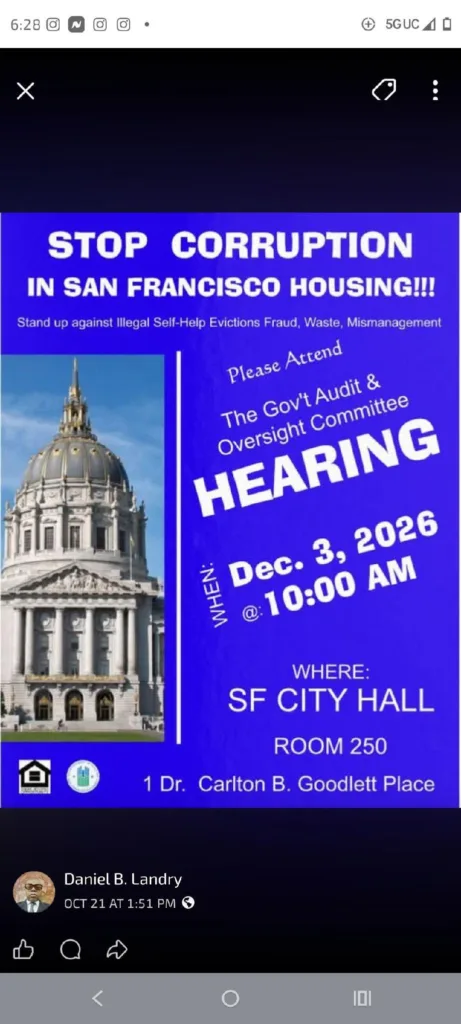
Community advocacy graphic encouraging attendance at the December 3, 2026 hearing. Its references to corruption, illegal self-help evictions, fraud, waste and mismanagement are advocacy allegations, not findings established by this article or the committee.
The date, time and room above match the Board’s issued subpoenas. Before traveling, check the official hearing file and final agenda for scheduling updates and participation information. The hearing is an opportunity to seek answers, not a substitute for residents’ individual legal representation.
Housing preservation must include the people already living there. Let the community be present—and let the press bear witness.
Let the next announcement be about homes preserved
A gathering at Third Baptist Church is not evidence that the church endorsed every board decision. The invitation alone does not establish who paid for the event or what the church knew about the disputed financing. There is no basis here to turn the venue into an allegation.
Nor is a celebration itself a scandal. The question is whether the success being celebrated reaches the residents whose lives are most exposed.
If the financing is sound, explain it. If shareholder approval was properly obtained, produce the record. If repairs are funded, publish the plan. If seniors can be helped, put names, dates and responsible people beside that commitment.
If resources are restricted and cannot be used for assistance, say so—and help eligible residents reach organizations that can assess rental relief. Preservation is not a choice between fixing buildings and caring about the people inside them.
Hewitt’s statement ends with the fear that elders may not live to experience the future being promised. Her question should be heard without converting every allegation into a verdict.
A 20-year promise has to mean something to the person trying to remain housed this month.
The board has announced what it says it secured. Now let residents see the terms, understand the risks and share in the protection.
The next announcement worth celebrating is not that a bag was secured.
It is that an elder’s home was.
About the author

Journalist Malik Washington. Photograph supplied by the author.
Malik Washington is an investigative journalist, U.S. Army veteran, and CEO of Destination Freedom Media Group, which he co-founded with Gale Washington. The independent nonprofit newsroom focuses on civil rights, public integrity, disability justice, structural accountability and community survival.
He served as Editor-in-Chief of the San Francisco Bay View National Black Newspaper from 2020 to 2021 and has been a published journalist for more than 14 years. With journalist Maura Corkery, he is co-author of The Unquiet Resignation, an investigative series on the San Francisco Unified School District produced in partnership with The Davis Vanguard. His Price of Being Poor series is also produced in partnership with The Davis Vanguard.
His reporting examines government power, criminal justice, environmental justice and the human consequences of policy decisions, emphasizing documentary evidence, transparency and the voices of impacted communities.
Contact: mwashington2059@gmail.com · (719) 715-9592. Story suggestions and leads are welcome.
To comment please go to one of these social media platforms:
Facebook: https://www.facebook.com/DavisVanguard
LinkedIn: https://www.linkedin.com/company/peoples-vanguard-of-davis-inc/
Instagram: https://www.instagram.com/davisvanguard/
X: https://x.com/davisvanguard
Bluesky: https://bsky.app/profile/vanguardnewsgroup.bsky.social
Subscribe to the Vanguard News letters. To make a tax-deductible donation, please visit davisvanguard.org/donate or give directly through ActBlue. Your support will ensure that the vital work of the Vanguard continues.
