
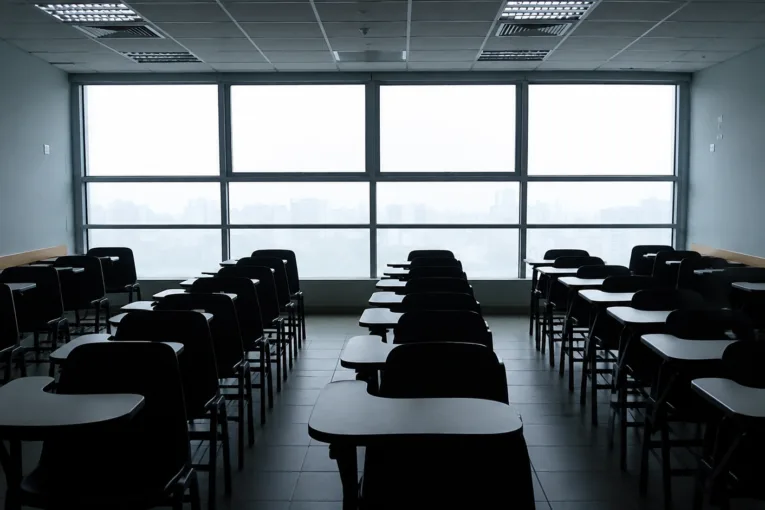
In most prisons there are classrooms set aside for the purpose of education or meetings. However, most of these classrooms are underutilized, sit empty most of the time, are not easily accessible to residents and often remain closed off.
Valley State Prison (VSP) is unique in its design, in that every housing unit has a designated classroom, adjacent to the Dayroom. These classrooms have about ten school desks and folding chairs, looking reminiscent of a time many years ago where some of us as children and young adults sat, uninterested, disengaged and wanting to be somewhere else. The subject matter forced upon us and required by the school administration in order to advance or graduate. Failure to comply would result in a mark on your “Permanent Record Card.” The majority incarcerated individuals in America have never completed high school, earned a G.E.D., or can read above the ninth grade level of comprehension.
Just as in society, most justice impacted have never been exposed to or participated in self-help programs or effective counseling, in order to help them navigate life’s challenges, or develop real emotional intelligence. Prison quickly teaches you to recognize the devastation that trauma, abuse, neglect, chemical dependency, domestic violence, poverty, and the resultant broken families, have played in keeping prisons filled with broken, uneducated, and hurt people who have hurt people. An apathetic system, dealing with apathetic stakeholders, officers and captives alike – perpetuates an apathetic baseline, to be sure. The flow of bodies into the carceral system seems endless. Residents with sentences of Life Without the Possibility Parole, or extremely long sentences are routinely kept out of the few groups or programs that are offered at any given prison. The prevailing justification, historically, can be summed up by the following officer’s refrain that I have heard for decades: “what’s the point? Its not like they are ever getting out.”
However, over time proactive individuals of the carceral state housed around the country, regardless of whether or not they were ever to be released, still wanted to understand why and how they became the person that society felt needed to be removed, labeled unredeemable and unworthy of society’s time, help or understanding. These same residents were searching for purpose and ways to make amends for their past behavior, looking beyond the walls that held them. Essentially, ethically reverse an apathetic system that never thought it’s “throw aways” might possess the desire or ability to heal themselves.
In their search they first found other like-minded individuals to convene with, and then sought out resources from outside organizations and individuals willing to assist them on their path. With little or no support from the administration, they formed peer to peer groups that allowed them to exchange information and to discuss issues and secrets that they had long kept hidden from themselves and others. The groups that they formed allowed them a safe space to foster an environment where individuals could dive deep into the generational traumas and warped belief systems that form their anti-social behaviors. Creating opportunities to learn about the ripple effects that their actions have caused others to contend with, these discoveries helped deliver healing, insight and purpose, along with a desire for change, and a motivation to become better humans, searching for ways to atone for their mistakes, develop empathy, and put an end to the cycle of generational violence, abuse and trauma that marks their stories. Instead of being forced to participate, residents voluntarily attended, became eagerly engaged in the curriculum, and remained diligent in completing their assignments.
These residents sat in classrooms, or wherever they could gather, not because they were forced to be there, not because they hoped to gain a Certificate or Chrono, or time off of their sentence, or owing to any transactional accolades of any kind – but because they needed to do the work. They simply were looking for answers that had been withheld from them for so long. These residents voluntarily gathered, and eagerly participated with their peers, not because they were forced to do so by an authority figure.
Over time, the administration recognized the benefits of some of these groups and programs, and attempted to formalize their integration into the programming offered. The challenge then became that the resources and staff were limited, therefore, the amount of participants was limited, and long waiting listed became the norm. So, what were the options for someone who needed and wanted the help and true rehabilitation that these programs offered? What happens when many of the participants placed in groups, were only in the groups because they were forced to be there, or were only chasing another chrono to put in their Central File?
The reality is that you end up with the same scenario that was described at the beginning of this article, “reminiscent of a time many years ago where we sat, uninterested, disengaged and wanting to be somewhere else. The subject matter forced upon us, and required by the school administration in order to advance or graduate. Failure to comply would result in a mark on your “Permanent Record Card”.(or now your Central-File). A system that did not work for most in the past, so it just reinforced the experience of a prior failed system.
Instead of residents voluntarily gathering together with individuals that they knew and grew to trust, they were instead now forced into a room with strangers, and a staff member overseeing the groups and programs. This kind of situation is not conducive to someone who has kept secrets for so many years, suddenly and freely opening up and becoming vulnerable, or diving deeply to expose their former flawed thinking and behavior. Unfortunately, in most cases this has an opposite effect, and shuts a person down even more.
Where is the hope of true rehabilitation in this situation? While there is room and purpose for having formalized groups and programs for some, there should also be room for voluntary groups of residents that are doing their best to understand themselves, and to be able to gather in a safe place to be vulnerable and to share past experiences in hopes of bettering themselves and improving their community. Instead of telling them, “No, you cannot gather together until “we” say that it is okay for you to do so.” In effect saying, “It doesn’t matter that you have a Parole Hearing coming up, or that you have an issue that you are dealing with right now, we will tell you when you can deal with your issues.” If the goal and stated mission is for “Rehabilitation”, why would you ever hinder a resident from searching out the resources among their peers to address these issues? Yet, in many institutions incarcerated individuals are restricted or even forbidden to gather together and utilize the spaces that could be made available for residents to convene. This despite the fact that it has been proven that Peer to Peer counseling and groups are the most effective way to reach real rehabilitation and pro-social awareness and behavior.
Resident stakeholders have benefited from voluntary self-help and peer to peer groups such as Preparing for Life Outside the Wall (PLOW) and Trauma Speaks, having the support of outside Institutions and Non-Profit Organizations such as the Harvard-Yale Institute of Policing, Incarceration, & Public Safety (IPIPS), Inside Knowledge, La Sierra University’s Criminal Justice Department, Justice For Everyone.org, Parole Justice Works (PJW), and Compassion Prison Project. Here are a few statements made by residents that have benefited from these groups and programs;
Forrest shared, “I have waited up to 5 years to get into a group that I had requested, until I finally just gave up. Being in the PLOW and Trauma classes has allowed me to connect with fellow residents, in a way I have never been able to do in my 40 plus years of incarceration. These groups have allowed me to talk about things in my life that I have not EVER been able to talk about with anyone ever before. These groups are different, I am finally in a safe zone, and I have come to realize that we have more in common, then we are different. I only want to do the work, and learn how to become a better person, I am learning priceless information about myself from others that have shared experiences. I only wish that it hadn’t taken me over 60 years to realize and discover this.”
From Johnny, “After over 40 years of incarceration, I have learned more about myself, and how my childhood trauma affected me, in the first 7 weeks that I have participated in the PLOW and Trauma groups, I have learned more than I have learned in all of my years of incarceration. I was so ashamed of my past, that I used violence to keep anyone from learning about the real me. In the last few weeks I have finally felt safe enough to open up about and speak about the horrible crimes that I committed, and I am finally learning why and how I got to the point of thinking that it was okay to harm another human being. For the first time I feel that I am no longer in denial, and because I am gaining a better understanding of my issues, I can now address them head on, instead of hiding from them. For the first time I felt safe to cry in front of other men, and not feel embarrassed. I actually believe now that I can heal from a past that had become such a burden to carry.”
Richard shared, “I am a Mentor and Facilitator in the Youth Offender Program, and I participate in many rehabilitative programs, such as college, community sports and events, and religious programs, all in support of building a better community, and a better self…my schedule is fully booked, and though I have sought out these responsibilities, it does not detract from the reality that many of the self-help programs provided by the Institution are not presently compatible or available to those, who like me, are striving to be positive role models. The PLOW and Trauma classes that I have participated in on the weekends serves to compensate for what I am presently unable to do otherwise. My participation has allowed me to continue improving myself and gaining additional knowledge and understanding, which I can then give back to this community.” Richard recently shared with the PLOW group, “I am 51 years old, and this is the very first time that I have ever spoken to anyone about my abusive childhood, and the horrific crimes that I have committed, and I feel safe doing so with this group.”
Rocci, a resident incarcerated for over 30 years shared, “After waiting on mile-long lists to be accepted into self-help groups, it was a with a sigh of relief and hope that we finally were able to participate in voluntary self-help groups in my Housing Unit. No one is paid to run the groups, and the Facilitators are always on time (not so with sponsored groups). Working as a Peer Support Specialist, I have seen first hand the value of the groups that help to instill important values that build character into those that participate. I see residents who chose to participate instead of watching TV, playing games, or other activities, and voluntarily attending PLOW and Trauma groups, because they are getting RESULTS from residents who give of their personal time to work one-on-one with people building their confidence, trust and hope. These groups enable residents to open up and talk about sensitive issues in a mature and safe environment. I see participants, who are serious about changing and bettering their lives (no chrono chasers like their are in many groups). I have seen nothing but integrity, and a willingness to helping others to better themselves for a successful future while incarcerated, and upon their release back into society.”
Residents need to identify and seek out the use of underutilized but available rooms and spaces for the convening of voluntary self-help and peer to peer groups, in order to demonstrate that residents can gather in a responsible manner. If these groups are run properly, there is no need for additional staff (most Institutions already have cameras in the room); no funding is necessary (participants should be creative and self sufficient, or search outside sources and organizations willing to support the groups efforts). The voluntary peer to peer self-help groups only ask for the ability to convene in classrooms that have sat empty and unused for the most part, and to seek out ways to occupy them for the purpose that they were intended, so that residents may run support groups. Look for ways to overcome the objections for using the classrooms. Emphasize the value of utilizing residents as Teachers/Facilitators, and that incarcerated individuals have the capacity and desire to learn from one another.
The goal is to build communities of people helping each other achieve their rehabilitation goals. Find ways to Occupy the Unoccupied Spaces.
Matthew Fletcher has participated in, Facilitated, Co-Facilitated, and created numerous Self-Help and Support Groups, over the course of his over 24 years of incarceration. Along with other Facilitators and residents, advocates for those that are doing all that they can to become positive and productive citizens, both while incarcerated, and when they return to their communities.
To comment please go to one of these social media platforms:
Facebook: https://www.facebook.com/DavisVanguard
LinkedIn: https://www.linkedin.com/company/peoples-vanguard-of-davis-inc/
Instagram: https://www.instagram.com/davisvanguard/
X: https://x.com/davisvanguard
Bluesky: https://bsky.app/profile/vanguardnewsgroup.bsky.social
Subscribe to the Vanguard News letters. To make a tax-deductible donation, please visit davisvanguard.org/donate or give directly through ActBlue. Your support will ensure that the vital work of the Vanguard continues.
