
As unsheltered homelessness continues to rise across the United States, communities face mounting pressure to respond quickly and decisively. The debate is often framed as one between compassion and accountability, treatment versus tolerance, or enforcement versus services.
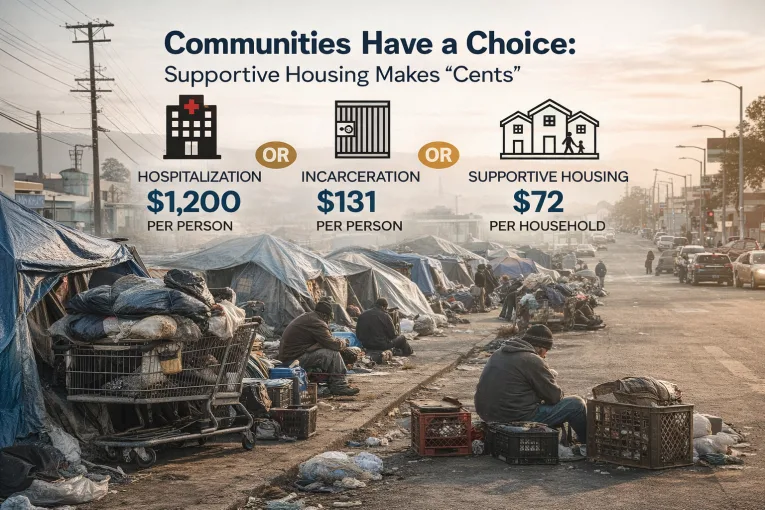
The Corporation for Supportive Housing (CSH) centered its national policy advocacy on a simple but pointed comparison: communities can continue to spend heavily on emergency responses to homelessness, or they can invest in supportive housing that costs less and produces better outcomes. (see: link).
But data drawn from housing, health care and criminal legal systems point to a different and more pragmatic conclusion: supportive housing is the most cost-effective and effective way to reduce unsheltered homelessness.
Supportive housing combines affordable housing with on-site or closely linked services such as case management, health care, mental health treatment, substance use treatment and employment support.
It is designed for people with complex needs, including those who have experienced long-term homelessness, repeated hospitalizations or frequent incarceration. While critics sometimes characterize supportive housing as an expensive or permissive approach, cost comparisons show the opposite.
Public systems already spend enormous sums responding to homelessness, largely through emergency and institutional settings.
Hospitalization of an unhoused person can cost approximately $1,200 per person per day. Incarceration costs roughly $131 per person per day.
By contrast, supportive housing costs about $72 per household per day.
These figures highlight a basic but often overlooked reality: communities are already paying far more to manage homelessness through crisis response than they would by providing stable housing with services.
Emergency rooms, jails and psychiatric facilities frequently become de facto homelessness systems, cycling people through expensive interventions that do little to improve long-term stability.
People experiencing homelessness are more likely to be hospitalized, arrested and held in custody for low-level offenses, or discharged back onto the street without meaningful support. The result is a revolving door that drains public resources while leaving people no better off.
Supportive housing interrupts this cycle by addressing homelessness at its root: the lack of stable, affordable housing.
Once housed, people are better able to engage in treatment, manage chronic conditions and pursue employment or benefits.
Studies consistently show reductions in emergency room visits, inpatient hospital stays and jail bookings after people enter supportive housing, leading to significant savings for health care systems, law enforcement agencies and local governments.
Despite this evidence, policy responses often prioritize enforcement or treatment without housing.
Cities increasingly clear encampments, issue citations or mandate treatment, arguing that visible homelessness requires immediate action.
But enforcement-heavy approaches do not eliminate homelessness; they displace it.
Encampment sweeps often result in people losing what few possessions they have, including medications, identification and phones, making it harder to connect them to services and housing. The underlying housing shortage remains unchanged.
Mandating treatment without housing has also shown limited success. Treatment works best when people have a stable place to live. Without housing, people often exit treatment programs back into homelessness, undermining progress and increasing the likelihood of relapse or crisis. As one national housing leader has argued, “Mandating treatment without housing fails to address the root causes of homelessness, ignores the overwhelming data on our housing shortage, and will once again prove to be a financial burden for states and localities.”
The scale of the housing shortage is central to understanding why supportive housing matters. Over the past several years, rents have risen sharply while wages and fixed incomes have not kept pace.
Even short-term disruptions — job loss, illness, eviction or family breakdown — can push people into homelessness when affordable housing is scarce. For people with disabilities, chronic health conditions or histories of trauma, the barriers are even higher.
Reducing unsheltered homelessness requires a comprehensive strategy, but housing must be the foundation.
Evidence from multiple states and cities points to five actions that consistently produce better outcomes.
First, communities must respond urgently to encampments by prioritizing outreach that connects people directly to housing rather than cycling them through temporary displacement. Outreach is most effective when it focuses on exits to housing and has resources available immediately.
Second, access barriers to shelter and treatment must be addressed. High-barrier shelters, restrictive rules and long waiting lists prevent many people from entering or staying in programs. Low-barrier models, paired with housing pathways, are more likely to engage people who have been unsheltered for long periods.
Third, communities must build and preserve more affordable and supportive housing. Zoning restrictions, financing complexity and fragmented funding streams slow production and preservation, even as need grows. Cutting red tape and aligning funding sources can significantly expand housing supply.
Fourth, homelessness inflow must be reduced through prevention. Eviction prevention, discharge planning from jails, hospitals and foster care systems, and reentry support all play a role in keeping people housed and preventing new episodes of homelessness.
Finally, transparency and data accountability are essential. Communities that track outcomes and investments can identify bottlenecks, adjust strategies and ensure public dollars are used effectively. Data also helps counter myths about homelessness and supportive housing.
One of the most persistent misconceptions is that people in supportive housing receive “free housing” without responsibility. In reality, tenants typically pay 30% of their income toward rent, just as tenants in other subsidized housing programs do.
Many residents work or receive disability benefits, and housing stability often makes it possible for people to return to work or increase earnings over time.
Another myth is that supportive housing discourages employment. Evidence shows the opposite: when people are no longer preoccupied with survival, they are better positioned to pursue education, training or employment, while maintaining health care coverage and stability.
Supportive housing is not a silver bullet, nor does it eliminate the need for emergency shelter or short-term interventions. But it provides a durable, evidence-based backbone for homelessness response systems. It reduces public costs, improves health and safety outcomes, and offers people a realistic pathway out of homelessness.
The choice facing communities is not whether to spend money on homelessness, but how. Continuing to rely on hospitals, jails and repeated enforcement guarantees high costs and poor results. Investing in supportive housing shifts spending toward solutions that work.
As unsheltered homelessness remains one of the most visible and contentious challenges facing cities and states, the data make one point increasingly clear: supportive housing is not only the humane response, it is the fiscally responsible one.
Follow the Vanguard on Social Media – X, Instagram and Facebook. Subscribe the Vanguard News letters. To make a tax-deductible donation, please visit davisvanguard.org/donate or give directly through ActBlue. Your support will ensure that the vital work of the Vanguard continues.

You can’t just put forth figures describing cost savings, and expect them to be accepted without independent analysis.
This is similar to research papers that haven’t been peer-reviewed.
There are assumptions being put forth here as well, which would impact the cost.
There is likely a wide range of costs regarding each alternative. (And one of those alternatives is to do “nothing”, to be honest.)
So next January, are we going to regurgitate the same ideas that have failed in past years again, every year, decade after decade, forever? This article recycles your familiar script that treats housing as a magic solvent while minimizing the realities playing out on streets. The public problem is not abstract “housing instability”; it is people in visible crisis, psychosis, addiction, violence, and disorder, occupying public spaces in ways that make parks unusable, sidewalks unsafe, and emergency services overwhelmed. Any framework that does not begin with immediate care, stabilization, and public safety is mis-ordered. Housing does not treat fentanyl addiction. Housing does not resolve untreated schizophrenia. Pretending otherwise confuses shelter with care. Example: viral vid – his mother says don’t buy him a motel room. Sounds like she’s been to Al Anon and gets it.
https://www.youtube.com/watch?v=AZYyl4acWso
The “Housing First” logic embedded in your article mistakes sequencing for compassion. Requiring sobriety, compliance with treatment, and basic behavioral standards is not cruelty; it is triage and realism. Every successful recovery model in history starts with stabilization and accountability. Allowing active addiction and untreated mental illness to continue in public spaces and in shelters under the banner of low-barrier tolerance is not humane; it is abandonment. The article dismisses enforcement as mere “displacement,” but enforcement is how societies set boundaries. Public spaces are shared civic infrastructure, not private living rooms. The right of a child to use a park or a senior to walk a sidewalk safely outweighs an individual’s claim to camp anywhere indefinitely. Rights without responsibilities collapse into neglect. Supportive housing that does not require sobriety or enforce rules frequently becomes warehousing with services on paper and chaos in practice. When units fail, residents cycle back to the street, and the public pays twice. The article’s approach protects an ideology, not the housed nor the unhoused, and the status quo keeps failing, all the while asking the public to accept permanent disorder as compassion.
And that’s what we see . . .