
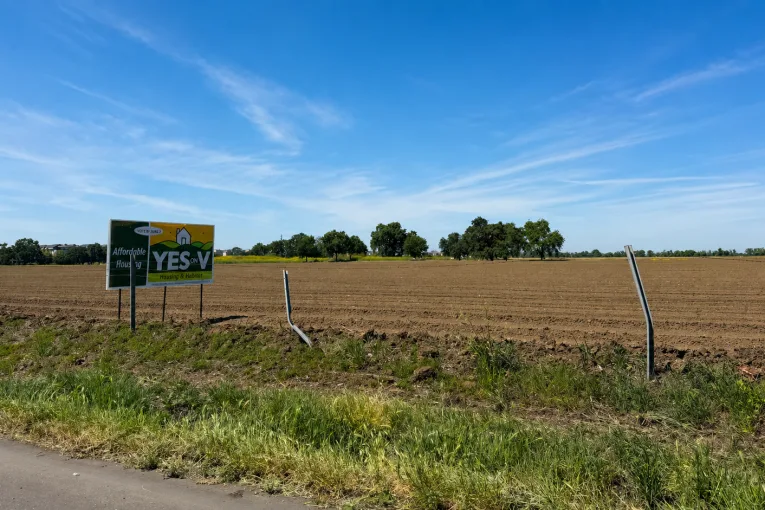
As a member of the Davis City Council, my primary responsibility is to look toward the horizon. I am constantly asking: How do we preserve the soul of the city we love while ensuring it remains a viable, vibrant home for the next generation? Since the initial planning application for Village Farms was submitted in April 2023, I have engaged deeply with the details, the data, and—most importantly—the residents.
Over the last three years, this project has undergone rigorous public scrutiny, environmental review, and repeated refinement. After witnessing this collaborative process and reviewing the robust commitments secured in the project’s Baseline Features, I am proud to support Measure V. Village Farms Davis is not just another housing development; it is a meticulously planned extension of our community values.
Infrastructure That Connects Us
One of the most compelling aspects of Village Farms is its commitment to connectivity. Davis has long been the “Bicycle Capital of America,” but maintaining that title requires more than just nostalgia; it requires bold investment. Village Farms delivers this through two transformative pieces of infrastructure: the F Street bike and pedestrian overcrossing and the Pole Line Road undercrossing.
These are not mere “amenities.” They are essential safety improvements that bridge the gap between neighborhoods. The F Street overcrossing will provide a dedicated, grade-separated path that allows families and commuters to bypass heavy traffic, making active transportation the easiest and safest choice. Similarly, the Pole Line undercrossing addresses a long-standing bottleneck, ensuring that as our city grows, our ability to move through it without a car remains a reality. These investments reflect a vision of Davis where the bicycle remains the primary vehicle for community connection.
A Meaningful Commitment to Affordability
We often talk about the “missing middle” and the struggle for young families, teachers, and service workers to find a home in Davis. Village Farms takes a decisive step toward solving this. The project’s generous Affordable Housing commitments go beyond the standard requirements. By integrating a diverse range of housing types—from deed-restricted affordable units to innovative small footprint market rate to create housing for all ages and income levels can afford—Village Farms ensures that Davis remains a multi-generational community.
This is about equity. It is about ensuring that the people who work in our shops, teach in our schools, and staff our local businesses can actually afford to live in the city they serve. Since the 2023 submittal, the developer has significantly strengthened these commitments, including a $6 million contribution to the city’s housing trust fund and 16 acres of dedicated land for 100% affordable projects. This proposal provides the variety and volume of housing necessary to fill the gap in our housing market.
Integrity Guaranteed by the Voters
A common concern with large-scale projects is the fear of “bait and switch”—that the promises made today might be negotiated away tomorrow. This is where the Baseline Features of Village Farms are revolutionary. These features are legally binding and, thanks to our local land-use ordinances (Measures J, R, and D), they cannot be altered without another vote of the people.
When we talk about the 47 acres of protected habitat, the carbon-neutral energy goals, or the specific traffic mitigation measures, we aren’t talking about suggestions. These are locked-in guarantees. This structure puts the power exactly where it belongs: in the hands of Davis voters. It ensures that the high bar we have set for this project remains high through every phase of construction.
Environmental Stewardship and Protected Space
Davis has always been a leader in environmental policy, and Village Farms honors that legacy. The inclusion of 47 acres of permanently protected habitat is a testament to the project’s “land-first” philosophy. This space isn’t just “leftover” land; it is a functional, managed ecosystem designed to support local biodiversity and provide a natural buffer.
Beyond the habitat, the project’s commitment to environmental sustainability is exhaustive. From all-electric building requirements to integrated water conservation systems and onsite agricultural components, Village Farms functions as a living laboratory for sustainable urban growth. It proves that we can add homes while simultaneously reducing our per-capita environmental footprint.
Addressing Traffic and Growth Responsibly
I have listened to many neighbors express their concerns about traffic. It is a valid concern, and one that has been addressed with unprecedented rigor during the environmental impact report process. The commitments to traffic improvements are robust, focusing on optimizing existing intersections and funding regional improvements that benefit more than just the new residents. By emphasizing internal “walkability” and providing the aforementioned bike crossings, Village Farms is designed to internalize trips, keeping cars off our main arterials whenever possible.
Growth is inevitable, but it must be managed with intention. Since 2023, we have had the time to hammer out the specifics, ensuring that this project doesn’t just “fit” in Davis, but improves it. We have a choice: we can allow Davis to become an exclusive enclave, or we can embrace a future that is inclusive, sustainable, and connected.
A Vote for Our Values
Over the last three years, I have seen the Village Farms team listen, adapt, and strengthen their proposal based on community and Council feedback. What started as a strong application in April 2023 has evolved into a project that truly reflects the unique spirit of Davis.
Village Farms Davis offers a path forward that protects our environment, builds the homes we desperately need, and invests in the infrastructure that defines us. It is a project rooted in the belief that Davis’s best days are ahead of us. I invite you to join me in supporting this vision. Let’s choose a future where our children can afford to live, where our commuters can bike safely, and where our natural habitats are preserved for generations to come.
Please join me in voting Yes on Measure V.
Linda Deos is a Council member, City of Davis
Disclaimer: Opinions are those of the writer and do not reflect those of The Vanguard or its Editorial Staff. The Vanguard does not endorse political candidates and is committed to publishing all public opinions and maintaining an open forum subject to guidelines related to decency and tone, not content.
Follow the Vanguard on Social Media – X, Instagram and Facebook. Subscribe the Vanguard News letters. To make a tax-deductible donation, please visit davisvanguard.org/donate or give directly through ActBlue. Your support will ensure that the vital work of the Vanguard continues.

I like the Village Farms site the way it is – a highly visible reminder that Davis is connected to farming. I like looking at sunflowers and tomatoes (and the mountains beyond, to the west) more than housing developments. It would be a loss to cover it with a development.
Seems to me that (looking around the area), there is no “shortage” of sprawl – and it’s continuing to occur. And then there’s the traffic it would generate. Pretty simple, really. All of the other nonsense regarding school closures, people supposedly “missing” from Davis, fake housing “mandates” – it’s all just noise intended to fool people into voting for something that makes their own lives/town WORSE, and irreversibly destroy high quality farmland with the largest development ever proposed for Davis.
As far as the people “missing” from Davis, has anyone considered plastering their faces on milk cartons or billboards? That probably worked once or twice. Or maybe one of those alerts you see on freeways these days?
“As far as the people “missing” from Davis”
Come on Ron, there are a lot of future Bay Area transplants missing from Davis. 😂
Where you guys from?
I was from the Bay Area so I know what I’m talking about. 😉
So it was okay for you but you don’t want others to follow.
I can’t speak for Keith, but I’m also “missing” from the Bay Area. (My initial response was not posted, for reasons unknown to me.)
As such, I’ve seen what’s occurred there (as well as the efforts to protect what remains). Even if the protection of what remains might be a factor in my displacement, I fully support it regardless.
There are successful efforts continuing to this day, to further protect what’s left. Creation of new parks, agricultural easements, etc. I could specifically point some of these out, as I follow them pretty closely.
Perhaps if I wasn’t priced out by the technology industry . . .
But I could probably return now, if I wanted to. And I may do so, yet (but not to my hometown). Sometimes, one has to have patience in life.
Where are you from, Ron G?
Weird all the people who praised Willow-Shriners for not having all problems of the ‘other vote-required project’, and yet for VF, ‘the perfect is the enemy of the good enough’ still stands.
Please Council member Dios, You have swallowed the 7 Families development bait here and are shilling for the interest of a for profit private comercial entity. There is no baseline guarantee of bike loop continuity since the F street crossing depends on the railroads final agreement. I personally vote for political representation that moves forward project votes based on clear and honest information. Village Farms is an obviously flawed proposal. I do not vote to have my representatives give personal endorsements to private developers. I’m not sure that is even politically ethical. ???
Unfortunately, the Village Farms project is far from the description in this article. Village Farms is a disastrous project due to many reasons including: the toxics leaking carcinogenic PFAS “forever chemicals”, the 200-acre floodplain with flooding potential, massive traffic including more than 15,000 additional car trips PER DAY at Covell Blvd and Pole Line Rd, enormous infrastructure costs, habitat destruction including tearing out hundreds of trees along Channel and endangering the vernal pools due to the re-routing of Channel A which would disrupt the hydrology that the vernal pools depend upon for survival, UNaffordable housing, and an abysmal affordable housing plan which would most likely result with ZERO affordable housing units due to word “may” loophole included in the Development Agreement.
https://davisite.org/2026/05/01/its-a-may-day-for-village-farms/
These are just some of the reasons why the Village Farms project needs to be voted down by Davis voters on June 2nd. Then, the project can be re-planned at the Reduced Footprint alternative similar to the Covell Village “Environmentally Superior” alternative which would be developing only below Channel A which distances the housing from the toxics and the enormous floodplain.
This plan also avoids the need to fill in the flood plain which is located predominately above Channel A and avoids the need to re-route Channel A. A conservation easement would be needed to be in place to protect the vernal pools, and developing 900-1.000 housing units on the site. This alternative avoids the toxics and floodplain issues, but also avoids the City liability issues that the current present Village Farms project would impose on the City long-term.
Eileen is correct. We can ask much more of our developers here. Our housing commands a substantial premium and this development group has long owned this property meaning that they will make a sufficient profit at almost any cost of development. We need to put this project into the queue under the new forthcoming General Plan Update. We need an orderly process, not just a series of one-off uncoordinated proposals.
An orderly process? This property has been planned over almost 1/2 decade.