
By Vanguard Staff
LOS ANGELES, Calif. — As California communities continue to confront escalating wildfire risks and rising insurance challenges, a newly-completed accessory dwelling unit in Los Angeles is offering a model for how homeowners can build more resilient housing without significantly increasing construction costs.
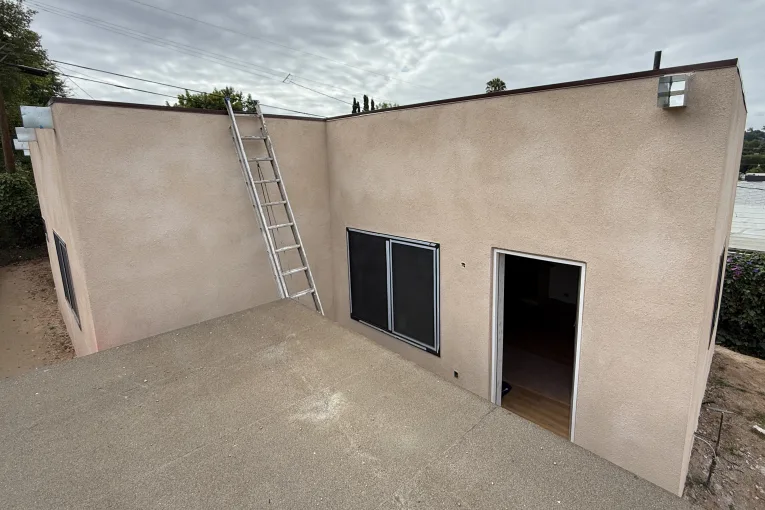
Builtech Construction announced the completion of what it describes as Los Angeles’ first known insulated concrete form-based accessory dwelling unit built to meet Type I standards, the highest fire-resistance classification under the International Building Code and California Building Code. The project is located in Eagle Rock, a high-risk Wildland-Urban Interface zone near the area affected by the Eaton Fire evacuation.
The 1,150-square-foot, two-bedroom home was designed using a comprehensive fire-resilient building system intended to withstand up to three hours of direct fire exposure. According to Builtech, the project demonstrates an approach to residential construction that focuses on reducing vulnerabilities throughout the entire structure rather than relying on a single fire-resistant feature.
The home’s exterior walls were constructed using insulated concrete forms (ICF), a building system that utilizes lightweight hollow foam blocks reinforced with steel rebar and filled with poured concrete. The resulting walls are noncombustible and provide both fire resistance and energy efficiency.
Builtech reported that the entire exterior wall structure was completed in approximately 10 days by a crew of two to three workers, a process the company said required less labor than conventional wood-frame construction.
In addition to its fire-resistant properties, the construction method also provides enhanced soundproofing and thermal performance. According to the homeowners, the home remains quiet despite its proximity to a major highway and maintains comfortable indoor temperatures even during periods of extreme heat.
“We took an idea and made it real,” said Aaron Liu, founder and CEO of Builtech and a Certified Wildfire Mitigation Specialist. “ICF is practical, it’s efficient to build, and the cost is accessible. Our hope is that this project opens people’s eyes to the fact that fire-resilient housing isn’t out of reach, and more Californians deserve to feel safe in their homes.”
Beyond the insulated concrete walls, the project incorporates several additional fire-resistant design elements. The roof system utilizes cold-formed steel trusses topped with a metal deck and lightweight concrete. Closed-cell spray insulation eliminates the need for traditional attic vents, which can serve as entry points for embers during wildfire events.
The home also features customized fire-resistant windows with triple-tempered glass and fire-resistant screening designed to maintain visibility while improving protection. In another uncommon residential feature, the rooftop plumbing vent is constructed from cast iron rather than plastic, reducing the risk of fire creating an opening through melted vent materials.
According to Builtech, the project was completed for approximately $410,000, a figure the company said is comparable to the cost of a traditional wood-frame accessory dwelling unit in the area.
“Honestly, I was surprised by the price; it came in right around what we were quoted for a regular wood home,” said Karl, the homeowner. “But this is concrete and steel. Knowing our family has a home that can stand up to fire and whatever else comes, that peace of mind is priceless. It already feels like a completely different level of security.”
The project comes as California homeowners, builders and policymakers continue to examine ways to reduce wildfire vulnerability across the state’s housing stock. Increasing wildfire frequency, rising rebuilding costs and growing difficulties obtaining insurance coverage have intensified interest in alternative construction methods and more resilient building designs.
Builtech said it is already seeing increased interest from homeowners interested in fire-resistant construction and is in the early design stages of a similar project in San Diego.
Liu emphasized that effective wildfire protection requires a systems-based approach rather than reliance on any single material or product.
According to the company, the Eagle Rock project was designed around the principle that every component of a home should contribute to resilience, minimizing potential weak points that could allow fire to penetrate the structure.
Follow the Vanguard on Social Media – X, Instagram and Facebook. Subscribe the Vanguard News letters. To make a tax-deductible donation, please visit davisvanguard.org/donate or give directly through ActBlue. Your support will ensure that the vital work of the Vanguard continues.

“To fire ecologists like Alexandra Syphard with the Conservation Biology Institute, it’s becoming increasingly clear that houses built in risky places are impossible to fire-proof.
“You can make a big difference in increasing the potential safety of your house but you can’t guarantee that it’s not going to burn,” she said.”
“Her research has found that where you build your house, not what it’s made of, is the biggest factor in determining whether it will burn.”
https://www.kqed.org/news/11711140/fire-resistant-is-not-fire-proof-california-homeowners-discover
You can also wear a helmet when riding a motorcycle – but it’s still inherently dangerous.
Or as Jerry Seinfeld once said, we now wear helmets to protect us from all of the head-cracking activities that we now voluntarily engage in. (Something like that.)