
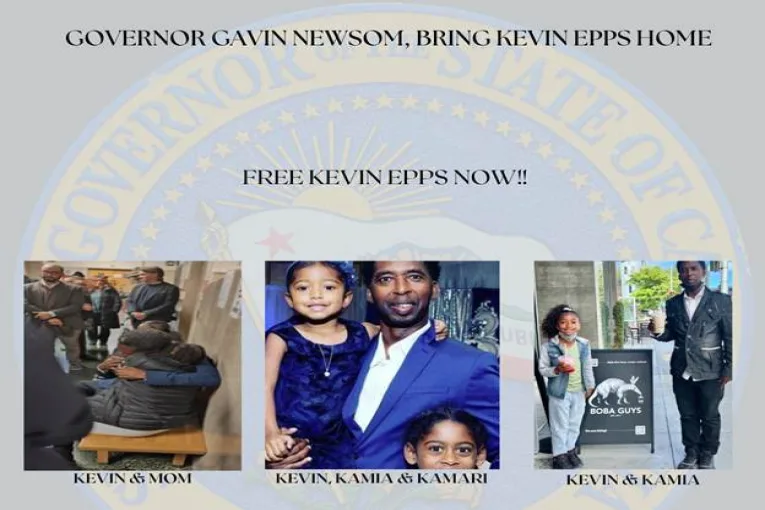
By Malik Washington, Destination Freedom Media Group | The Davis Vanguard
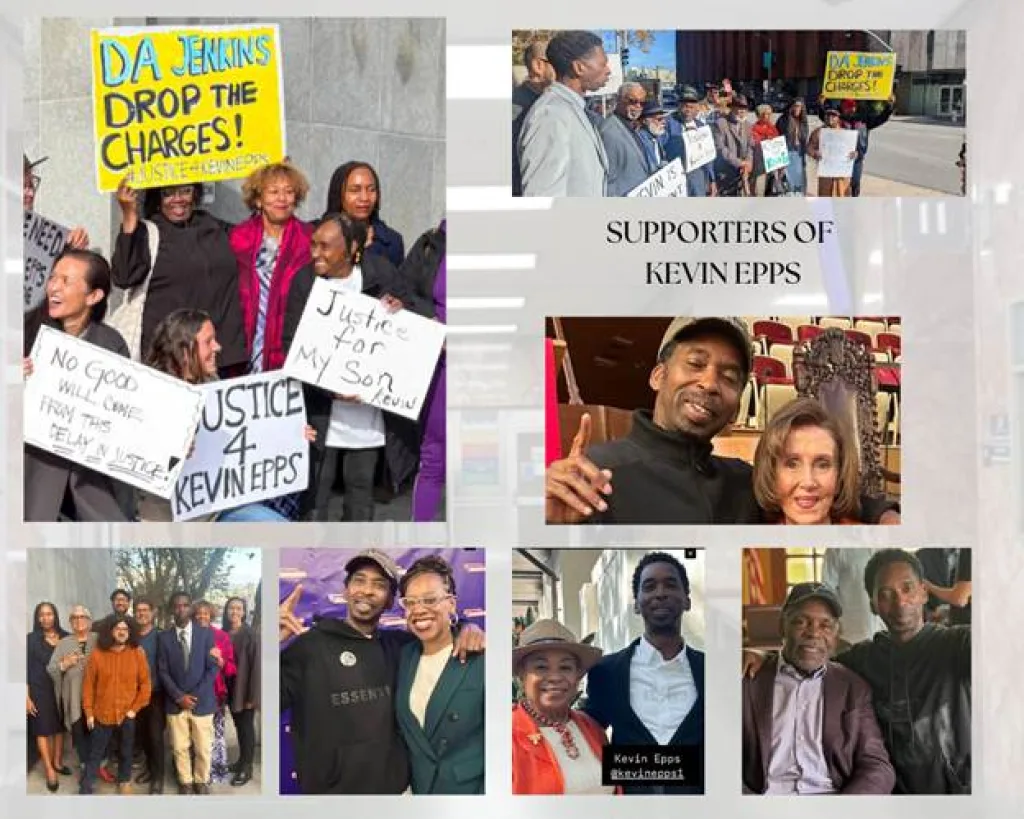
Middle right: Kevin & Nancy Pelosi; bottom left to right: Justice 4 Kevin Epps supporters, Kevin & Lateefah Simon, Kevin & Barbara Lee, and Kevin and Danny Glover – Background: https://missionlocal.org/2025/01/sf-hall-of-justice-850-bryant-court-sheriffs-prosecutors-public-defenders/
Although Kevin Epps is incarcerated, he is most definitely not forgotten!! There are many of us who refuse to give up the fight for freedom.
FREE KEVIN EPPS NOW!!
I covered the entire trial of Kevin Epps, the award-winning filmmaker and editor of the San Francisco Bay View National Black Newspaper. What I witnessed confirmed many of the concerns that Black communities, civil rights advocates, and criminal justice reformers have raised for generations about the American criminal legal system.
Throughout the proceedings, I observed a case marked by disputed evidence, contested legal interpretations, questions about fairness, and a process that often appeared more focused on securing a conviction than on pursuing a balanced search for truth.
Kevin Epps was not portrayed in court as the father, mentor, filmmaker, journalist, and community builder known to so many throughout the Bay Area. Instead, a Black man with deep roots in his community and a long record of service found himself facing the full weight of a system that too often struggles to recognize the humanity of the people it prosecutes.
One of the moments that remains etched in my memory occurred during sentencing.
Epps’ daughter stood before the court and pleaded for her father’s freedom.
Her words were not legal arguments. They were not procedural objections. They were the heartfelt plea of a daughter asking the court to consider the impact a prison sentence would have on a family already carrying enormous emotional burdens.
Another powerful moment came when legendary San Francisco community advocate Del Seymour addressed Judge Brian Ferrall. Seymour, whose own life story embodies redemption, rehabilitation, and second chances, urged the court to consider the consequences that imprisonment would have on Epps’ children and the broader community that depended upon him.
Neither plea changed the outcome.
Kevin Epps was sentenced to prison.
Yet those moments have remained with me because they revealed something often lost in criminal proceedings: every conviction reaches far beyond the defendant. Families suffer. Children suffer. Communities suffer.
Having reported extensively on this case from jury selection through sentencing, I believe the public deserves a full examination of why Kevin Epps has become one of the strongest clemency candidates presently before Governor Gavin Newsom.
This is that case.
BEGIN WITH THE TRUTH
Any honest discussion about clemency must begin with a truth that cannot be ignored.
Marcus Polk lost his life.
His children lost their father.
A family suffered a devastating loss that can never be undone by any court ruling, prison sentence, or executive action. Their grief is real. Their pain deserves respect. Nothing written in support of clemency should erase that reality.
In one of the most morally compelling appeals made on behalf of Kevin Epps, longtime environmental justice advocate Carol McGruder began from that very place. She did not deny the tragedy. She acknowledged it. Because justice worthy of public trust must be rooted in truth, not convenience.
But truth does not end there. The complete truth surrounding Kevin Epps is far more complicated than the verdict that ultimately sent him to prison.
THE MURDER THEORY THE JURY REJECTED
Kevin Epps was not convicted of murder.
A San Francisco jury acquitted him of first-degree murder.
The same jury acquitted him of second-degree murder.
That distinction is not technical.
It is foundational.
The prosecution spent years advancing a narrative of murder. Jurors rejected it.
The state asked them to conclude that Kevin Epps acted with the malice and criminal intent necessary to sustain a murder conviction. They declined. Instead, jurors convicted him of voluntary manslaughter.
The most serious moral accusation leveled by the state failed in the jury room.
That fact should matter when California evaluates whether continued incarceration serves the interests of justice.
A CASE ONCE DEEMED TOO WEAK TO PROSECUTE
There is another fact that deserves careful examination. Following the 2016 shooting, then-San Francisco District Attorney George Gascón declined to file charges, citing
insufficient evidence. For many defendants, that would have been the end of the matter.
Not here.
Years later, the prosecution was revived.
The revived case relied in part upon digital 3D reconstructions and forensic presentations that later became the subject of significant legal challenges and were ultimately withdrawn after defense objections.
Consider what that means.
A case once considered too weak to charge ultimately resulted in a prison sentence after being resurrected through evidentiary theories that themselves became deeply contested.
If clemency has any meaningful purpose within our justice system, it is to provide a safeguard when legal outcomes exist but serious questions about fairness, reliability, and proportionality remain unresolved.
THE SELF-DEFENSE QUESTION NEVER WENT AWAY
At the heart of this case sits an issue that continues to generate debate among legal scholars, journalists, community advocates, and retired judges.
Self-defense
More specifically, whether California’s Castle Doctrine protections were applied fairly and consistently.
The underlying facts remain significant.
Marcus Polk had previously come to the residence.
Testimony indicated he had been turned away the night before the shooting.
He returned the following day.
Reports indicated he entered the residence after being told to leave. Inside that home were Kevin Epps and his children. The defense viewed these facts through the lens of a homeowner confronting an unwanted and volatile intrusion.
The prosecution viewed them differently.
That is what trials are designed to resolve.
Yet years later, respected legal observers continue to question whether the presumption of fear traditionally afforded inside one’s home was applied equally in this case. American Community Media examined broader concerns regarding racial disparities in self-defense cases. Harvard historian Dr. Caroline Light has argued that Black homeowners and Black defendants frequently encounter greater skepticism when asserting self-defense claims than similarly situated white defendants. Whether one agrees entirely with that conclusion is beside the point.
The concerns are serious.
The concerns are documented.
And the concerns remain unresolved.
QUESTIONS THAT EXTENDED BEYOND THE VERDICT
The questions surrounding this prosecution did not disappear after conviction.
In fact, they persisted. Following the verdict, jurors reportedly deadlocked on multiple aggravating factors sought by prosecutors. Judge Brian Ferrall declared mistrials on three of four aggravating allegations.
That detail matters
Because even after convicting Kevin Epps of voluntary manslaughter, jurors remained unconvinced by significant portions of the prosecution’s effort to portray him as an exceptionally aggravated offender.
Again, the pattern emerges.
A conviction.
But not certainty.
Punishment.
But not consensus.
WHEN FORMER JUDGES RAISE ALARMS
The concerns surrounding this case are not confined to supporters and friends.
Retired Alameda County Superior Court Judge Brenda Harbin-Forte publicly questioned the outcome and expressed concern about the prosecution’s use of digital animation, the handling of Castle Doctrine issues, and what she viewed as cumulative legal errors.
Reasonable people can disagree with her conclusions.
But her concerns deserve attention.
A former judge questioning the integrity of a conviction should never be dismissed lightly. Particularly when those concerns echo issues raised by journalists, legal advocates, and members of the public who closely followed the proceedings.
CALIFORNIA ALREADY KNOWS WHO KEVIN EPPS IS
Perhaps the strongest argument for clemency has nothing to do with legal doctrine.
It has everything to do with lived reality. California does not need to speculate about who Kevin Epps might become if released.
California already knows.
For years after the shooting, Epps remained in the community while the case worked its way through the courts.
He did not flee.
He did not disappear.
He did not retreat from public life.
He worked.
He raised his children.
He made films.
He mentored young journalists.
He strengthened one of the Bay Area’s most important Black-owned newspapers.
He served his community.
The Society of Professional Journalists recognized those contributions when it honored Epps with its Silver Heart Award for helping revitalize the San Francisco Bay View and preserve a vital Black media institution. During the COVID-19 pandemic, public health leaders credited Epps with helping build trust between underserved communities and healthcare providers through Umoja Health.
Dr. Kim Rhoads described him as a trusted public-health bridge whose credibility helped connect people to life-saving resources.
That is not the profile of a public safety threat.
It is the profile of a community asset.
THE COMMUNITY HAS ALREADY RENDERED ITS VERDICT
The support for Kevin Epps extends far beyond his family.
Clergy members.
Civil rights leaders.
Journalists.
Artists.
Former public officials.
Community advocates.
Longtime residents.
Many have publicly called for clemency. Among them are respected figures whose names carry weight throughout California’s social justice, faith, and civic communities.
Their support is not based on celebrity.
It is based on character.
They know Kevin Epps.
They have worked beside him.
They have trusted him with their communities.
And they have concluded that his place is among the people he has spent a lifetime serving.
Carol McGruder perhaps framed the issue most clearly. For years after the shooting, Kevin Epps lived openly in the community while facing the possibility of prosecution.
California does not need to imagine what he would look like if released. The state already witnessed it.
A father.
A worker.
A journalist.
A filmmaker.
A community advocate.
A man who remained rooted in the very neighborhoods he has spent his career documenting and defending.
WHY CLEMENCY EXISTS
Governor Newsom’s clemency authority was not created for easy cases. It was created for difficult ones.
For cases where legal guilt and moral complexity collide.
For cases where punishment has been imposed but questions remain.
For cases where accountability has been established, rehabilitation is evident, and continued incarceration serves no clear public purpose.
The case for clemency is not that nothing happened.
It is not that no life was lost.
It is not that grief should be subordinated to popularity or community standing.
The case for clemency is that justice here remains clouded by unresolved legal questions, racial context, a rejected murder theory, a deeply contested self-defense framework, concerns about prosecutorial fairness, and overwhelming evidence that Kevin Epps has already demonstrated accountability, service, rehabilitation, and value to the public.
This is precisely the territory where clemency has meaning.
GOVERNOR NEWSOM, BRING KEVIN EPPS HOME
Continued incarceration does not restore Marcus Polk’s life.
It does not heal his family.
It does not strengthen public safety.
It does not advance rehabilitation.
What it does is remove a father from his children.
A son from his mother.
An editor from a newspaper.
A mentor from young journalists.
A filmmaker from his audience.
And a trusted community builder from neighborhoods that have already lost too many of their leaders to violence, incarceration, displacement, and neglect.
Justice should never be confused with destruction.
Mercy should never be mistaken for weakness.
And clemency should never be reserved only for cases that present no political risk.
Governor Newsom has before him a man acquitted of murder, convicted in a highly disputed prosecution, supported by a broad coalition of community leaders, marked by demonstrated service, visible accountability, and proven public value.
CLEMENCY UNDER CALIFORNIA LAW
In California, “clemency” usually means the Governor’s constitutional power, after sentence, to grant a reprieve, pardon, or commutation. That power comes from Article V, section 8 of the California Constitution. A pardon generally provides relief from punishment and restores some civic rights after a California conviction; a commutation reduces a sentence; and a reprieve temporarily delays punishment.
A few core rules matter. The Governor is not required to consider an application, and there is no set timeline for review. Also, the Governor cannot pardon or commute a person twice convicted of a felony unless the California Supreme Court recommends it, with 4 justices concurring.
If this is not the type of case for which clemency was created, then Californians deserve an honest explanation of what clemency is actually for.
Governor Newsom bring Kevin Epps home.
Bring him home because justice is larger than a verdict form.
Bring him home because redemption matters.
Bring him home because families matter.
Bring him home because communities matter.
Bring him home because accountability and mercy can coexist.
And bring him home because when the full record is examined—not selectively, but completely—the argument for clemency is not merely compelling.
It is overwhelming.

ABOUT THE AUTHOR
Malik Washington is a San Francisco-based journalist and co-founder of Destination Freedom Media Group, an independent nonprofit newsroom dedicated to accountability reporting at the intersection of civil rights, public integrity, disability justice, structural accountability within American institutions, and community survival. He has been a published journalist for over 14 years.
His work—published in partnership with the Davis Vanguard—focuses on government power, criminal justice, environmental justice, and the human consequences of policy decisions too often insulated from public scrutiny. Washington’s reporting amplifies the voices of impacted communities while insisting on documentary evidence, transparency, and the unvarnished truth—especially when institutions demand silence.
His work appears on platforms such as Muck Rack and Black Voice News, examining the intersection of justice, governance, and community.
You can reach him via email: mwashington2059@gmail.com or call him at (719) 715-9592.
Facebook: facebook.com/destfreedom13
Instagram: @destinationfreedom13
X: @dest_freedom
Follow the Vanguard on Social Media – X, Instagram and Facebook. Subscribe the Vanguard News letters. To make a tax-deductible donation, please visit davisvanguard.org/donate or give directly through ActBlue. Your support will ensure that the vital work of the Vanguard continues.
