
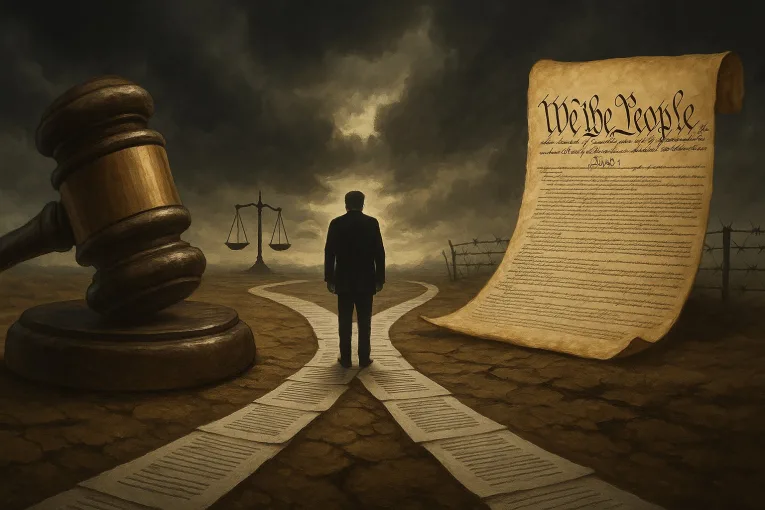
In a democracy governed by laws, due process is the foundation—without due process we become an arbitrary tyranny. It is the idea, embedded in the Fifth and Fourteenth Amendments of the U.S. Constitution, that the government cannot deprive any person—citizen or noncitizen—of life, liberty, or property without fair legal procedures.
Yet President Donald Trump, in a recent interview on NBC’s Meet the Press, revealed that he either does not understand this principle or is perfectly willing to discard it in pursuit of political expediency. Given where he has gone policy-wise, that should not be shocking.
Asked point-blank whether people on American soil—citizens and noncitizens alike—are entitled to due process, Trump’s response was astonishing. “I don’t know,” he said. “I’m not a lawyer.” When pressed again, he doubled down on his ignorance: “It might say that, but if you’re talking about that, then we’d have to have a million or two million or three million trials.”
This really can’t be seen as a gaffe or a slip of the tongue. As noted above—it embodies his administration’s policy.
It is indeed a crystallization of Trump’s longstanding view of the legal system: an obstacle to be bulldozed, not a framework to be upheld. His flippant dismissal of the Constitution’s most basic protections reveals a deeper truth—Trump doesn’t believe in the rule of law. He believes in the rule of Trump.
Trump’s words aren’t just ignorant—they’re dangerous. A president who openly questions whether people deserve a hearing before being exiled from the country is not simply uninformed. He is inviting the erosion of a legal tradition that separates free societies from authoritarian regimes.
The principle of due process is not a partisan issue, or at least should not be. It is not a luxury reserved for those with U.S. passports. It is a guarantee extended to “persons,” as the Constitution plainly states—a term that includes immigrants, undocumented people, asylum seekers, and yes, even those the president deems undesirable.
The Supreme Court has reaffirmed this again and again, from Yick Wo v. Hopkins in 1886 to Zadvydas v. Davis in 2001. Trump’s claim that respecting due process would require “millions of trials” is an argument against the Constitution itself.
This is, once again, autocratic thinking. Trump has spent years cultivating a worldview in which legal checks are inconveniences, judges are enemies, and constitutional rights are conditional. In his first term, he called for suspending habeas corpus, sought to defund the judiciary, and flouted court orders on everything from immigration to protest rights. In his second term, he’s gone further—defying a Supreme Court order to return a wrongly deported migrant and musing about an unconstitutional third term in office.
This is not a man constrained by the idea that government power must answer to law. This is someone who sees the law as a weapon to wield against enemies—and a nuisance to ignore when it gets in his way.
The specific context for Trump’s recent outburst was his plan to deport millions of undocumented immigrants using rapid mass removals. He is frustrated, apparently, that people insist on legal hearings before being removed from the country. But that’s not a flaw in the system—it is the system. The very idea that the government must prove its case, that people have a right to a hearing and to legal counsel, is what separates justice from tyranny.
And Trump knows this. Or at least, his lawyers do. When he punted to his “brilliant lawyers” during the NBC interview, it was a familiar Trump tactic—abdicate personal responsibility while retaining maximal power. But the buck doesn’t stop with Trump’s lawyers. It stops with Trump. As president, he swore an oath to “preserve, protect, and defend the Constitution of the United States.” When asked if that oath requires him to uphold due process, he shrugged: “I don’t know.”
We should all be alarmed.
What’s more troubling is that Trump’s rhetoric is echoed by key figures in his administration. The Department of Homeland Security has invoked the Alien Enemies Act to argue for diminished rights for those it deems threats—an act originally intended for wartime use against hostile foreign powers. And when courts push back, Trump has responded not with deference but with contempt. He attacks judges by name. He floats impeachment for those who rule against him. He ignores legal mandates when it suits him.
This is not normal.
The idea that we must abandon due process to implement Trump’s agenda is a false choice. America has faced waves of immigration before, and our legal system has handled them—imperfectly, but without shredding the Constitution. What Trump wants is not efficiency. What he wants is unchecked power: the ability to detain and deport without hearings, to decide guilt without trial, to punish without limits.
That is the logic of authoritarianism.
Trump’s defenders will argue that he’s simply expressing frustration, that his “I don’t know” was off-the-cuff, or that his administration will follow the law even if he doesn’t understand it. But that’s not how democracy works. We don’t entrust our highest office to someone who shrugs at the Constitution. The presidency is not a spectator role. Ignorance is not an excuse. And willful indifference is disqualifying.
The deeper concern is not just Trump’s ignorance but what it reflects about the broader political climate. When the president treats legal protections as optional, he emboldens others to do the same—police officers, immigration agents, prosecutors, governors. He creates a culture in which power answers only to itself. And once due process is eroded for some, it is eroded for all.
We’ve seen this movie before. In the wake of 9/11, the U.S. government rounded up thousands of Muslim men and held them without charges. After Pearl Harbor, we interned Japanese Americans without trials. In the Jim Crow South, Black men were lynched without hearings. Each time, the justification was the same: these people didn’t deserve due process. And each time, history judged us harshly.
The Constitution is a constraint on the exercise of power by the government. It was written that way, out of fear of tyranny of the majority, but also the founders feared above all that an executive would become a tyrant.
We have avoided this fate thus far, but this is yet another reminder that our democracy and our freedom is thinner than we’d like to believe.
This statement by the President is once again a reminder that power must yield to principle. Trump may not know that. But we do.

“75 percent of people removed do not see a judge before being expelled from the U.S”
Guess when this happened? Clue, it’s not Trump.
If you guessed Obama you got it right.
Did the Vanguard write articles pointing this out when Obama was President?
https://www.aclu.org/news/immigrants-rights/speed-over-fairness-deportation-under-obama
Then there was Biden:
99.1% of all cases completed as of February 1, 2022 on the Dedicated Docket in Los Angeles, resulted in deportation orders.
70.1% of those on the Docket in Los Angeles do not have attorneys.
72.4% of deportation orders were issued in absentia—i.e. the immigrant families never had their day in court.
48.4% of in absentia deportation orders were against children, two-thirds of whom were age 6 and under.
https://law.ucla.edu/news/new-report-finds-children-ordered-deported-families-without-lawyers-and-other-gross-miscarriages-justice-biden-administrations-dedicated-docket
“Trump’s response was astonishing. “I don’t know,” he said. “I’m not a lawyer.”
Here’s more to his comment without cherrypicking a small snippet:
“I don’t know,” Trump said. “I have to respond by saying, again, I have brilliant lawyers that work for me, and they are going to obviously follow what the Supreme Court said. What you said is not what I heard the Supreme Court said. They have a different interpretation.”