
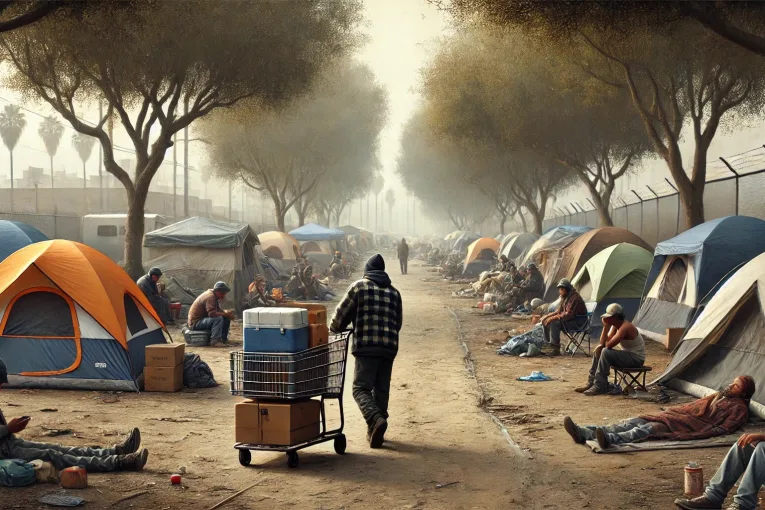
SACRAMENTO — As California lawmakers finalize the state budget, a growing chorus of local officials and advocates is sounding the alarm over the Legislature’s decision to eliminate new funding for the Homeless Housing, Assistance and Prevention (HHAP) program in fiscal year 2025–26. The move comes despite ongoing public concern over homelessness and mounting pressure on cities and counties to clear encampments and provide services.
The joint budget agreement, negotiated by legislative leaders and Governor Gavin Newsom, proposes no new funding for HHAP in the upcoming fiscal year and includes only an intent to appropriate $500 million in 2026–27 — half of last year’s $1 billion allocation and far from guaranteed.
In a joint statement, California State Association of Counties CEO Graham Knaus and League of California Cities Executive Director Carolyn Coleman criticized the decision: “Investing no new money this year and only half as much for next year will stop progress in its tracks. More tents will pop up alongside highways, train tracks and rivers, and more families will struggle.”
They urged state leaders to reconsider, calling the restoration of $1 billion in HHAP funding “less than a third of a percent of the state’s budget” and warning that “for what Californians have declared to be their most pressing issue, that’s not an unreasonable ask.”
Since its creation in 2019, HHAP has served as California’s primary vehicle for distributing flexible homelessness aid to local governments and service providers. The program has funded emergency shelters, interim and permanent supportive housing, street outreach, and mental health and addiction services. According to the Bring California Home Coalition, HHAP funds have helped house more than 57,000 people since 2023.
But in the current deal, the budget language is nonbinding. It reads: “It is the intent of the Legislature to appropriate $500,000,000 for a Round 7 of the Homeless Housing Assistance and Prevention (HHAP) program in 2026–27 by formula funding to cities, counties, continuums of care, and tribes, with prompt distribution to eligible recipients.” Without statutory enforcement, such language can be revised or dropped in future negotiations.
Local governments say the consequences will be severe. Without new HHAP dollars in 2025–26, jurisdictions may be forced to scale back operations, cut programs, and lay off staff. Cities like San Jose, which have relied heavily on HHAP funding for interim housing and encampment services, say they may not be able to expand capacity or complete planned housing projects.
San Jose Mayor Matt Mahan, who has championed tough encampment policies paired with investments in temporary housing, said the state’s move was out of touch with public priorities. “Residents of California tell us consistently that ending unsheltered homelessness is one of their very top priorities,” he said. “So the idea that the state can’t make a substantial, consistent investment in residents’ top priority makes me question whether or not they’re really listening.”
Advocates worry the funding gap will not only reverse recent progress but could deepen public frustration and embolden more punitive local responses. In the wake of the U.S. Supreme Court’s Grants Pass v. Johnson decision, which gave cities broad authority to criminalize public camping, some jurisdictions — including San Jose, Sacramento, and Fresno — have stepped up arrests and encampment sweeps. Newsom has encouraged cities to pass anti-camping ordinances and recently said he was “not interested anymore…in funding failure.”
Yet according to experts like Ben Metcalf of UC Berkeley’s Terner Center for Housing Innovation, cutting off HHAP funds could also mean defunding success. “Without that money, some shelters and housing programs are likely to close,” Metcalf said. “Others could simply become less effective. So what you end up with…is more Band-Aids, or patchworks of systems…not really helping transition people permanently out of homelessness.”
While the final budget includes more than $50 million in funding for housing department operations, such as policy development and surplus land coordination, it contains no funding earmarked for direct homelessness services. Lawmakers did preserve other housing-related allocations, including $500 million in low-income housing tax credits and $120 million for the Multifamily Housing Program. But advocates argue that permanent housing construction must be paired with services and shelter to address the full continuum of homelessness.
The Legislature passed a placeholder budget on June 15, but further negotiations are underway. Whether lawmakers will reverse course on homelessness funding remains uncertain.
As cities brace for the potential fallout, many leaders worry they will be left holding the bag. “Simply put,” said the Bring California Home Coalition, “this choice will lead to more people moving onto California’s streets and fewer avenues off the streets.”

And the downfall of the Homeless Industrial Complex begins.