
This week a jury has awarded $3 million in damages to former Orange County Senior Assistant District Attorney Tracy Miller, along with $25,000 in punitive damages personally against Orange County District Attorney Todd Spitzer.
The decision came after weeks of emotional testimony, hard-fought legal arguments, and mounting public scrutiny of one of California’s most powerful prosecutors.
The verdict found that Spitzer, along with Judge Shawn Nelson and the County of Orange, had retaliated against Miller after she stood up for female colleagues who had reported sexual harassment and for refusing to tolerate what she described as a culture of misogyny, racism, and political corruption inside the DA’s office.
“Millions and millions and millions of dollars of Orange County taxpayer money has been spent defending this man. And at some point somebody’s got to say enough,” Miller told the Vanguard in a phone interview on Friday evening.
She added, “I’m happy that the jury just didn’t vindicate me, but there are over a hundred people that left that office early and several people he fired and got their jobs back. And I’m happy that they finally had some justice. This verdict wasn’t just about me, it was about all of the people that have been hurt by him and them.”
“This has never happened before. This is the first time an elected district attorney has been taken to court by one of his top deputies and lost. It’s a testament to Tracy’s strength and integrity.” – John Barnett
Miller, who served for over two decades in the Orange County District Attorney’s Office, filed the lawsuit after what she described as a pattern of systemic harassment, professional sabotage, and retaliation.
She alleged that she was pushed out of the job she loved and forced into early retirement after she defended a young female prosecutor who came forward about being sexually harassed by one of Spitzer’s close personal associates—his best friend and best man.
Miller reported the misconduct to Spitzer and Nelson, only to be met with mockery and derision.
“They called her a chicken,” Miller recalled, “and said there were no real victims in this case.”
From that moment forward, Miller said, she became a target herself.
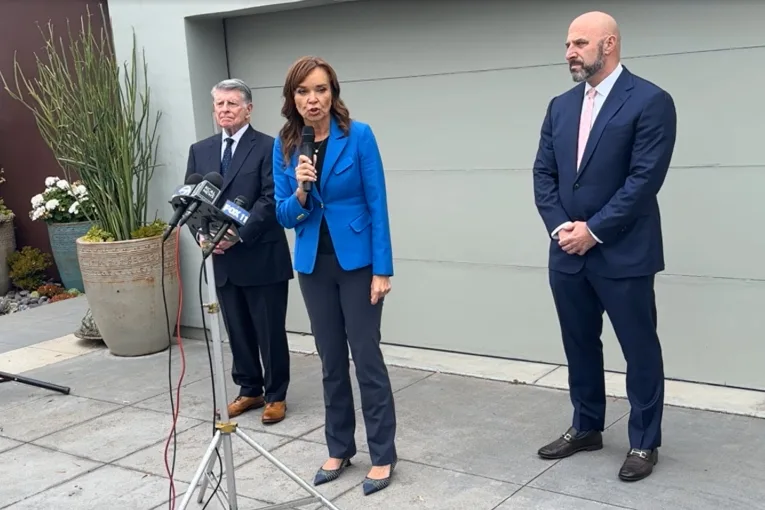
In her courtroom testimony and at a press conference following the verdict, Miller described how Spitzer and Nelson repeatedly tried to isolate and humiliate her. She was stripped of responsibilities, referred to in demeaning terms, and saw her closest allies inside the office targeted.
Spitzer allegedly attempted to fire another prosecutor who had supported the harassment victim.
“He tried to fire my best friend in the office,” Miller said, “and he tried to take my duties away. It was consistent, constant, and pervasive.”
Miller also described being called a babysitter by male colleagues, undermined in high-level meetings, and treated as less than by the very leadership team she had helped support.
The trial, which lasted nearly four weeks, featured extensive testimony, including from sitting judges and other senior attorneys.
Spitzer himself was on the stand for four and a half days, during which Miller’s attorneys allege he committed perjury multiple times.
According to Miller, his demeanor during the trial veered from hostile to erratic. She recounted seeing him glare at her attorney, bang his water bottle, and behave with open aggression—behavior she says mirrors the conduct he routinely exhibited behind closed doors at the DA’s office. “I had to do those meetings alone for years,” she said. “This time I had a judge and a lawyer to help me.”
Beyond the deeply personal dimension of the harassment and retaliation, the case exposed broader concerns about Spitzer’s conduct in high-stakes criminal prosecutions. During the trial, evidence emerged that Spitzer had interfered in at least two capital murder cases for what Miller described as political reasons.
In one case, referred to as the “Buggs case,” Spitzer was found to have violated the California Racial Justice Act by making an inflammatory and racist remark during an internal deliberation over whether to pursue the death penalty.
According to court records and Miller’s account, Spitzer said that many Black men only date white women “to get ahead.”
The comment was made during internal deliberations regarding the death penalty in the case of Jamon Buggs, a Black man convicted of murdering a white couple.
That comment ultimately led to the death penalty being taken off the table in that case, a decision Miller says denied the victims full justice. In another case, Spitzer’s political maneuvering allegedly compromised the integrity of the proceedings and hurt victims further.
“He put politics before justice,” Miller said. “He put himself above the people he was sworn to represent.”
Despite the serious nature of these violations, Miller said the County of Orange failed to hold Spitzer accountable. Instead, county supervisors continued to appear alongside him in public, supported his office financially, and refused to speak out—even after a court of appeal found that Spitzer had violated the Racial Justice Act.
Supervisor Wagner made a statement that ‘Crime is down, so it doesn’t matter,’” Miller recalled. “But crime wasn’t down for those victims whose cases were compromised because of his misconduct.”
For Miller, the silence from other public officials was just as damaging as the abuse she experienced directly. “They allowed it to happen. They looked the other way. And they used millions of taxpayer dollars to defend it.”
At her press conference, Miller addressed the remaining district attorneys still working under Spitzer, many of whom, she says, are too afraid to speak out.
“So many people told me, ‘I can’t talk to you. He’ll retaliate against me,’” she said. “That’s why this verdict matters. It gives them hope. It gives them a voice.”
She also called on Orange County residents, politicians, and community groups to stop giving Spitzer legitimacy.
“If you are a politician or a crime victims’ group, don’t share a stage with him. Don’t let him buy a table at your event. That tells us you’re okay with racism, sexism, and political corruption.”
Miller said she received hundreds of messages of support from public defenders, prosecutors, private attorneys, and even judges following the verdict. Many expressed relief that someone had finally succeeded in exposing what they described as long-standing issues of abuse and impunity within the DA’s office. While she expressed gratitude and a sense of vindication, Miller also made clear that the road ahead remains uncertain—and potentially dangerous. “I’m excited he was held accountable by a jury. I’m hopeful others will follow. But I’m also terrified for the people who are still there. The people who told the truth. They are vulnerable, and the county still hasn’t shown it will protect them.”
When asked whether Spitzer should resign, Miller said that question belongs to the public and to the Board of Supervisors. But she made clear that, in her view, continued silence and complicity would only deepen the damage.
“The people of Orange County deserve better,” she said. “Better than a DA who lies under oath, better than a judge who harasses women, better than county supervisors who look the other way.”
Miller’s legal team, led by veteran civil rights attorney John Barnett and trial lawyer Bijan Darvish, praised her for her courage. “This has never happened before,” Barnett said. “This is the first time an elected district attorney has been taken to court by one of his top deputies and lost. It’s a testament to Tracy’s strength and integrity.”
Since leaving the DA’s office at the end of 2022, Miller has started a communications and consulting firm and continues to support victims, whistleblowers, and those navigating public institutions. She says she misses the work she was forced to leave behind but hopes that her case can lead to greater transparency and justice for others.
“This wasn’t just about me. It was about over a hundred people who were pushed out, fired, or silenced. People who were called unethical, corrupt, and liars by a man who’s none of those things himself. He’s the one who lied. And now, finally, a jury saw that.”
The legal and political implications of the case remain to be seen. The County of Orange may choose to appeal, potentially spending even more public funds defending Spitzer despite the damning findings. Several additional lawsuits from other women in the office are expected to proceed. What’s certain is that the silence that once shielded Orange County’s top prosecutor from accountability has been broken. Whether that break will be followed by real reform is now in the hands of the public.
