
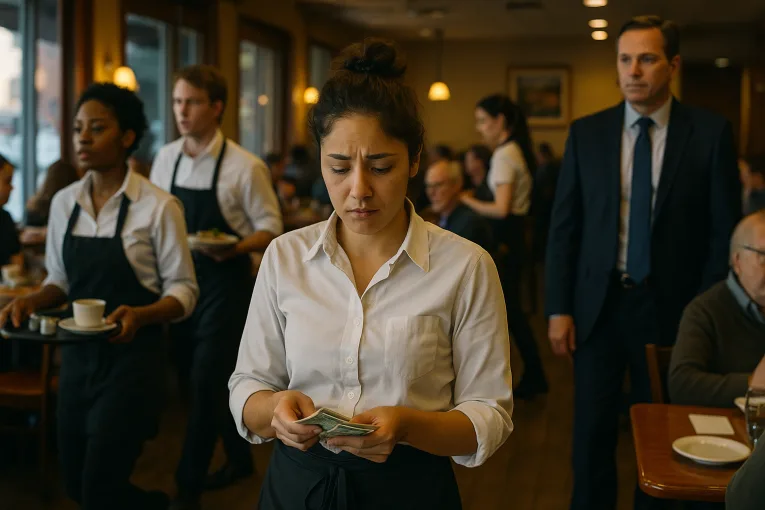
NEW YORK — A recent New Yorker exposé reveals how the restaurant industry orchestrated a decades-long campaign—leveraging lobbying, misinformation and worker messaging—to preserve the subminimum wage, keeping millions of tipped workers at base pay as low as $2.13 an hour.
The story, titled “No Tax on Tips Is an Industry Plant,” pulls back the curtain on a behind-the-scenes campaign by the National Restaurant Association, the leading voice of the U.S. restaurant industry, to preserve the subminimum wage system that allows employers to pay tipped workers as little as $2.13 an hour federally.
The exposé spotlights how the National Restaurant Association systematically trained workers to speak out against wage increases while sowing doubt about the benefits of reform.
At the same time, the NRA funneled significant financial support to politicians from both parties, cultivating bipartisan alliances that shield the subminimum wage system from reform.
By stoking fears of widespread job losses and business closures, these tactics have stalled legislative efforts to raise wages and, according to critics, deepened economic inequality and fractured worker solidarity nationwide.
This coordinated strategy has effectively derailed or reversed attempts to eliminate the subminimum wage in key jurisdictions, including Washington, D.C.
Supporters of the current tipping system argue it encourages better service and offers businesses essential flexibility.
Critics argue the system entrenches a two-tiered labor market.
Tipped workers—mostly women, people of color and immigrants—are stuck in the lower tier with unstable, often subminimum wages, while employers and non-tipped staff occupy the higher tier with steady pay and greater protections.
Saru Jayaraman, president of One Fair Wage, a nonprofit leading efforts to end the tipped wage model, told the New Yorker: “It’s no coincidence that immigrants and Black people are overrepresented among tipped workers today. Women, too, face heightened vulnerability—not only to harassment but also to discrimination—due to their reliance on tips.”
The exposé raises a fundamental question: Should wage policy be shaped by an industry with a financial stake in suppressing labor costs, or by the workers themselves?
The issue is complicated by the diversity of stances within the tipped workforce.
Some fear losing income if the system changes, while others advocate for a full minimum wage plus tips, citing unstable earnings, wage theft and harassment tied to their economic dependence on gratuities.
This division has created rifts not only between employers and employees but among workers themselves.
According to the New Yorker, the NRA has exploited this fracture, amplifying voices opposing reform, sometimes through orchestrated testimonies that echo industry talking points.
In Washington, this dynamic has triggered a broader crisis of representation as lawmakers, according to the article, often receive filtered messages shaped more by employers and less by the workers they seek to understand.
The New Yorker highlights a political dynamic complicating reform efforts: industry-backed measures like the federal Tipped Workers Protection Act have been advanced primarily to block stronger initiatives such as Arizona’s One Fair Wage Act.
The latter aimed to raise the state’s minimum wage to $18 by 2028 and guarantee tipped workers receive that full wage without losing tips.
Yet the Arizona Restaurant Association, representing owners, pushed the Protection Act through Republican lawmakers as a tactic to undercut this more ambitious reform.
Critics of the One Fair Wage proposal warn that requiring employers to pay tipped workers the full minimum wage—on top of tips—could trigger layoffs, menu price hikes or restaurant closures, especially among small businesses.
However, the New Yorker reports that early data from cities like Chicago and states like Michigan, where the policy has been adopted, show that many restaurants have adjusted without major disruption.
While long-term effects are still being studied, initial fears appear overstated.
According to a recent press release from One Fair Wage, the New Yorker story comes at a pivotal time when Washington lawmakers are debating whether to override Initiative 82—a voter-approved measure to eliminate the tipped wage.
Workers warn that any rollback could trigger political backlash, including referenda and recalls.
But this fight stretches far beyond the capital.
Chicago recently became the largest U.S. city to adopt a One Fair Wage ordinance.
Michigan followed, joining eight other states in ending the tipped wage.
Campaigns are also gaining ground in Arizona, Maryland, Ohio, Los Angeles and San Francisco.
The restaurant industry, however, remains a powerful opponent.
Worker advocates accuse lobbyists of exaggerating threats of closures, downplaying positive economic data and backing politicians who obstruct reform while posturing as allies.
“In city after city, they’ve lied to the public and tried to silence workers,” Jayaraman told the New Yorker. “But this movement isn’t going away. It’s growing stronger.”
The struggle also spotlights deeper concerns about corporate influence.
In Baltimore, former City Councilmember Eric Costello—who opposed eliminating the tipped wage—now works for a major restaurant lobbying group.
To activists, it’s a clear case of the “revolving door,” where public officials shift into roles that serve industry interests at the expense of the workers they once represented.

Just don’t spit in my schnitizel