
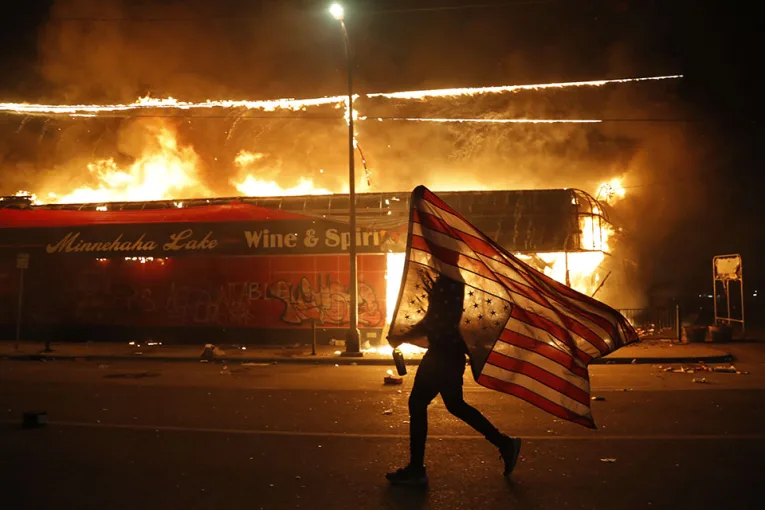
Whether we formally admit it or not, liberation is selective.
I write this while hearing the incessant pops and sizzles of fireworks piercing the near and distant skies, knowing they won’t end until a couple more weeks—at least in Los Angeles. Though our screens today are pervaded with red, white, and blue, not even the occasional thunderclap-esque boom that sets off car alarms can stop my mode of reflection on the eroding integrity of independence in the United States.
The creed of this nation boasts this purported idea of “liberty and justice for all” yet when it comes to extending said liberty and justice, there are several individuals excluded from this vision of “all.”
Whether it be the logic of the Three-Fifths Compromise and the ontology of “the slave,” or even the logic that sought to justify the unlawful detention of Columbia University students, Mahmoud Khalil and Mohsen Mahdawi, “liberty” as a principle has historically displayed itself to be conditional—and justice as well.
With these values’ ambiguity, this thus raises the question of what it means to be an American, especially as an uneven distribution of rights and justice, then challenge the very foundation of “freedom” itself.
If liberty and justice are not universally guaranteed and instead selectively applied—depending on race, culture, origin, beliefs, or political expression—then we must admit that the entire premise of these values exists as an instrument of statecraft, easily weaponized and manipulated to reinforce the state’s theoretical “monopoly on the legitimate use of violence” rather than as a tool that demands equity and a liberated public.
From the dehumanization of Black slaves being put up as a legitimate compromise on the bargaining table when drafting the Constitution, to the police planting crack in our neighborhoods amidst Nixon’s infamous “War on Drugs,” to the predatory lending practices mobilized by financial institutions and private mortgage lenders which led to subsequent decades of Black people’s economic exclusion and the expansion of the racial wealth gap, the mere reality for Black people in America has always been one of dispossession—irrespective of formal manumission and the abolition of Jim Crow.
Moreover, with new pathways for social mobility ultimately creating opportunities for Black people to fill seats for representation in political office, the sole aspect of descriptive representation unfortunately fails to address the question of our liberation.
In a country where Black people are incarcerated at five times the rate of their white counterparts, with outpours of finances directed toward police budgets and real estate proprietors instead of community schools and educational facilities, healthcare clinics, or family planning programs, the question of “freedom for whom” becomes more pressing than ever.
Legacies of material dispossession have manifested into a reality where certain people and entities are able to reap the benefits of a system deliberately curated to leave a certain other people behind.
The struggles of the Black community serve as a stark illustration of how rhetoric on reform and representation fail to yield the answer for collective liberation.
How can I expect someone in office to substantively address the struggles of me and my community’s lived experience while they line their pockets with corrupt money and prioritize re-election rather than genuine material change?
However, this sentiment transcends racial lines, thus making this question of freedom and genuine representation one that is shared rather than exclusive.
While Black people have endured a distinct and enduring history of marginalization in American political life, the broader struggle for liberation in the U.S. exists as a collective one amongst other marginalized folk—a struggle more so grounded in the enduring legacy of class exploitation and economic inequity.
Understanding contemporary racial rhetoric and anti-[insert minority group or sensationalized phenomenon here] vitriol means to understand how the ruling class instrumentalizes these framings to manufacture consent for their continued exploitation of marginalized communities.
Trump’s re-election campaign in 2024 was strategically riddled with anti-immigration rhetoric paired with crime sensationalism, both weaponized to exploit the public’s dissatisfaction over worsening economic conditions and to redirect blame toward vulnerable communities rather than systemic failures.
In recent years, Western OECD (Operation for Economic Co-operation and Development) states have seen a rise in populist anti-globalist anti-immigration movements, which have manifested differently in various geographic and political contexts (i.e. Western Europe’s increasing anti-Arab racism and Islamophobia and the U.S.’s anti-Hispanic/Latine attitudes).
This idea of immigrants coming into “developed” nations and forcing their respective cultures or stealing jobs from native-born residents all while augmenting the crime rate is an erroneous cultural fantasy anchored in the politics of economic insecurity and class dispossession.
Ironically, the renowned slogan of “there is no war but class war” has been doctored by the ruling class itself, taking on a new distorted meaning as the politicization of public economic fatigue and disillusionment has led to racially and culturally-charged class infighting rather than cultivating solidarity and this mutual understanding of collective struggle.
Hence, with the constant targeting of particular demographics relative to others, the reality of freedom has become significantly manipulated, with resistance increasingly perceived as criminal rather than as a people’s endeavor to break out of this spectacle of criminalization itself.
American society has been heavily influenced into believing this illusion of what it means to be free.
Sure, social mobility may grant greater access to opportunity. However, when you have the wealthiest city in the country—New York City—with 25% of its own metropolitan population living below the federal poverty line despite an unemployment rate of under 5%, the integrity of this idea of “social mobility as a pipeline for opportunity and freedom” then becomes legitimately questionable.
Freedom has come to materially exist as this reality where the wealthiest echelon bears no accountability, all at the expense of those beneath, while the working class and those through which the ruling class extracts their wealth are conditioned to equate their freedom with purchasing power and their individual capacity to participate in the very market that exploits their existence and commodifies their humanity.
To celebrate the “land of the free” during a time when democracy’s erosion on our home soil is being facilitated by this administration’s constructed environment of surveillance and carcerality—with the most striking example being the infamous “Alligator Alcatraz” being installed in one of the most ecologically-vulnerable regions in North America—is to continue feeding into this psychology of apathy, inherently disconnected from Fannie Lou Hamer’s lesson of “nobody’s free until everybody’s free.”
While free speech and the protection of civil liberties are being purged left and right alongside repeated violations of the Fifth Amendment—as seen by the detainments and deportations pursued without due process—the American public’s conformist psyche has effectively legitimized this lived reality of detachment and willful ignorance towards the values (liberty and justice) upon which this country was ostensibly founded.
These ideological pillars have continued to decay over time, with people pledging allegiance while blind to the fact that this nation has been crumbling right before our eyes, with our own complicity fueling its collapse.
More explicitly, in what universe would a statewide public university system’s formal ban on student-initiated boycotts of a foreign nation—whose prime minister currently bears arrest warrants for war crimes and crimes against humanity—ever be seen as an indication of true “freedom?”
When the right to dissent is policed in institutions built on the premise of free expression and inquiry, then freedom itself exists not as a value, but rather as a performative veil that works to conceal power rather than liberate the truth and reflect the will of the people.
And furthermore, if we cannot draw the line at genocide and a livestreamed deliberate starvation campaign—both of which America actively aids and abets—how can we ever expect to draw the line at democratic backsliding and the revocation of the very liberal principles upon which this country was established?
To understand freedom is to understand what it means to NOT be free, with the latter being a reality that several Americans seek to dismiss for the sake of preserving their own comfort and affective disengagement.
With the slashing of public services and over $3 trillion projected to be added to the national debt over the next decade with this new “Big ‘Beautiful’ Bill” being officially signed into law, its signing at the White House’s Fourth of July celebration today serves as a symbolic reminder of who this nation is—and has always been—designed for: the big banks, top executives, defense contractors, big tech, real estate monopolists, healthcare profiteers, corporate conglomerates, and so on… all of whom wear this banner of freedom while securing that freedom at the direct expense of you and your neighbors.

I wonder how many people spend more time/energy investing in Bitcoin, for example, rather than writing vague social justice articles complaining about the state of the country.
(No, I haven’t done so, either. Too busy writing comments on the Vanguard, apparently.)
In any case, you could have almost doubled your money over the past year. You don’t have to be wealthy or a particular skin color (or even a citizen, I understand) to make investments.
Nor do you have to be one of those super-talented people who are actually changing the world (though they have opportunities that others don’t).
I dunno – I guess it’s more fun to complain about social justice (or fake housing shortages, in my case).
I appreciate your remarks posted at 8am, “bright” and early. And though you may be right poking fun at my enjoyment in communicating social justice issues, I also seek fun in critiquing comments like yours, which assume I bear no thoughts about fiscal logistics and their broader implications on class and society.
I, too, wonder how many people spend more time and energy investing in Bitcoin rather than criticizing a country they’ve lived in their entire life, however I also wonder how many people spend time understanding how Bitcoin and the topic of “social justice” intersect at various points. In other words, I wonder how many people actually spend time critically thinking rather than perceiving legitimate criticisms like mine as mere “complaints.” :)
Though this framing of Bitcoin may serve as a pathway that exudes financial sovereignty, it serves more as a speculative asset that ends up mirroring capitalist functions that reproduce wealth disparities. People without access to a disposable or discretionary income often can’t meaningfully participate in digital currency exchanges like Bitcoin to their fullest extent. If a person isn’t in a stable financial position to invest, then even the smallest loss could yield significant consequences on their financial stability. Volatility poses a legitimate risk for first-time, low-income investors, unlike wealthier investors whose financial security grants them the capacity to take on greater risk. Of course, this doesn’t speak for every individual, however in a general sense, not many people who are concerned about next month’s rent payment will bear the interest or risk tolerance to invest.
At the same, I do think that DCEs and Bitcoin are revolutionizing the way we conduct economic operations at large! I believe their decentralized nature and autonomy from state surveillance allows for an accessible and sovereign realm that facilitates global financial flows. However, it is fair to acknowledge the various challenges associated with its function, such as mirroring the wealth gap as mentioned, along with its volatility posing significant risk, or even its general lack of protections and oversight leading to potential criminality and little recourse for consumers/investors (especially those who lack the complex financial knowledge that wealthier or more experienced demographics disproportionately possess).
Well, that is a thoughtful, detailed response.
But I do suspect that most people could (and should) invest – even those without much disposable income. If someone can afford a cell phone, they likely have some disposable income by definition.
And if they invest, they will almost certainly have more disposable income over time. Delayed gratification pays off.
I’ve been surprised in the past, when some employees didn’t take advantage of an employer’s matching contribution toward 401Ks. That’s like Rule #1 to do so.
But yeah – Bitcoin is the Wild West of capitalism.
In a sense, pure capitalism (and money itself) doesn’t discriminate. That’s why, for example, some of those who might normally oppose illegal immigration end up supporting it, since it helps their own business. When there’s green involved, no other color matters. Green sits in the “front of the bus” – ahead of all other colors.
And no – I don’t think most people think about the intersection between investments like Bitcoin and social justice. (Most people just wish they had a time machine.)
My simplified theory (in general) is that conservatives analyze the world (and people) as they actually are, while progressives/liberals view it in the way they think it “should” be. And that’s also related to the reason that most people tend to get more conservative as they get older.