
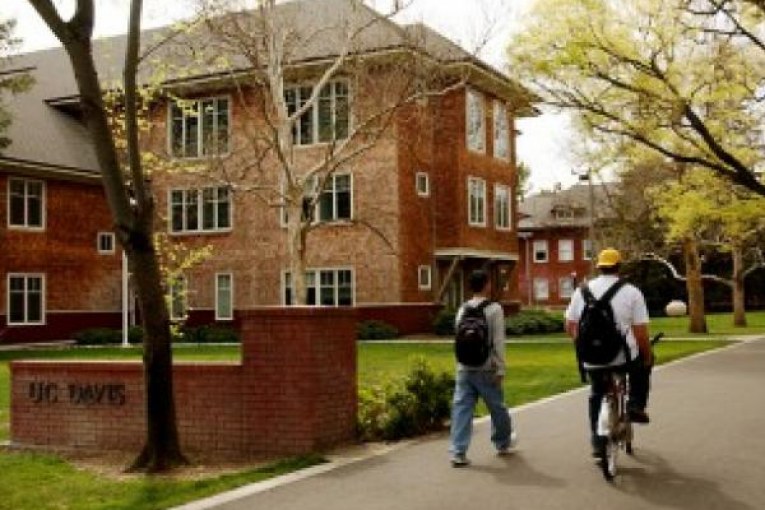
UC Davis has offered undergraduate admission to 55,739 students for fall 2025, including a record-breaking 45,963 first-year applicants, marking a 10.4% increase over last year, according to data released by the University of California on July 28.
This year’s total represents an 8.6% increase in admissions offers compared to fall 2024. In addition to the record first-year offers, 9,776 students were admitted as transfers, a 0.8% increase from the previous cycle. Of the total admitted, 34,088 are California residents, a 1.7% rise from last year.
The campus received a record 120,131 applications and admitted approximately 46.3% of applicants. The university expects between 9,750 and 9,800 new undergraduates to enroll this fall.
The admitted cohort includes students from all 57 California counties with a high school, all 50 U.S. states, the District of Columbia, five U.S. territories, and 104 countries. For first-year and transfer admissions combined, 25,677 students were admitted from California high schools and 8,411 from California community colleges. An additional 13,225 international students and 8,426 U.S. out-of-state students were also offered admission.
Of the total admitted, 61.1% are California residents. According to the university, California residents tend to accept offers at a higher rate than their out-of-state and international peers and are therefore expected to comprise a larger share of the enrolled class.
Among California first-year admits, 4.0% identified as African American, 0.6% as American Indian, 28.1% as Hispanic or Latino, 0.2% as Pacific Islander, 41.5% as Asian American, 21.0% as White, and 4.4% did not report a race or ethnicity. Among U.S. domestic transfer admits from California community colleges, 5.0% were African American, 0.8% American Indian, 26.5% Hispanic or Latino, 0.3% Pacific Islander, 37.8% Asian American, 27.2% White, and 2.4% unknown.
First-generation college students made up 34.6% of California residents admitted as first-year students and 42.9% of California community college transfer admits. Low-income students represented 34.2% of California first-year admits and 46.5% of community college transfer admits.
UC Davis expects total fall 2025 enrollment—including undergraduate, graduate, and professional students, as well as interns and residents—across all locations to be about 40,900. The university also monitors a three-quarter average enrollment to manage growth under the 2018 Long Range Development Plan, which sets a target of 39,000 students at the Davis campus. That average has remained steady at about 36,500 over the last six years.

“UC Davis Admits Record Number of Students for Fall 2025”
Wow, they might need housing. You should write an article on that.
Or several hundred articles on that :-|
Or maybe I can go to public comment, rant and rave and wave my arms all over the place instead?
Would you lessons from The Master ?
“Among California first-year admits, 4.0% identified as African American, 0.6% as American Indian, 28.1% as Hispanic or Latino, 0.2% as Pacific Islander, 41.5% as Asian American, 21.0% as White, and 4.4% did not report a race or ethnicity. Among U.S. domestic transfer admits from California community colleges, 5.0% were African American, 0.8% American Indian, 26.5% Hispanic or Latino, 0.3% Pacific Islander, 37.8% Asian American, 27.2% White, and 2.4% unknown.”
Any Jews?
I see white students are underrepresented again this year.
Coincidence or by design?
Third option?
UC stopped using race as an admission criteria decades ago.
There’s that as well.
“UC stopped using race as an admission criteria decades ago.”
That’s what we’re told anyway. But I asked Google chat this simple question:
How colleges still use race for admission criteria even though they state they don’t:
Even though the Supreme Court effectively ended the explicit consideration of race as a factor in college admissions in 2023, colleges can still utilize other approaches that may indirectly influence the racial composition of their student bodies.
Here’s how this can occur:
Considering the impact of race on an applicant’s life: While colleges cannot directly use race as a factor in admissions decisions, they can consider how race has affected an individual applicant’s life, experiences, and perspective, according to UW School of Law. This can be explored through application essays or recommendation letters discussing a student’s lived experiences related to race.
Holistic admissions: Many colleges employ a holistic review process, which considers a wide range of factors beyond grades and test scores, including extracurricular activities, accomplishments outside school, and socioeconomic background. Factors such as socioeconomic disadvantage and educational hardships can be considered, and these can be closely linked to race and ethnicity due to systemic inequalities.
Targeted outreach and recruitment: Colleges are still permitted to conduct targeted outreach and recruitment efforts to attract diverse student populations, as long as these efforts don’t provide preferential treatment in the admissions process.
It’s important to note:
The Supreme Court ruling emphasized that any consideration of race must be tied to a unique ability or quality an applicant can contribute to the university.
The effectiveness of these race-neutral strategies in achieving racial diversity has been a subject of debate.
The legal landscape surrounding race in admissions remains complex and continues to be debated and potentially refined through further legal challenges.
The key takeaway is that while the overt use of race as a direct admissions factor is prohibited, colleges can still pursue diversity goals by considering the impact of race on individuals’ lives and by using other legally permissible methods within the framework of a holistic review process.
None of that address UC policies. Besides by going this direction, you are missing a huge problem that is likely to increase in the coming years.
https://www.chronicle.com/article/affluent-white-students-are-skipping-college-and-no-one-is-sure-why
https://www.pbs.org/newshour/show/why-fewer-young-men-are-choosing-to-pursue-college-degrees
https://feed.georgetown.edu/access-affordability/why-are-fewer-white-students-attending-college/
Like I stated, there’s ways around it:
“Students Against Racial Discrimination (SARD) filed a lawsuit against the University of California (UC), claiming that their admission policies unfairly favor Black and Latino students at the expense of more academically qualified white and Asian American students. They claim race played a part in the UC’s admissions practices, and they are asking the court to prohibit race-based questions.”
“Students Against Racial Discrimination believe this was done in violation of the law. The University of California asks about a student’s race and background on their application.” They are claiming the UC system is illegally using this information and racial preferences to boost the representation of minorities on its campuses.”
https://www.findlaw.com/legalblogs/courtside/university-of-california-schools-illegally-used-racial-preferences-in-admissions-lawsuit-alleges/
Sure, I don’t need to know the racial demographics of the applicants to approximate a student body that is reflective of the racial makeup of California. I could do it simply by knowing the applicants respective zip codes.
Take your resentment up with John Roberts. Apparently his decision overturning Affirmative Action was limited to prohibiting the use of race. Other methods of selection that achieve the same outcome are not prohibited.
But, I would challenge your anxiety over the decline in the whiteness of the student body on another basis, personal responsibility.
Everyone knows that many young Californians of Asian descent work their asses off to get into UC, so, it should come as no surprise that they make up the largest demographic in the incoming class.
That’s the point. The racial demographics of the incoming class are not reflective of the racial makeup of California especially when it comes to whites.
California:
Latino – 40
White – 34
Asian – 16
Black – 6
UCD
Asian – 41
Latino – 28
White – 21
Black – 4
So what’s basically happened is that Asians are overrepresented and whites as underrepresented but so too are Latinos and Blacks. So what you’re alleging isn’t reflected in the data.
Well I guess you can’t claim UC is messing around with the selection process to mirror the demographics of the state. So then what is your complaint?
Perhaps you believe its something other than merit. You wanted to get rid of Affirmative Action but are still unsatisfied now that its gone.
It actually is showing in the data you provided.
By the way, the lawsuit that overturned racial preference in college admissions was brought by Asian parents against Harvard. I guess they knew that they could out compete everyone on a level playing field. Are you now somehow surprised?
Using David’s data Latino students are underrepresented by 30%, Blacks are underrepresented by 33% while Whites are underrepresented by a whopping 38%.
Unless we know what the applicant pool looks like, the admission criteria, and can calibrate it, there is not enough data to make even a preliminary conclusion.
Ron G says: “Everyone knows that many young Californians of Asian descent work their asses off to get into UC, so, it should come as no surprise that they make up the largest demographic in the incoming class.”
There’s often some truth to stereotypes like that one.
This type of fact does bother those who are out to “get whitey”, though. :-) (Or for that matter, to “get the Jews”.)
Nixon comes to mind (something about “not having Dick to kick-around, anymore” – something like that).
I find the whole thing amusing, and I’ll be dead within a few decades (at most), anyway.
Though it’s not so-amusing for those who are at least temporarily “top dog” (see Lowell High School, for example). The former school board member who was recalled was not exactly “wrong” when she said that Asians were using “white supremacy” to get ahead.
(Though I think you’d have to argue that Asians are using the “new and improved” white supremacy. In other words, exactly what you said regarding working hard, having a culture that emphasizes the right choices, etc.).
Personally, I don’t really care if “white” students are increasingly under-represented on campus. (The more-universal discrepancy has to do with sex, not skin color.) In any case, one of David’s cited articles (from Georgetown) states the following, which suggests that universities don’t care, either:
“When the pandemic started in 2020, we were focused on race and ethnicity and the large declines in Black and Hispanic enrollments,” particularly at two-year community colleges. Now, few higher education institutions seem prepared to recruit more white students while remedying racial inequities for students of color, who may soon make up the majority of their student population, The Chronicle says.”
Of course, the larger problem for universities is also stated in that same article:
“Colleges already are facing other factors that may dampen college attendance. Experts predict that, in the next year or two, many campuses will face an enrollment cliff: a substantial decline in enrollment of traditional-age college students, as the college age population shrinks for five to 10 years.”
What we’re actually seeing is the hollowing-out of the community college and CSU systems, for now. Seems like those students are now increasingly moving to the UC system. In other words, the UC system is increasingly taking CSU’s lunch money.
And since acceptance is now easier in the UC system, it seems increasingly-likely that the UC system itself will be viewed in much the same way as the CSU system – thereby weaking its “exclusive/quality” status. (Except perhaps for the “elite” UC campuses – Berkeley and UCLA.)
Seems like a far more-important consideration (than a particular campus) is the type of degree a student pursues (and succeeds at). And truth be told, it’s primarily Asian students who focus on that – staring well-before college.
I just read the other day that Asians (as a group) have now surpassed whites (on average) regarding wealth. Good for them, I say. (Turns out there’s “consequences” for doing the right thing.)
Perhaps, with year after year of record enrollment at UCD, we can put to rest the nearly 20 years of assertions by various commenters on the Vanguard that UCD enrollment is going to decline due to some change in demographics or demand for 4-year college programs. UCD continues to grow in enrollment and will for the foreseeable future, and that fact is central to Davis planning issues.
Seemed like the much more important point, but Keith wanted to bang the race card.
“Seemed like the much more important point, but Keith wanted to bang the race card.”
That’s so hilarious and ironic coming from you of all people. Thanks for my laugh of the day.
Housing uber alles
“Keith wanted to bang the race card.”
I had to revisit this for another good laugh. Thank you David Greenwald, I can’t believe YOU actually wrote that.
I can’t believe you don’t believe it.
“UCD continues to grow in enrollment and will for the foreseeable future, and that fact is central to Davis planning issues.”
That fact should be central to UCD’s planning issues.
Don says: “Perhaps, with year after year of record enrollment at UCD, we can put to rest the nearly 20 years of assertions by various commenters on the Vanguard that UCD enrollment is going to decline due to some change in demographics or demand for 4-year college programs.”
Actual enrollment is not the same thing as being “offered” a spot. (As the article itself notes.)
“The university also monitors a three-quarter average enrollment to manage growth under the 2018 Long Range Development Plan, which sets a target of 39,000 students at the Davis campus. That average has remained steady at about 36,500 over the last six years.”
Demand for college is on a steep decline, and there is absolutely no dispute regarding that (nor is there any dispute regarding the decline in the public school “feeder system”). For now, it appears that it’s not yet impacting the UC system, since they are essentially “poaching” students from the CSU and community college systems. I would argue that’s not a “good thing” for those systems or communities, but that apparently doesn’t matter to some on here, as long as UCD keeps growing (albeit – pretty moderately at this point).
Thank goodness for International students (in their view, at least).
“Demand for college is on a steep decline”
Not at UC Davis. Not now, and not in the foreseeable future.
Again, for the reasons noted (poaching from other college systems in California, and pursuit of International students). And again, I would argue that it’s hurting those communities/systems.
Sonoma state recently had to make massive cuts to its programs.
The article doesn’t specifically mention the number of International (non-resident) students, but it appears to be around 6,000 – 7,000 (base on a comparison between the resident students listed, vs. total expected enrollment).
Really? Offering someone a world-class education that they would not receive in their community is poaching? Seems like a silly argument.
Ironically, it’s the same argument that’s made in regard to declining enrollment at DJUSD. (That is, declining enrollment “hurts” the education provided at DJUSD.)
But yes, it definitely hurts those “left behind” in systems which aren’t receiving as much attention/funds as a result of poaching. Do you actually not see that?
Also, truth be told – UCD is not the “top level” university in the UC system itself in the first place.
Maybe “everyone” should be guaranteed a spot at Berkeley or UCLA, and shut down all the rest of the UC universities – including UCD (as well as the entire CSU and community college system) – using this argument.
Or maybe you and Don don’t actually care about those “left behind”.
(Just pointing out where this argument leads. It’s not unlike the “no opportunity” – entire cities you that you sometimes cite.)
That’s completely wrong. People go to the college that’s in their best interest. Most of the international students are here on student visas and then return to their community’s with a great education where they then work in R*D or Business and give back to their communities that way. There is a reason why they come over for an education.
I don’t blame individual students for pursuing what’s “best for them”.
But when the local CSU or community college starts offering “less”, with the UC system taking a larger percentage of a shrinking “pie”, then the result is not helping those communities or systems as a whole. Again, it’s causing a lot of anguish at Sonoma State, for example.
As far as students coming from a country that’s run by a communist party that’s essentially opposed to the U.S. in regard to issues like Taiwan, I’m not sure that’s in the interest of the U.S. (And as I recall, it’s an issue that’s come up in regard to UCD, though I haven’t looked into that in-depth.) But for sure, if the racial background of those students were included in the statistics, UCD would count a much higher percentage of students as “Asian”. As I recall, they’re not counted in regard to those particular statistics.)
I don’t agree
On a more-local level, DJUSD’s “poaching activities” is likely causing WJUSD to “not build” a school at the technology park, which includes 1,600 planned housing units.
This is causing a group of parents in Spring Lake a lot of concern, as well.
(Truth be told, WJUSD also doesn’t want to close down a school in the older parts of the city where enrollment is declining – which is also a factor regarding the lack of sufficient capacity on the “newer” Spring Lake side of town. The local parents are aware of that situation as well, but don’t focus as much on that.)
Bottom line is that poaching does hurt the communities and systems that are being poached, at least until they close down a college or school. (At which point, “everyone” can live in a “high opportunity” city like Davis, I guess. Or more accurately, IN Berkeley or around UCLA. – since UCD doesn’t have quite the reputation as those universities.
Maybe Woodland should support their schools better and stop voting down tax measures instead of whining about what Davis does?
Well, that might happen if they weren’t able to send their kids to Davis schools (and without paying DJUSD parcel taxes). At least in regard to Spring Lake.
Honestly, I don’t blame Spring Lake parents (or even DJUSD employees who live in Spring Lake) for the situation. (I strongly suspect that Spring Lake is where the majority of new, out-of-district DJUSD students are coming from.)
But it does remind me of what’s occurring regarding the UC vs. CSU (and community college) systems.
Maybe, but the reality is that Davis has invested heavily in its schools and Woodland hasn’t, so you have a bunch of faculty at UC Davis who can’t live in Davis because of lack of housing and costs, but they can send their kids to better schools – why wouldn’t they? If Woodland has a problem with that – step up.
I suspect that long-term DJUSD faculty members primarily live in Davis, and that newer DJUSD faculty members wouldn’t even be needed if they weren’t sending their own kids (and others from the Spring Lake neighborhood) to DJUSD.
In other words, it’s DJUSD’s “excess capacity” which encourages that to continue, and which disincentivizes investment at WJUSD. Both from lack of students (funding from the state), and willingness of parents (and the city) to invest in their own system.
But no, I don’t expect those with an incentive to ignore this to honestly acknowledge it – whether it’s the local school system, or the university system (including UCD).
Instead, they’ll just continue to ignore the impact of what they’re doing.
I don’t know what you’re talking about nor why it matters.
Well, it matters if you’re looking at the “cause” of growth (and the impact that poaching has). I thought that was pretty clear, given that I spelled it out (in regard to both the CSU/community college system, and on local public school systems that are being “poached” from).
You can find quite a few articles in the Santa Rosa paper, for example, regarding the cuts at Sonoma state. And I can also refer you to the local group of parents who are concerned about the lack of school capacity on the newer side of Woodland, if you’d like. I believe they’ve largely given up at this point, however. (So, that’s another 1,600 Spring Lake housing units with potential commuters to UCD and DJUSD.)
Is there something else I can clarify for you?
Just saw the following article in SF Gate. It does appear that the reduction in the number of college-age cohort is just starting to impact the UC system – despite their “de facto” poaching activities. I guess we’ll see how that plays out going forward.
“At the same time, though, applications for first-year students from California decreased by 2.6%, or by 3,520 applicants, compared with last year. The application pool decreased in every race/ethnicity group, UC data shows.”
“Some of the most competitive campuses, such as UC Berkeley and UCLA, admitted a smaller percentage of California applicants. At UC Berkeley, 68% of admitted students were in-state, compared with 79% of its admitted students in 2024.”
https://www.sfgate.com/bayarea/article/new-admissions-data-uc-berkeley-ucla-numbers-20794406.php
In any case, Davis is probably fortunate that it’s not adjacent to (or reliant-upon) a CSU campus (instead of a UC campus), at this point.
Meanwhile, UC Merced and UC Riverside had some of the biggest increases in admissions. (I guess we’ll see how that plays out regarding actual enrollments – since those are no doubt the “backup choice” for a lot of students.)