
Key points:
- Housing crisis is complex with no single solution.
- California’s housing problem is driven by difficulty in building new units.
- Economist Steve Keen proposes a policy to cap mortgage debt at ten times rental income.
Housing is more complicated than many people think, and I don’t believe there is a single answer to the housing crisis.
One of my goals in this space is to bring in different aspects and perspectives, and to center community discussions around them rather than put forward one silver-bullet fix.
A reader recently responded to one of my op-eds by that, while I am focusing on the affordability of housing in my writings, I seem to be stuck on deregulation as a solution.
They don’t believe it is a solution.
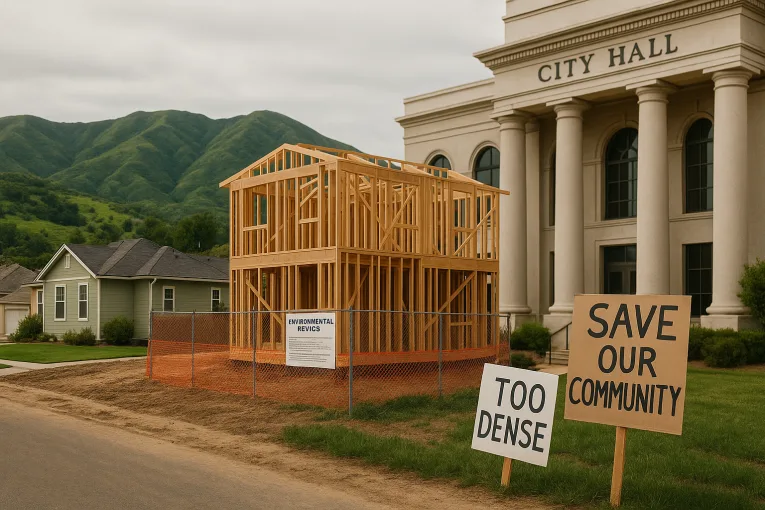
On the surface, that sounds reasonable. But I have to somewhat disagree. One of the problems in California is that it is too difficult to build housing, and that has driven up the cost of housing both on the production side and the supply side.
In Davis, for example, you can’t seriously address the housing problem without confronting the elephant in the room—Measure J and its ability to stop housing from being built.
First approved by voters in 2000 and renewed twice since, Measure J requires a public vote before most new development on agricultural or open space land can be approved.
Supporters say it protects farmland and keeps growth in check. But in practice, it has acted as a nearly impenetrable barrier to new housing construction. (And really, it doesn’t protect farmland either—it simply moves the development to another community).
In more than two decades, only two Measure J projects have been approved by voters—and housing, particularly housing for families and the workforce, have lagged way behind demand.
Even people who want to focus on affordability acknowledge that there is a big problem.
One analyst put it this way: “While there’s no shortage of housing in general, there’s a real lack of units for our middle- to lower-middle-class workforce.”
Let’s follow that logic. There’s supposedly no shortage of housing, but we lack units for middle- and lower-middle-class residents. And even critics of market-driven approaches acknowledge there is also a shortage for low-income households. When you add those groups together, you’ve accounted for a huge swath of the population. But somehow there’s no housing crisis? It’s as if people don’t know what the term actually means.
The same analysis continued, “Building more housing won’t alone remedy this deficiency. The government (funded by taxpayers) must subsidize this critical need.”
I agree with that point, and it gets to the real heart of the matter. The housing crisis is not a shortage of homes for wealthy buyers—it’s a shortage of housing affordable to middle- and low-income families and households.
We may on the whole have enough physical building nationally to accommodate the need, but we actually need to have housing near jobs that people can afford—and that’s where we are falling down, and the collateral consequences go way beyond the affordability matrix.
The harder question is how to actually build that housing that people can afford.
The federal government is showing more interest in cracking down on perceived “social programs” than in expanding them, which puts HUD’s low-income housing programs and Section 8 vouchers at risk.
California, meanwhile, has its own challenge: since the elimination of redevelopment agencies in 2011, the state has never figured out how to consistently fund affordable housing on a large scale.
That leaves cities and counties scrambling to patch together subsidies from local bonds, state competitive grants, and federal allocations—and often relying on market-rate developers to include affordable units as part of larger projects.
Recent legislative efforts in Sacramento have tried to address pieces of the problem.
Bills such as SB 35, which streamlines approvals for housing developments that meet certain affordability requirements, and SB 330, which limits local governments’ ability to reduce housing capacity, have made some progress.
More recently, the “Fast Track Housing” package introduced this year aims to speed up permitting and reduce CEQA-related delays for certain projects. But none of these laws, on their own, solve the problem of how to produce deeply affordable units without dedicated funding.
Production barriers are only part of the story.
Economist Steve Keen recently published an in-depth analysis arguing that the housing market is “a rigged game,” driven in large part by the financial sector. “The main factor making housing unaffordable in the USA—and most of the rest of the world—is too much mortgage lending by banks,” Keen wrote on Substack.
Keen argues this is not a uniquely American problem but a global pattern tied to decades of financial deregulation. “Gen Xers and Millennials can’t afford housing, not because supply is inadequate—which is the excuse used by conventional economists and politicians—but because banks have been allowed to lend too much money for housing.”
His core argument is straightforward: most people cannot purchase a home without taking on a mortgage, and therefore the total monetary demand for housing in any given year is directly tied to the level of new mortgage debt issued.
Since the supply of housing—especially developable land—is relatively fixed in the short term, an increase in mortgage lending primarily drives up prices rather than significantly increasing supply.
Keen’s examination of data from 1970 to the present found a consistent, near lock-step relationship between the acceleration of household mortgage debt and rising home prices.
While rising prices can encourage more borrowing, Keen contends that the dominant direction of causation is from increased mortgage lending to higher prices. “There is strong evidence of Granger causality from the mortgage debt ratio to house prices, but not vice versa,” he noted.
This dynamic has played out differently across countries. In Germany, strong tenant protections have given renters long-term stability, making them less willing to take on massive debt just to secure housing. German household debt is significantly lower than in the U.S., the U.K., or Australia, and housing prices there have remained relatively stable. In contrast, countries with weaker tenant rights and more permissive lending policies have seen prices rise far faster than incomes.
Keen proposes breaking the link between escalating mortgage debt and housing bubbles through a policy he calls “Property Income Limited Leverage,” or “The PILL.” His idea is to cap mortgage debt at no more than ten times the annual rental income of a property, whether actual or imputed.
“With this rule in place, bubbles in mortgage debt would cease, and so therefore would house price bubbles,” he wrote. He also notes that decades ago, when banks required 30% down payments and limited leverage, average income earners could buy homes at far younger ages than today.
Keen acknowledges that such a policy would be politically difficult to enact.
Too many current policymakers benefited personally from the rise in property values over the last four decades. But he believes demographics may eventually shift the balance.
As younger generations—those priced out of ownership—become a larger share of the electorate, political support for measures to bring housing back within reach could grow.
All of this points back to my starting position: there is no single solution to the housing crisis.
Deregulation to allow more construction matters, particularly in places like Davis where voter-approved growth controls make it nearly impossible to build.
Funding affordable housing matters, especially when federal and state programs are unstable or inadequate.
And rethinking the financial system’s role in driving prices matters, as Keen argues.
We will not solve the crisis if we treat it as a one-dimensional problem.
Until we address the interconnected issues of production barriers, financing practices, and sustainable funding for affordability, we will continue to circle around partial solutions while the overall problem deepens.
And until we are clear that the crisis is not about a shortage of luxury housing but about the lack of housing that ordinary people can afford, we risk talking past each other while the situation gets worse.

David says: “One of my goals in this space is to bring in different aspects and perspectives, and to center community discussions around them rather than put forward one silver-bullet fix.”
There’s not even a singular definition of “housing crisis”, much less a “community discussion”. So it doesn’t appear that your “goal” is going very well.
David says: “Supporters say it protects farmland and keeps growth in check. But in practice, it has acted as a nearly impenetrable barrier to new housing construction. (And really it doesn’t protect farmland either – it simply moves the development to another community).”
Every once in awhile, someone puts forth a lie which claims that Covell Village was “moved” to Woodland (and became Spring Lake). A recent council member repeated that lie, as I recall. But the fact is that Spring Lake planning preceded Covell Village.
Cities which surround Davis are governed by the type of leaders that you and some others advocate for Davis.
In any case, the only thing that Measure J does is to provide Davis voters with an opportunity to say “no” to developments IN ADDITION to the developments that are pursued outside of the city – regardless.
On August 13 there will be the start of a community conversation on housing.
You’re referring to the general plan update?
Not too worried about it, as long as Measure J remains in place. Pretty much over-rides any amount of “planning” that’s proposed outside of city limits.
I’ve seen quite a few “plans” come and go. (Can’t help but think of the “Studio 54” plan, in regard to DISC.)
Not to mention the “community discussion” at the church next to the Farmer’s market – a year or two ago.
The type of people who go to (or arrange for) these “planning meetings” generally think there’s something “wrong” with the current plan. And they usually end up disappointed.
“His idea is to cap mortgage debt at no more than ten times the annual rental income of a property, whether actual or imputed. ”
God what a stupid idea. Mortgage and rent are not directly related and vary between markets. Who would pay for the difference between the economic reality of a property and its valuation by this rando proposal?
You might be interested in the article describing Keen’s approach and conclusion. It’s here: https://www.patreon.com/posts/housing-market-135767065.
A little more about Keen. Unlike orthodox economists from the left (e.g. Krugman) and the right (e.g. Mankiw) he accurately predicted the Global Financial Crisis (the subprime/derivatives meltdown) years before it occurred. For this he received the Revere prize in economics, not the pseudo-Nobel. The estate of Alfred Nobel doesn’t issue a prize in economics, the Swedish Central Bank does “in memory of Alfred Nobel.” Oddly enough, no theories critical of banks ever receive the pseudo-Nobel. Quelle surprise!
Personally, I’m waiting from some local gym to issue a Nobel prize in workouts (“in memory of Alfred Nobel). Yes, it’s silly, but that’s what we’ve got from the Sveriges Riksbank. (The Swedish “Fed”).
You might also read some of his many books. The top of the list is “Debunking Economics: The Naked Emperor Dethroned” in which he documents the sins of orthodoxy, which are many. He is no kidding the John Maynard Keynes of this era…or perhaps the Michal Kalecki, if you’re an economics maven.
As for whether mortgages and rent are directly related, as a former appraiser I can tell you that the appraised value of property can be calculated from comparable sales or from potential income generated. The appraised value determines the maximum loan available, and Keen’s program would stop property speculation (e.g. Blackstone) untethered by actual economic value of rent produce-able. It would prevent the “greater fool” theory of housing value from getting any traction.
From article: “As younger generations—those priced out of ownership—become a larger share of the electorate, political support for measures to bring housing back within reach could grow.”
Seems like the opposite is true, in regard to the boomers dying-off and leaving their houses to their kids. Especially since subsequent generations are progressively smaller.
You can be sure that the millennials and subsequent generations are already well-aware of the value of their parents’ house, investments, etc. (At least to the degree that their parents share that information, and/or where they can see it for themselves on sites like Zillow.)
Not to mention boomer parents helping their kids before that time comes.
I’m personally looking forward to the rise of the “super-NIMBYs”, as some will probably label them. The ones who will suddenly become wealthy, over the next few years/decades. (Lots of them in California.)
But yes, it probably will result in more wealth discrepancy (and might already be doing so). Better pick/vet your parents carefully, BEFORE your next lifetime! Don’t immediately accept the first applicant.
Apparently, inheritance distributions below about $14 million (per individual) and $28 million (per couple) aren’t taxed by the IRS. Sweet!
(Plus, I understand there’s ways to avoid some of that limitation, as well.)
https://smartasset.com/taxes/how-much-can-you-inherit-without-paying-taxes
I would agree that we need a “many points of reform” approach if we really want to be effective at doing pretty much anything “good” about the housing crisis.
Measure J is an obvious target, but removing it would only mean more McMansions as developers pursue highest margins for their projects – the point about affordability woudl remain.
There are also systemic issues if we wanted to make a policy goal of producing missing-middle housing…. these are just a few that I have read about: Lawsuits post-building condos / the number of required staircases in apartments / parking minimums / propety line setbacks / Osha rules re: safety in taller developments / labor unions using CEQA lawsuits as a cudgel…. the list goes on, and financing is a nightmare as well…
I dont like the idea of “subsidy” outside of capital-A affordable ( means tested) housing. But it is certain that the city needs to adopt policies to try to encourage projects to actually be built. That includes procedural streamlining, reduction in development fees (cant treat developers as a cash cow for funding pet projects) and perhaps some policy safeguards, underwriting help, or even financial partnerships are all on the table. In the success stories of communities that have really done a good job turning their cities around into more walkable / non car centric / missing middle kinds of communities, they have had to do all of these things.
Tim Keller says: “In the success stories of communities that have really done a good job turning their cities around into more walkable / non car centric / missing middle kinds of communities, they have had to do all of these things.”
Name even “one”, and also compare it to what you propose OUTSIDE of city limits – which are also far from downtown and UCD.