
BERLIN — After touring prisons in Germany to study approaches that prioritize rehabilitation over punishment, several U.S. states are turning to European-style prisons in an effort to improve prison conditions in America, reported The New York Times.
According to The New York Times, a delegation of prison officials from Massachusetts, North Dakota and Oklahoma were struck by how much conditions differed in Berlin’s Tegel Prison compared to what they see at home.
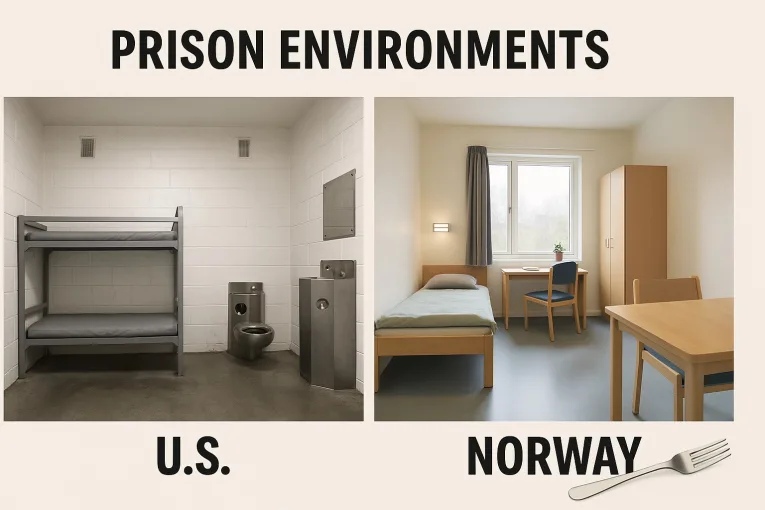
The German maximum-security prison resembled a college campus more than a traditional prison, with incarcerated people wearing street clothes, working outside the gates, and even maintaining access to open windows and kitchens where they could cook their own meals, added The New York Times. In addition, incarcerated people maintained their right to vote and could learn skills like carpentry; open prisons in Germany even allow residents to leave for work and errands.
The New York Times quoted Shannon Davison, a deputy prison warden from North Dakota, who noted, “They treat their maximum-security prisoners like minimum-security prisoners.” Yet, as the Times reported, Tegel’s levels of violence are far lower than most U.S. prisons, even with this relaxed treatment, as suicide and homicide rates are extremely low in German prisons.
Scandinavian countries have long been famous for the modernized design of their correctional facilities, but Germany and New Zealand have also drawn interest, shared The New York Times.
According to the report, in recent years states like California, Arizona and Pennsylvania have introduced “European-style” units within existing prisons, seeking to shift their focus from punishment to rehabilitation.
“I’m amazed by how quickly these ideas are taking off across the United States,” said criminology professor Keramet Reiter at the University of California, Irvine, as quoted by The New York Times.
However, The New York Times highlighted the limited nature of these efforts due to the drastic size of the American prison population, political and financial barriers, and opposition by voters to improving conditions. The report cited such examples as New York state officers walking off the job to protest limitations of solitary confinement, as well as President Donald Trump expressing that he would “love” to transfer convicts to El Salvador.
The push for prison reform stems from current U.S. prison crises, with facilities across the country facing severe staffing shortages, crumbling infrastructure and high levels of inmate violence. Extreme temperatures and vermin infestations in solitary confinement have also been endured by inmates, reported The New York Times.
“It’s unsustainable, which is why we have to change the justice system to lock up only those who are a danger to others,” said Tricia Everest, Oklahoma’s secretary of public safety. According to the report, Oklahoma once had the highest incarceration rate in the nation but has since closed four prisons and redirected resources toward mental health and substance abuse rehabilitation.
In Georgia, the U.S. Department of Justice recently cited “frequent, pervasive violence” in state prisons, while a federal judge declared the excessive temperatures in Texas prisons to be “plainly unconstitutional,” the report included.
Meanwhile, German prisons have required new prisons to provide single-occupancy cells of at least 10 square meters, with maximum-security units even allowing family visits in private rooms with amenities like cribs and balconies, reported The New York Times. The report highlights the “dynamic security” approach that German prisons take, where officers purposely develop relationships with prisoners, allowing them to anticipate and defuse potential conflicts—a sharp contrast with U.S. prisons that strictly prohibit fraternization.
Conducting research in prisons to measure the effects of these models, the Times underscored a randomized, controlled study in South Carolina that found inmates in European-style units to be 73% less likely to face disciplinary action for violence and 83% less likely to be placed in restrictive housing.
The report also highlights the importance of improving staff morale, such as correctional officers practicing more meaningful interaction rather than constant surveillance.
According to The New York Times, however, replicating these European-style systems in the U.S. faces significant challenges, the most notable being cost. Additionally, states are already struggling to increase the staff-to-inmate ratios in their prisons. “A guard and inmate sharing a cup of coffee could require an overhaul of longstanding policies designed to prohibit fraternization,” the report explained.
The Times also highlights the issue of cultural differences potentially complicating reform. While German prisons permit closed-door bathrooms, American prisons emphasize constant visibility. According to Colby Braun, director of the North Dakota Department of Corrections and Rehabilitation, the state had attempted to design a more “dignified arrangement” but failed to achieve it due to “a requirement that officers be able to see prisoners on their round,” wrote The New York Times.
Furthermore, the prison officials in Massachusetts who had toured the German prisons were frustrated at the fact that their state’s liberal legislature refused to replace their prisons, even ones that have existed for over a century, reported The New York Times.
As U.S. prisons face overcrowding, high rates of violence and deteriorating infrastructure, these tours of European-style prisons have sparked both discourse and hope that American prisons might shift toward models prioritizing rehabilitation over pure punishment. Although proposed changes are encountered by political resistance and high costs, state officials continue to argue that inaction will only worsen these ongoing systemic issues.
