
Key points:
- California Democratic Party endorses Senate Bill 79.
- Bill legalizes multifamily homes near major transit stops.
- California’s median home price now exceeds $900,000 due to housing shortage.
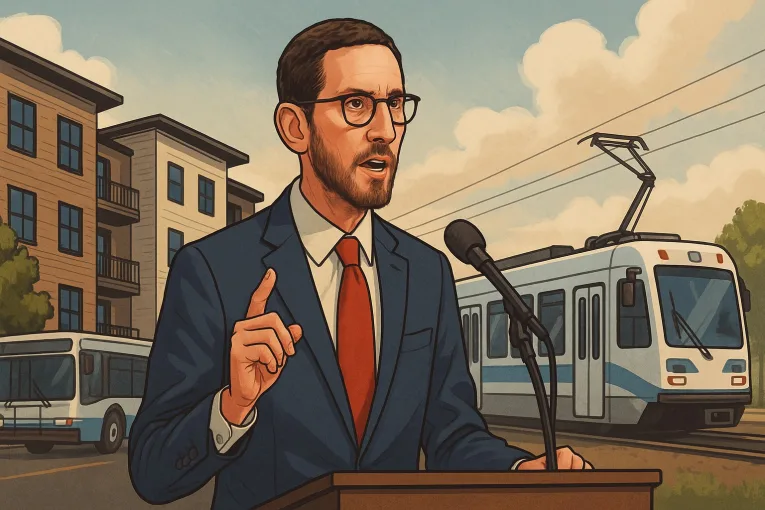
During this past week, the California Democratic Party (CADEM) endorsed State Senator Scott Wiener’s Senate Bill 79, this session’s major housing measure that would legalize multifamily homes near major public transit stops statewide.
The endorsement passed with a 111 to 62 vote, marking what many advocates are calling a major shift in the party’s approach to housing policy.
Jordan Grimes, a housing advocate, called the vote a sea change.
“Even just 5 years ago, CADEM embracing a position like this was unthinkable. The party was too dominated by anti-housing zealots and suburban homeowners. Today, the vote to support SB79 was 111 to 62. It’s nothing short of a sea change.”
The legislation, sponsored by Wiener, is intended to tackle California’s severe housing shortage by mandating up-zoning near transit hubs such as train stations, subway stops and rapid bus lines.
SB 79 would allow new apartments to be built near high-quality transit, setting building height limits tied to the level of service. Tier 1 stops could see projects up to 75 feet, Tier 2 up to 65 feet, and Tier 3 up to 55 feet within a quarter-mile of the transit stop. The legislation also scales height allowances further out, up to a half-mile from qualifying stops.
Supporters argue the measure will provide a crucial tool to meet the state’s housing needs while addressing traffic congestion, climate pollution and the growing affordability gap.
According to California YIMBY, SB 79 would ensure that between 7 and 13 percent of the new homes built are subsidized affordable units, while cities retain control over design standards, fees and permitting processes.
Wiener said the bill offers a chance to connect housing growth directly to climate goals.
“The California Democratic Party just voted to support our legislation to allow more housing near train & subway stations & rapid bus stops. SB 79 means more housing, stronger transit, less traffic congestion & lower carbon emissions,” Wiener said.
Rep. Katie Porter, who is running for Governor in 2026, also praised the move.
“I support it and was glad to see @CA_Dem endorse it this weekend. Workers, students, seniors and other Californians will all benefit from more housing—especially near transit,” Porter wrote.
The endorsement signals a political turning point for Democrats, who have historically been divided on the question of housing growth.
Five years ago, opposition from suburban homeowners and local officials often carried more weight in party politics.
The CADEM endorsement suggests that the party is now moving toward aligning itself with the state’s pro-housing coalition, including groups such as California YIMBY, Streets For All, SPUR, the Bay Area Council and the Greenbelt Alliance, all of which formally sponsor SB 79.
Still, the legislation faces significant pushback.
Los Angeles developer Rick Caruso said, “State and City of LA housing construction has been totally anemic, and it’s a significant driver of out of control housing costs which are boxing people out of owning a home. With SB 79, the State is right to encourage more housing, but it must be done with the full engagement and support of local officials and residents.”
Los Angeles Mayor Karen Bass announced her opposition last week unless the bill is amended.
“Today I signed a City Council resolution opposing SB79 unless it is amended to exempt cities with a state-approved and compliant Housing Element. While I support the intent to accelerate housing development statewide, as written, this bill risks unintended consequences for LA,” Bass said.
On the ground, grassroots coalitions have also mobilized against the bill. CBS 8 reported that Neighbors For A Better San Diego joined a statewide protest organized by Neighbors For A Better California. Opponents argued that the legislation’s language around bus stops is vague and could allow developers to take advantage of ambiguities in the law.
Marcella Bothwell, chair of Neighbors For A Better California, said, “That bus stop can be anything from just 15-minute frequency in the height of morning and evening. That will qualify as a bus stop. That 500 homes or a half a mile around that area, the height now can go up to six, to eight, even nine stories. These homes, there’s no affordability requirement. They’re not concerned about fire safety.”
Community advocate Charlie Nieto added, “All of it is basically catered to luxury housing, luxury apartments, specifically rental apartments. I understand there’s an argument that you gotta create more supply to lower prices, except you’re just not really seeing that housing trickle down.”
Housing advocates counter that SB 79 represents one of the few scalable solutions to California’s ongoing housing crisis. Nicole Lillie, executive director of Our Time To Act, told CBS 8 that the bill is vital to meet both housing and transportation needs.
“SB 79’s critical implementation and allowance of apartments to be built near high-frequency transit will allow for not only necessary housing to be built, but will also serve to start to curb the really severe car dependence that we have in California,” she said.
Lillie also said the bill ensures developers provide subsidized affordable homes.
California’s median home price now exceeds $900,000, requiring an annual income of $237,000 to afford, while the typical family earns less than half of that.
Rent increases have outpaced wages across much of the state, with particularly steep rises in places like Fresno County and San Diego County.
California has permitted about 100,000 homes annually in recent years, far short of the state’s target of 180,000 new units per year to meet demand by 2030.
Transportation costs also play a role.
Research shows that when housing near good public transit becomes unaffordable, people who depend on buses and trains are forced to move further away from their jobs.
A $230 rent increase leads to 22 percent fewer transit riders, according to studies cited by California YIMBY. This displacement forces more people to drive, worsening traffic congestion and pollution, and undermining billions in taxpayer investments in transit infrastructure.
SB 79 would apply only to specific, high-quality transit stops that meet strict criteria, meaning that most bus stops in the state would not qualify. The legislation is designed to focus growth near rail stations, rapid bus corridors with dedicated lanes, and high-frequency transit hubs in major metropolitan areas.
The bill has moved steadily through the Legislature since being introduced in January. It passed out of the Senate Housing Committee in April, the Senate Local Government Committee later that month, and the Senate Appropriations Committee in May. It cleared the Senate floor in June by a vote of 21 to 13, and advanced through the Assembly Housing and Local Government committees in July. It now awaits further action by the full Assembly.
With the endorsement of the state Democratic Party, Wiener and supporters hope momentum will carry SB 79 to final passage. But opponents, including some Democratic mayors and community groups, are prepared to keep fighting. The debate has now become a litmus test for California’s political future, balancing local control and concerns about displacement with the urgent need to build more homes.
The outcome could reshape the landscape of housing development near transit for decades to come.
Follow the Vanguard on Social Media – X, Instagram and Facebook. Subscribe the Vanguard News letters. To make a tax-deductible donation, please visit davisvanguard.org/donate or give directly through ActBlue. Your support will ensure that the vital work of the Vanguard continues.

From article: “SB 79 would apply only to specific, high-quality transit stops that meet strict criteria, meaning that most bus stops in the state would not qualify. The legislation is designed to focus growth near rail stations, rapid bus corridors with dedicated lanes, and high-frequency transit hubs in major metropolitan areas.”
Don’t know what “high frequency transit hubs” means, but glad to hear that most bus stops would not qualify (assuming that’s true).
I can see a scenario in which a given community rejects public transportation projects as a result of this, and possibly tries to change/reduce existing lines. (In other words, having a perverse impact in the “opposite” direction from what this bill supposedly encourages.)
Perhaps this (e.g., the definition of a qualified transit line) is where the legal battles (and endless delays) will occur, as well.
As far as Democrats are concerned, they declared war on cities a long time ago. It’s actually the Republican-leaning cities along the coast that are among the biggest opponents of the state’s new laws. (But not always – witness Los Angeles.)
“I can see a scenario in which a given community rejects public transportation projects as a result of this,”
This already happened with Atherton and Caltrain service with existing law.
And then there’s this (from the same article above):
Marcella Bothwell, chair of Neighbors For A Better California, said, “That bus stop can be anything from just 15-minute frequency in the height of morning and evening. That will qualify as a bus stop. That 500 homes or a half a mile around that area, the height now can go up to six, to eight, even nine stories. These homes, there’s no affordability requirement. They’re not concerned about fire safety.”
(The citation from my first comment above is in conflict with this. Is there any explanation for this difference?)
Talk about a recipe for blight.
“including groups such as California YIMBY, Streets For All, SPUR, the Bay Area Council and the Greenbelt Alliance, all of which formally sponsor SB 79.”
These are all direct developer vehicles or tools. I know how this works. I saw it the years I worked as executive director and did some lobbying for small nonprofit in Sac. Larger orgs would take a stand, and suddenly change their tune, and I found out they were getting money from consultants who would benefit from legislation, but nonprofits don’t have to disclose who is donating to them. It’s all so dirty, but all too legal.
I now these groups, and they are all knowingly or unwittingly (being blinded by their ideology) tools.
The approach seems right, but it’s all backwards. Our transit in CA is sh*t, and our investments in transportation all wrong. RIP any hope of reversing the I-80 widening with the recent decision – though the judge even said it was legal but didn’t agree it should be. We need to be investing tens of billions in heavy rail – such as an electrified, direct to San Francisco and Peninsula, Capitol Corridor with half-hour frequencies. That’s not cheap, and the time to have started this investment was in the 1950s.
But investing in housing around ‘quality’ transit in California is all backwards. Build the transit, and the investment in housing and land use will follow naturally. You can’t force bad transit on people and expect vehicle use to decrease. But all the developers care about is build baby build. Agenda 21 isn’t a U.N. conspiracy, is a developers using progressive nonprofits as tools conspiracy.
Alan – I think you are the one that has it backwards. SB 79 is designed to flip the script. The bill assumes that clustering more people near transit stops generates the ridership and political will needed to improve and expand service. In this view, more housing near transit corridors creates a base of riders, which in turn encourages transit agencies and governments to invest in better service.
Since sprawl already exists (and the state is continuing to allow more of it), those houses aren’t going to suddenly be abandoned.
What this is actually about is a “goal” to continue growing the population of the state. Business interests are behind this.
Now, if they simultaneously took any steps whatsoever to discourage more sprawl, they’d at least have (some) credibility regarding funneling future growth into more “climate-friendly” locations.
Of course, the population itself isn’t really growing anymore in the first place. (And those interests are clearly not happy about that.)
In any case, this will never address the price discrepancy that causes newcomers to seek housing where it’s farther and cheaper.
Oh BS, DG.
You can’t magically wish transit to become quality, the state actually has to change its priorities and invest in it. You can model all this, and people don’t take transit unless it is fast, frequent, convenient — and actually gets them where they are going in less time than driving. We are decades behind, and all that clustering people around carp transit with parking maximums will do is create traffic and parking frustration. You and this entire state needs to get a head-out-of-arse-ectimy.
You also can’t build transit when the housing isn’t set up for it.
How do you explain the fact that some robust public transit systems ALREADY exist to serve the EXISTING population? (Muni, BART, etc.)?
Were they built decades ago, in anticipation of the rise of the YIMBYs decades later? (Because that’s what’s implied in your comment – that they’re unsustainable as is.)
Sort of like how some people claim that downtowns are suddenly unsustainable, without residential highrises. Despite thriving for decades.
(Same thing regarding public transit. It seems like those who advocate for it have never actually used it. I can personally attest to buses and light rail which were too tightly-packed to even board. This was not a “rare” occurrence.)
I routinely had to stand on the bus – even on the Express bus from Davis to Sacramento.
Ron, this is all brought to you by the same people who burdened California with the Bullet Train to Nowhere. So that shows there expertise on transit solutions.
Yeap.
The bullet train “could have been great”, if they established the rail line between San Francisco and Los Angeles 100 years ago. (Actually, not quite sure if there is some type of similar rail line already, but perhaps they just can’t use it for a bullet train.)
In any case, forget about all this “Modesto” nonsense.
Maybe there’s still hope for some kind of relatively high-speed rail between the Sacramento region (and wherever that line ends – Emeryville? Or at least a viable connection to BART, at that point).
But whenever you have to transfer to another system, a lot of efficiency is lost.
In any case, I’ll personally still be driving during the times I have to travel in that general direction, and I’ll continue blaming “everyone else” for the traffic.
I’m halfway convinced that if you interviewed everyone causing traffic jams, they wouldn’t be able to justify the reason that they’re there in the first place. Other than they got a group text that it’s time to give “Ron” a hard time, again.