
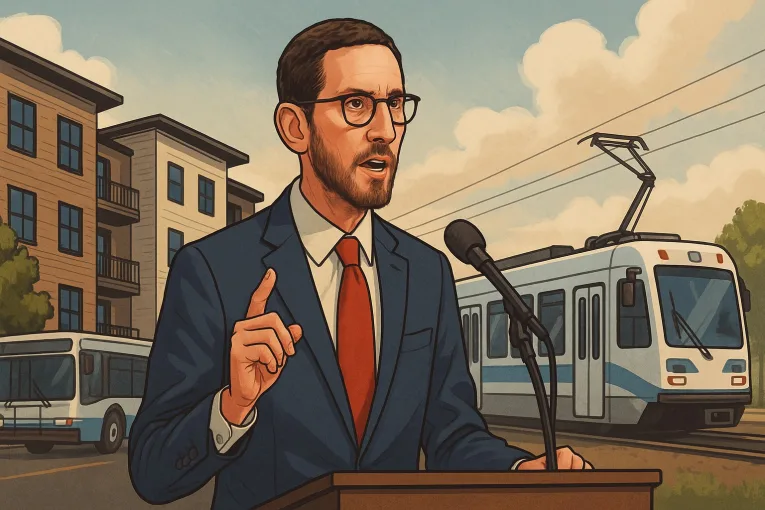
Key points:
- California lawmakers consider Senate Bill 79 to lower housing costs.
- SB 79 requires cities to allow more housing near transit stops.
- Families in LA County spend over $14,000 annually on transportation costs.
LONG BEACH — As California lawmakers weigh Senate Bill 79, local advocates in Long Beach are making the case that the measure is critical to lowering housing costs and aligning state transit investments with affordable housing.
SB 79, authored by Sen. Scott Wiener, would require cities to allow more housing near transit stops, including mid-rise apartments within a half-mile of rail stations and frequent bus lines. The bill has already cleared the Senate and is moving through the Assembly with final votes expected in early September.
Supporters say the bill directly addresses the state’s affordability crisis. A commentary in the Signal Tribune from members of Everybody’s Long Beach, a grassroots organization, argues that exclusionary rules have made it nearly impossible to build affordable apartments and starter homes near public transit.
“Too many hardworking people from all walks of life are being priced out of the neighborhoods they helped to build,” the group wrote, stressing that SB 79 would help reverse this trend.
The authors pointed to the Wardlow Station on the Metro A Line as an example of wasted public investment. Despite millions in state funding for improvements, the station received a failing grade in a statewide study due to its lack of nearby housing and jobs. A UCLA study cited in the op-ed found that for every $230 monthly rent increase near transit, ridership drops by 22 percent.
Statewide leaders have echoed similar concerns. “California’s disconnect between our public transit investments and our housing policies is failing our communities — and we urgently need reform,” wrote Reps. Laura Friedman and Scott Peters in a joint commentary.
Housing advocates also point to the broader economic stakes. Tracy Hernandez, CEO of the New California Coalition, wrote that “when workers can’t afford to live near their jobs, businesses lose talent to other regions. And eventually, businesses themselves move.” She noted that since 2018, more than 100 corporate headquarters have left Los Angeles, many relocating to Texas.
Hernandez highlighted research showing that 75 percent of employers say housing costs affect worker retention, forcing companies to raise wages beyond sustainable levels. “These expensive fixes increase operating costs without solving the underlying problem,” she wrote.
Housing costs in Los Angeles County are now among the highest in the nation. Hernandez noted that housing accounts for 77.6 percent of median income in L.A. compared to 39.6 percent in Austin. A family of four earning $111,000 is considered “low income” in L.A., a level that elsewhere might be squarely middle class. While Austin’s talent pool grows by 4.1 percent a year, L.A.’s has shrunk by 0.2 percent.
For workers and families, the consequences are personal and costly. Monica Rivera, a real estate sales manager and chair of the Gateway Cities chapter of Abundant Housing LA, described how families are displaced to the edges of the region and face long, exhausting commutes.
“Thousands of Angelenos are stuck with costly, exhausting commutes because they can’t afford to live near their jobs, burning through more than $14,000 a year on transportation — much of it on car payments, gas and maintenance,” she wrote in CalMatters.
Rivera added that her niece once woke up at 3 a.m. to take four buses to class at Rio Hondo College, and her younger sister at Cal State Long Beach sometimes paid $50 to $60 each way for rideshares due to poor transit access from home. “In L.A. County, families earning the median income of $88,000 can’t afford sky-high rent, much less a median home price approaching $1 million,” she wrote.
Supporters of SB 79 argue the measure would deliver not only affordability but also climate and transportation benefits. Households near transit spend about 40 percent less per year on transportation, according to the Mineta Transportation Institute at San Jose State University. Studies show that families living near reliable transit drive nearly 50 percent fewer miles than those in car-dependent neighborhoods.
Advocates also stress that California has already invested billions in new transit infrastructure, including upgrades to the Metro A Line and expansions of the D Line to Century City and Westwood. Yet these investments risk being undermined without corresponding housing near stations. Friedman and Peters wrote that “by building housing near transit stops, we provide a greater return on investment for taxpayers, as farebox returns improve with increased ridership.”
Examples of successful transit-oriented housing already exist. In Long Beach, the Midtown Specific Plan enabled The 101, a 52-unit permanent supportive housing project located within walking distance of the Pacific Coast Highway station. The development will provide stability for families, help seniors avoid displacement, and allow workers to remain close to their jobs.
SB 79 builds on earlier reforms like AB 2097, which eliminated parking minimums for new developments near transit. Together, these measures are intended to reduce development costs and make building housing more feasible.
Despite widespread support from pro-housing groups such as California YIMBY, the bill has faced opposition from some local governments and slow-growth advocates who argue it threatens local control and neighborhood character. But supporters counter that SB 79 still leaves cities flexibility over design and affordability standards while requiring them to permit more homes near transit hubs.
“Today is a landmark moment — for California, for the YIMBY movement, and for everyone fighting to keep the California Dream alive,” said Brian Hanlon, CEO of California YIMBY, after SB 79 cleared the Assembly Local Government Committee last month. “With the Assembly Local Government Committee advancing SB 79, the Legislature just brought us one big step closer to making California more affordable for everyone.”
Hanlon described the bill as the culmination of years of advocacy. “SB 79 is the product of seven years of listening, learning, and adapting,” he said. “We’ve worked with local and state leaders, community advocates, builders, and others to craft a smart, flexible policy that can work in communities across the state. This bill proves that we can tackle the housing crisis with both urgency and nuance.”
If enacted, SB 79 would legalize increased housing density in areas currently off-limits to development due to restrictive local zoning. Housing would be allowed within a half-mile radius of high-frequency transit corridors, including BART, Caltrain, LA Metro Rail and rapid bus lines.
California is not alone in pursuing such reforms. States like New Jersey, Colorado and Utah already encourage housing near transit, and Washington is considering similar legislation. Cities in Maryland, Texas and Florida are also aligning transit investments with housing access.
Hernandez wrote that “state legislators must pass SB 79 or risk economic decline as other metropolitan areas permanently capture the next generation of businesses and workers.”
Friedman and Peters put it more bluntly: “We can no longer invest billions on public transportation while artificially constraining who gets to live close enough to use it.”
If SB 79 passes the Assembly, it will head to Gov. Gavin Newsom, who has supported similar housing streamlining measures but has not yet taken a position on the bill.

From article: “Tracy Hernandez, CEO of the New California Coalition, wrote that “when workers can’t afford to live near their jobs, businesses lose talent to other regions. And eventually, businesses themselves move.” She noted that since 2018, more than 100 corporate headquarters have left Los Angeles, many relocating to Texas.”
Sounds like the problem is creating its own solution.
“Thousands of Angelenos are stuck with costly, exhausting commutes because they can’t afford to live near their jobs, burning through more than $14,000 a year on transportation — much of it on car payments, gas and maintenance,” she wrote in CalMatters.
I flat-out don’t believe that number, and I have more than one vehicle. Pretty sure I know how much it costs, and it’s nowhere near that number. In any case, the “solution” being implied here is suggesting that this cost would “disappear”, when there’s no evidence (as in NONE) that anyone would give up their cars and driving.
The other false implication is that housing costs would (correspondingly) be reduced by at least $14,000 per year in order to incentivize workers moving closer to their jobs, but that communities that are farther away would experience no such reduction in the cost of housing. (None of that makes sense, either.)
Also, perhaps those living far from their jobs need to find a job closer to their house; and not the other way around.
Or more to the point, go along with the “problem-created solution” described above (jobs leaving for cheaper areas).
Lots of jobs DEPEND ON having a vehicle – including all of the trades.
When was the last time you saw a landscaper bring his mower onto a bus? (Never mind – I realize they’re outlawing yards and external waters usage as a result of all this, as well.)
Maybe officials should first figure out the reason that public transit is declining in areas that already have robust systems and already-dense housing.
Ron O
AAA says the average cost per mile driven is $0.82. https://newsroom.aaa.com/wp-content/uploads/2024/09/YDC_Fact-Sheet-FINAL-9.2024.pdf Several sources give a range of average miles per year driven for California (and its higher in LA) of 11,000 to 14,000 (which is consistent with CARB EMFAC modeling). https://www.caranddriver.com/auto-loans/a32880477/average-mileage-per-year/ That equals $11,500 per year for a statewide average and ignores factors such as the cost of parking and insurance which is higher in LA. So no surprise in that number.
While some jobs, such as landscaping, depends on having a car, many more jobs do not. Retail, restaurants, office work, professional services are just few examples with both constitute the majority of employment and do not require a car. Your anecdotes and uninformed speculation do nothing to advance the conversation.
And public transit is rebounding from the pandemic in areas with good service. The return to office trend will drive transit ridership in the near term.
From your chart, it appears that the cost includes depreciation, insurance, license and registration, etc. – for an average NEW car.
Try calculating those costs for an older, smaller vehicle. My vehicles are not losing value at this point (and one of them might be INCREASING in value).
The cost of my vehicles is nowhere near as much as that listed in the chart. That’s not anecdotal – it’s factual (and would be for anyone who has vehicles like mine). And that would still be true if I drove them more than I do.
But again, what makes you (or anyone else) think that workers would abandon the suburbs to live in an environment where you get LESS for you money, and ALSO have to give up their own vehicles? What planet does that happen on?
A more “honest” comparison would be to include much of those same costs REGARDLESS of how far one is from work. Also, what makes you think that distance is the only factor in regard to the use of public vs. private transportation? You are aware that BART goes out to Pittsburg, for example, right?
The people who have made the choice to live in far-flung suburbs are ALREADY calculating-in their costs (including the cost of driving), and have ARLEADY DECIDED that the lower cost of housing which is farther-away more than offsets the cost of driving farther. They’re “voting” with their own dollars.
And nothing is going to change that equation. If housing becomes cheaper in cities as a result of increased density (which isn’t likely – since the OPPOSITE almost always occurs), then housing in communities which are farther away ALSO becomes cheaper. Which means that they’ll still choose the “cheaper” (more-distant) option.
None of this makes any sense.
So unless you can find a way to make housing cheaper in cities, without ALSO making it cheaper in far-flung suburbs, the DIFFERENTIAL will still exist (and many people will STILL choose the far-flung suburbs. (This is common sense, and has been occurring ever since the development of motor vehicles (and to some degree, public transit).
In what world do you live in, in which occupants of far-flung suburbs suddenly abandon their housing to live in dense cities? And what would happen to those far-flung suburbs if that actually did occur?
Has anyone even thought about any of this?
Public transit is NOT rebounding – where did you hear that? Have you been paying attention to BART and MUNI’s deficits, for example?
Despite what David claims here, SB 79 is apparently in trouble. I just received the following email from “Our Neighborhood Voices”:
https://mailchi.mp/a2f06d196083/a-commitment-to-truth-exposing-the-myths-shaping-californias-housing-debate-12850336?e=afb24801a1
You’re using a campaign email as evidence?
Are you kidding me, in regard to your own articles? Yes, campaigns are a sign of resistance.
But would you like to respond to any of my other points? You think people are going to move from distant suburbs as a result of more-dense housing in cities? And are going to give up their cars as part of that move?
What “evidence” do you have for THAT? And yet (without ANY evidence whatsoever), that’s apparently the solution to a non-existent problem.
Now, if you want cities to grow, just say so. Because that’s really what this is about.
And if you’re concerned about far-flung suburbs, what are you doing about the continuing sprawl that’s occurring? And what are the YIMBYS doing about THAT?
All of this exposes them for what they are. They couldn’t care less about sprawl, climate change, equity, or any of the other b.s. they put forth. They care about those who FUND them – and those are BUSINESS interests.
No, I don’t want to respond to any of your other points. There’s no point to discussing or debating anything with you.
No one asked you or Richard to respond to my comment.
But it is interesting, in that there’s apparently no thought behind this in regard to what the impact would be, if citizens abandoned suburbs in mass. Especially since the population is essentially not growing.
Au contraire
Well, you can certainly respond without actually stating anything of importance.
The campaign email that was sent to me does state that the Los Angeles Council voted to oppose SB 79.
And the YIMBY’s aren’t too happy about it (which certainly makes me smile):
“LA’s leaders are demonstrating their cowardice — the state legislature needs to act”
https://cayimby.org/news-events/press-releases/california-yimby-statement-on-la-city-council-vote-on-sb-79/
Personally, I think it’s important to point out that Davis’ representative (Cecilia Aguiar-Curry) has consistently aligned herself with YIMBY interests (as has the entire Davis council, for the most part).
This is also the problem with the system itself – the Democrats have essentially turned into Republicans – almost all of them. There’s no real choice, by the time a name appears on the ballot.
If anything, it’s the local Republicans/moderates who will end up derailing the state.