
Key points:
- California’s median home price hits $899,560 in June 2025, double the state’s median household income.
- Los Angeles permits fewer homes in 2024 than in 2023, exacerbating the housing shortage.
- California is losing 700,000 residents annually due to high housing costs.
Claremont City Councilmember Jed Leano, writing in a Pasadena Now column, said the affordability problem stems from a scarcity of homes and a political process that too often empowers obstruction over solutions.
Leano pointed to the latest data on the cost of buying a home. California’s median home price hit $899,560 in June 2025, a figure that means a household would need to earn $237,000 annually to qualify for a mortgage. That amount is more than double the state’s median household income. He noted that, while demand continues to grow, Los Angeles permitted fewer homes in 2024 than in 2023.
“Housing is unaffordable because it’s scarce — and new homes are nearly impossible to build,” Leano wrote. He argued that the problem is not a lack of potential solutions, but a system in which entrenched interests dominate local housing approval processes.
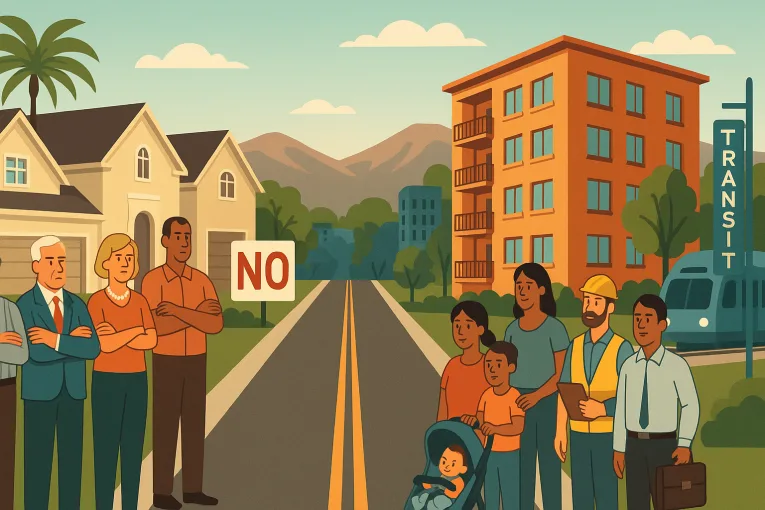
Citing studies from Boston University in 2017 and the University of North Carolina, Chapel Hill in 2024, Leano said researchers found “older, male, longtime-resident homeowners dominate participation in these meetings.” He said this pattern holds across Los Angeles County, where wealthy residents often mobilize to block proposals for new homes.
Those efforts are often successful, Leano argued, leaving middle-class families, teachers, and nurses with few options close to their jobs. “Our teachers, nurses, and middle-class families are increasingly forced to live far from where they work,” he wrote.
At the same time, he said, younger families — the very people most in need of affordable, entry-level homes — are largely absent from these meetings. Parents working long hours do not have the time or resources to participate in late-night council hearings. Leano added that “progressive cities that talk a good game on promoting equity nevertheless amplify white homeowner voices in making decisions about housing — while silencing communities of color, young families, and working people.”
That imbalance, he said, has produced a system that protects the property values of established homeowners while worsening inequities for new generations of Californians.
Leano is backing SB 79, a state housing bill now under consideration in the Legislature. The proposal would allow more housing to be built near publicly funded transit stops, bypassing some of the approval hurdles that give veto power to homeowners opposed to new development. He argued that the legislation would help reintroduce the kinds of moderately-sized apartments that once formed the backbone of affordable housing in California cities.
“The bill allows home builders to construct the types of homes that used to be legal in our cities — moderately-sized apartments, with heights that vary based on proximity to good transit,” he wrote. “These types of homes are the backbone of an affordable city.”
The homes envisioned under SB 79 would be located close to jobs, schools, and public amenities, and would give working families access to public transit and shorter commutes. Supporters argue that the bill would begin to reverse decades of restrictive zoning that has limited housing growth and driven up prices.
Opponents have argued the measure strips away local control. But Leano countered that local control currently reflects only the loudest voices in the room, which often belong to established, affluent homeowners. “What you rarely hear are the concerns of young families and new Californians looking for their first home,” he wrote.
He added that cities have had decades to act but have failed to address the crisis. “Progressive communities that pride themselves on equity have instead perfected systems that contradict their stated values,” he wrote.
The result, he noted, is brutal. California is losing 700,000 residents annually to other states, with housing costs cited as the main reason. In Leano’s view, SB 79 is not just about easing a housing shortage but about confronting a political system that prioritizes current property owners over future ones.
“SB 79 is about more than housing policy—it’s about changing an archaic system that prioritizes established property owners over future ones,” he wrote. “It’s about building homes for our children and newer Californians so the next generation can live in the communities they’ve always been proud to call home.”
Leano framed the policy choice clearly: “Continue a system where obstructionists control housing decisions at everyone else’s expense, or build communities that are affordable to working families.”
He concluded by invoking the history of California as a place that has long attracted immigrants, workers, and dreamers seeking opportunity. In his view, the current housing debate is a test of whether the state can still deliver on that promise. “SB 79 is about restoring a vision of California that has inspired past generations of Californians — immigrants, innovators, and visionaries — and building homes in our cities so future generations can have a shot at the California dream,” he wrote.
Leano, in addition to serving on the Claremont City Council, is Senior Policy Adviser at the Inner City Law Center and a Board Member of the Los Angeles County Affordable Housing Solutions Agency. He previously lived in Pasadena, where he served as the 80th President of the Pasadena Jaycees and National Legal Counsel for the United States Jaycees.
Follow the Vanguard on Social Media – X, Instagram and Facebook. To learn make a tax-deductible donation, please visit davisvanguard.org/donate or give directly through ActBlue. Your support will ensure that the vital work of the Vanguard continues.
