
By Vanguard Staff
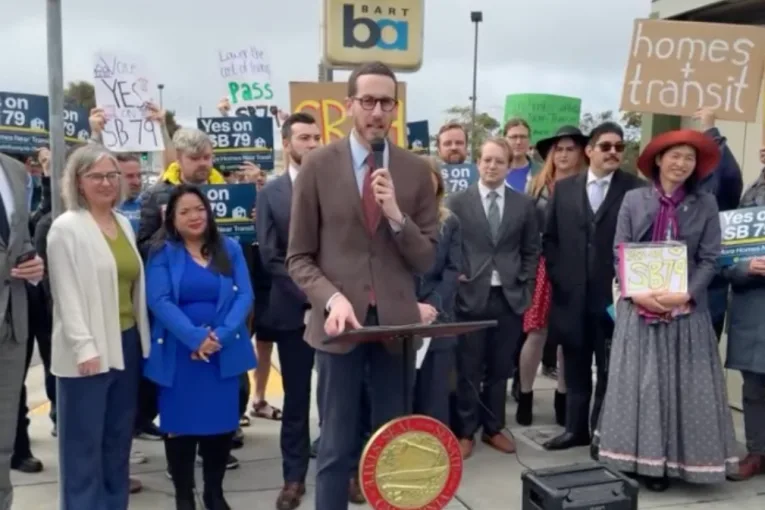
SACRAMENTO — Greenbelt Alliance is throwing its weight behind Senate Bill 79, the Abundant and Affordable Homes Near Transit Act, as the measure advances to the Assembly floor. The group has positioned the legislation, authored by Sen. Scott Wiener, as a critical tool for addressing California’s housing shortage while steering growth away from wildfire- and flood-prone areas.
Greenbelt Alliance announced earlier this year that it was co-sponsoring the bill along with California YIMBY, SPUR, Streets for All, and the Bay Area Council. The coalition has underscored that SB 79 would make it easier and faster to build new homes near major transit stops, including BART, Caltrain, and bus rapid transit corridors. At the Daly City BART station in March, the group stood alongside Wiener as the proposal was rolled out to the public.
Jordan Grimes, Greenbelt Alliance’s State and Regional Resilience Manager, said the measure addresses multiple crises at once. “This reduces the benefits to clean air and water that our open spaces provide and means dramatic increases in GHG emissions from super-commutes, as well as putting people directly in harm’s way — in areas with severe climate hazards like wildfires, floods, and extreme heat,” Grimes said. “SB 79 will make it easier and faster to build new housing around transit in our existing communities, helping to reverse those trends and create a more affordable and resilient California.”
The bill proposes a tiered zoning framework around transit hubs that allows mid-rise apartments and greater density near the highest quality transit stations. It ties the allowable size of developments to the frequency and capacity of the system itself, permitting taller buildings near heavy rail and smaller increases around lower-capacity lines. Projects within those zones would also qualify for permit streamlining to cut down on delays.
Another key component allows transit agencies to exercise authority over zoning of their own land, opening the door for them to generate revenue and boost ridership by building housing directly on underutilized properties. Supporters argue that empowering agencies to take this step is crucial at a time when many are facing financial shortfalls.
Greenbelt Alliance has highlighted the climate dimension of the legislation, pointing to the state’s history of sprawl development that has both worsened the affordability crisis and pushed families into high-risk areas. By directing housing growth into existing communities near transit, the group argues SB 79 can reduce greenhouse gas emissions, cut down on super-commutes, and protect natural and working lands.
For Wiener, the bill represents an evolution of his earlier efforts to tackle exclusionary zoning. He has described SB 79 as a “nuanced and surgical” approach focused on major transit hubs rather than blanket statewide upzoning. “California urgently needs to build more homes to bring down costs, and building them near transit provides our public transportation systems with an urgently needed infusion of new riders,” Wiener said.
The legislation has advanced steadily through the Capitol. It passed the Senate in June by a 21-13 vote, moved through Assembly policy committees during the summer, and survived the Assembly Appropriations Committee in late August. It is now eligible for a final Assembly floor vote before the mid-September deadline.
Housing and environmental advocates have consistently framed the bill as a landmark step. California YIMBY’s Brian Hanlon called its advancement “a landmark moment … bringing us one big step closer to making California more affordable for everyone.” SPUR policy director Michael Lane added that the bill’s provisions are modest compared to fears of overdevelopment. “These are not skyscrapers that we are asking for,” Lane said, stressing that small- to mid-rise density is enough to strengthen transit ridership and expand housing access.
Opposition has also surfaced, particularly from some city leaders and neighborhood groups who warn that the measure undermines local land-use authority. Geoffrey Hueter of Neighbors for a Better San Diego argued that SB 79’s definition of transit proximity could open the door for large-scale projects in areas that lack robust service. Los Angeles Councilmember Imelda Padilla criticized the bill on a podcast appearance, saying that allowing seven-story buildings near transit was “an insult to everyone who voted for the individual who they believe is going to help grow … their communities as they would like them to be.”
Despite those critiques, Wiener has insisted that SB 79 still allows for design standards and community input, even as it establishes uniform state requirements to address what he and his allies describe as a persistent failure of local governments to plan for enough housing.
Greenbelt Alliance has continued to frame the stakes in urgent terms. With housing costs rising, wildfires and floods worsening, and transit agencies under pressure, the group argues that California can no longer afford fragmented approaches. Directing housing toward infill, they say, is both a housing solution and a climate solution — and SB 79 is the vehicle to get there.
Follow the Vanguard on Social Media – X, Instagram and Facebook. Subscribe the Vanguard News letters. To make a tax-deductible donation, please visit davisvanguard.org/donate or give directly through ActBlue. Your support will ensure that the vital work of the Vanguard continues.

Doesn’t surprise me. Greenbelt Alliance is a tool for the developers, and just like with referendums with “green” in the name all get voted in because Greenies are too stupid to look any deeper than the color green, so too are we deceived by nonprofits with the name “green” as well.
I was a member of Friends of Lagoon Valley — a grass-roots citizens group based in Vacaville — decades ago trying to stop Lagoon Valley from being developed. The group fought for years, but eventually Greenbelt Alliance and the Solano Land Trust stepped in. You may notice Lagoon Valley is now being developed. To quote “E. A. D.”, a Vacaville citizen who also saw what these organizations did:
“Greenbelt Alliance’s actions negated two community supported referendums that would have protected Lagoon Valley, Solano County, in order to enter into an ill-conceived settlement agreement with Triad, the developer. As time passed, rather than ensure enforcement of the settlement agreement, the last line of defense to protect Lagoon Valley, Greenbelt Alliance instead partnered with Triad’s key person, Curt Johansen, on other Bay Area projects. The loss of Lagoon Valley, an environmental gem, is directly attributed to Greenbelt Alliance’s action and inaction.”
The developer’s website now touts that their development conforms to Greenbelt Alliance’s ‘sustainability standards’. Yes, they destroyed a beautiful undeveloped basin, but the development meets Greenbelt Alliance’s standards for a development that the developer advertises. You can’t make this S up, but all you greenies are being duped. NOW, Greenbelt Alliance is “fighting” California Forever as the lead organizer ‘against’ them. What do you want to bet a similar scenario occurs with Greenbelt as the ‘hero’ ‘negotiating’ with the evil Silicon Valley cabal — it is almost assured.
So it doesn’t surprise me one bit to hear those Greenbelt YIMBY-tools are supporting Weiner shill’s build-baby-build bill. Wake up everyone! You think you are green but you are just part of their machine.
I’m not being duped, and I already knew this from your previous comments (which I appreciate).
It’s an absolute and complete disgrace.
Truth be told (and I know you may not agree regarding this), the “greenies” as you put it are also selling out to tribal interests – on a massive scale. I’ve been following this pretty closely.
It’s enough to cause me to stop joining these groups. Ironically (in regard to its name), this includes the Trust for PUBLIC Land, as well as most other land preservation organizations. I’ve been permanently banned from some of their Facebook pages – apparently for pointing this out in a factual manner. (This was essentially acknowledged by one of those organizations, when the representative noted that my comments may dissuade their donors.)
Perhaps I’ll live long enough for these organizations to return to their actual missions.