
Key points:
- Federal court blocks Trump Administration’s use of federalized California National Guard troops for law enforcement in Los Angeles.
- U.S. District Judge Charles R. Breyer rules that the deployment violated the Posse Comitatus Act and infringed on state sovereignty.
- The ruling may be appealed, leaving the conflict between state and federal authority unresolved.
OAKLAND — A federal court on Tuesday permanently blocked the Trump Administration from using federalized California National Guard troops and U.S. Marines for law enforcement in Los Angeles, ruling that the deployment violated the Posse Comitatus Act and infringed on state sovereignty.
In a sweeping decision, U.S. District Judge Charles R. Breyer of the Northern District of California concluded that President Donald Trump and Defense Secretary Pete Hegseth “violated the Posse Comitatus Act willfully” by ordering troops to engage in policing functions during the summer deployment.
“The record is replete with evidence that Task Force 51 executed domestic law in these prohibited ways,” Breyer wrote. “Moreover, Defendants violated the Posse Comitatus Act willfully … Defendants knowingly contradicted their own training materials, which listed twelve functions that the Posse Comitatus Act bars the military from performing … They did so while refusing to meaningfully coordinate with state and local officials … And they ‘coach[ed]’ federal law enforcement agencies as to what language to use when submitting requests for assistance in an attempt to circumvent the Act. These actions demonstrate that Defendants knew that they were ordering troops to execute domestic law beyond their usual authority. Whether they believed that some constitutional or other exception applied does not matter; ‘ignorance of the law is no excuse.’”
Breyer’s ruling permanently enjoined the administration from using troops in California to engage in arrests, apprehensions, searches, seizures, security patrols, traffic control, crowd control, riot control, evidence collection, interrogation, or acting as informants.
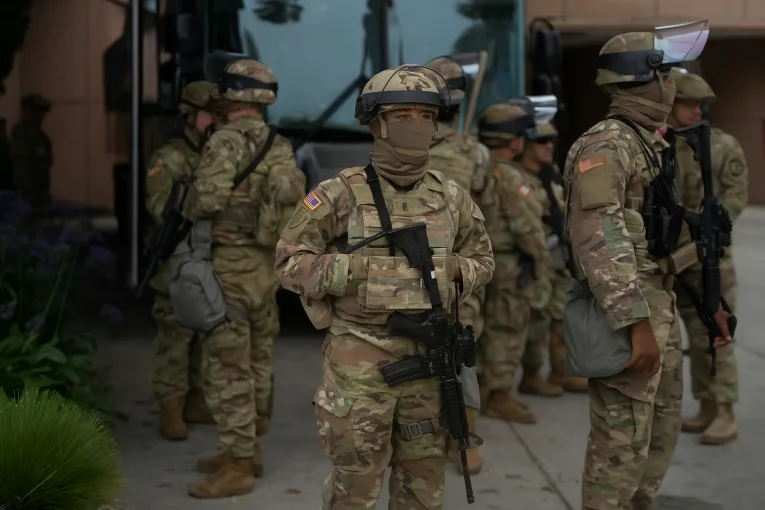
The decision came after Governor Gavin Newsom and Attorney General Rob Bonta sued to block the June federalization of 4,000 California National Guard troops and 700 Marines. The deployment, triggered by immigration enforcement operations across Los Angeles, continued even as local protests subsided.
The court found that the administration expanded the mission beyond protecting federal buildings, sending troops into immigration raids, narcotics operations, and crowd control missions far outside Los Angeles.
Congress, Breyer emphasized, spoke clearly in 1878 when it passed the Posse Comitatus Act to bar the use of the U.S. military to execute domestic law. “Nearly 140 years later, Defendants—President Trump, Secretary of Defense Hegseth, and the Department of Defense—deployed the National Guard and Marines to Los Angeles, ostensibly to quell a rebellion and ensure that federal immigration law was enforced. There were indeed protests in Los Angeles, and some individuals engaged in violence. Yet there was no rebellion, nor was civilian law enforcement unable to respond to the protests and enforce the law.”
The judge detailed how federalized troops in Los Angeles, often indistinguishable from ICE agents, carried out patrols, roadblocks and crowd control. Military training slides, admitted into evidence, specifically warned that such activities were prohibited under the Posse Comitatus Act. Despite this, Task Force 51 commanders told troops they could carry out security patrols, traffic control, crowd control and riot control under a supposed “constitutional exception” to the Act.
Breyer said the administration’s actions amounted to an effort to build a federal police force.
“President Trump and Secretary Hegseth have stated their intention to call National Guard troops into federal service in other cities across the country—including Oakland and San Francisco, here in the Northern District of California—thus creating a national police force with the President as its chief,” he wrote.
Trump himself had declared in an August 26 cabinet meeting: “I have the right to do anything I want to do. I’m the President of the United States. If I think our country is in danger, and it is in danger in these cities, I can do it.”
The court also ruled that California had standing to challenge the deployment. “Because Defendants’ alleged violations of the Posse Comitatus Act include allegations that Task Force 51 troops have engaged in law enforcement—a domain traditionally within the state’s control—California has suffered an injury that gives it standing to challenge those violations.”
Breyer rejected the argument that the reduction of forces to 300 Guard members made the injunction unnecessary. “Defendants mention that only 300 National Guard troops remain stationed in Los Angeles, suggesting that injunctive relief is unwarranted because their footprint is smaller than it was in early June. Their point is not well taken. Those 300 National Guard troops are set to remain deployed through November, see Aug. 5 Activation Order, and they have already been improperly trained as to what activities they can and cannot engage in under the Posse Comitatus Act.”
In the wake of the ruling, Governor Newsom filed for a preliminary injunction seeking to halt the continued deployment of 300 federalized Guard members in Los Angeles through Election Day. “The timing of Trump’s extension of the National Guard soldiers isn’t coincidental—he’s holding onto soldiers through Election Day,” Newsom said. “There was never a need and there is not a need now for soldiers to be deployed against their communities. The federal government hasn’t even tried to justify keeping the military in Los Angeles because they can’t. The reality is this—they want to continue their intimidation tactics to scare Californians into submission.”
Attorney General Bonta also criticized the extension. “The Trump Administration continues to hold our National Guard servicemembers hostage as part of an unprecedented attempt to militarize American streets,” he said. “The initial federalization and deployment of these troops was unjustified—their redeployment for an additional 90 days is absurd. We’re asking the court to block implementation of this latest order, and we are confident that given the facts—or lack thereof—underpinning this order, the court will agree.”
The state’s preliminary injunction filing argued that the deployment chilled public participation and undermined confidence in the upcoming November special election, where Californians will vote on new congressional maps under Proposition 50. “If allowed to stand, this new federalization order would ensure that California’s residents will remain under a form of military occupation until early November—including while they vote in the Statewide Special Election on November 4, 2025, on whether to adopt new congressional maps pursuant to Proposition 50—an election with national attention and significance,” the filing stated.
The state also warned of irreparable harm. “This unlawful deployment irreparably injures the State of California by violating the State’s sovereignty and Governor Newsom’s rightful authority over the California National Guard, escalating tensions with civilians, harming California’s economy, chilling participation in the upcoming election, and harming the morale of National Guard troops,” the filing said.
California’s complaint detailed how Guard troops were pulled away from civilian roles. Of the 4,000 initially federalized, many were taken from jobs as teachers, first responders, corrections officers, technology specialists and agriculture workers. Typically, about 450 Guard members are deployed statewide under the governor’s command, including in counterdrug operations at ports of entry. Those personnel were reassigned to Los Angeles by federal order, disrupting state missions.
Court records showed how troops were used far beyond federal building protection. On June 18, more than 300 Guard members and 50 military vehicles were deployed to a marijuana raid in Mecca, more than 140 miles from Los Angeles, despite no identified threat. On July 7, troops supported armed federal agents in MacArthur Park, in what DHS described as an immigration enforcement operation, but which internal Task Force 51 documents described as a “show of presence” to demonstrate federal maneuverability in Los Angeles.
The judge found that such missions, often justified by vague or nonexistent threats, underscored the unlawful nature of the deployment. “Without injunctive relief, California would lack any remedy against Defendants’ unlawful use of the U.S. military in a way that infringes on California’s police power and risks economic and other harms to California’s residents … It is ahistorical and illogical to think that Congress reacted to this by passing a statute that had as its sole enforcement mechanism federal prosecution of individual troops by the same federal government that would have ordered the troops to engage in domestic law enforcement.”
Breyer rejected the administration’s argument that 10 U.S.C. § 12406(3) authorized the deployment. “The Court will not take Defendants’ invitation to create a brand-new exception to the Posse Comitatus Act that nullifies the Act itself … President Trump did not rely on the Insurrection Act when he federalized the California National Guard … This is, perhaps, a tacit admission that President Trump would be unable to make the showing, required under the Insurrection Act, to rebut the presumption that state and local officials in Los Angeles were unable or unwilling to act … The Court therefore concludes that § 12406(3) is not an exception to the Posse Comitatus Act. If the President wants to avoid the Act’s restrictions, he must invoke a valid exception—like the Insurrection Act, along with its requisite showing that state and local law enforcement are unable or unwilling to act.”
The case began June 9, 2025, when California filed suit the day after Trump federalized the Guard. The court initially granted a temporary restraining order, but the Ninth Circuit stayed it, concluding Trump had a colorable basis under § 12406. The case returned to Breyer on the merits, focusing squarely on the Posse Comitatus claim.
The judge’s order now permanently bars the administration from using the military in California for law enforcement purposes. “The Court ORDERS that Defendants [Trump Administration] are enjoined from deploying, ordering, instructing, training, or using the National Guard currently deployed in California, and any military troops heretofore deployed in California, to execute the laws, including but not limited to engaging in arrests, apprehensions, searches, seizures, security patrols, traffic control, crowd control, riot control, evidence collection, interrogation, or acting as informants,” Breyer wrote.
The administration is expected to appeal.
The ruling marked a rebuke of Trump’s effort to expand federal military authority into state-controlled policing. With California continuing to press for immediate relief against the extended deployment, the conflict between state and federal authority remains unresolved ahead of November’s election.
Follow the Vanguard on Social Media – X, Instagram and Facebook. Subscribe the Vanguard News letters. To make a tax-deductible donation, please visit davisvanguard.org/donate or give directly through ActBlue. Your support will ensure that the vital work of the Vanguard continues.

Judge Breyer, a Clinton appointee, has already had one ruling stayed on the use of the National Guard and I’m sure this ruling will be appealed too.
Once it gets by the biased lower courts SCOTUS will eventually make the final ruling.