
Key points:
- Cities can grow intelligently by creating a hierarchy of centers connected by transit.
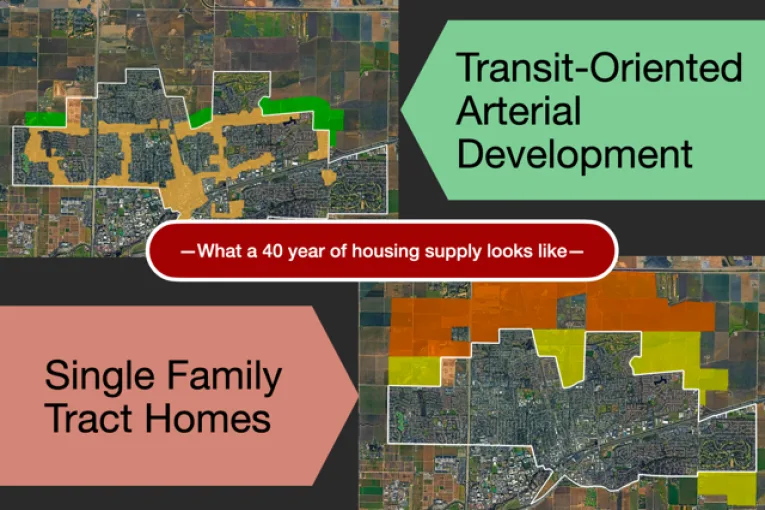
- A “Corridor densification” strategy can increase housing supply by 84% while minimizing land use.
- Multifamily homes consume half the water and energy of single-family homes.
Last week our group published a primer on one of the basic ideas in modern urban planning: that having a singular “downtown” no longer works in the age of the automobile, and cities like ours can grow most intelligently by creating a “hierarchy of centers” connected by transit rather than clinging to the simplistic idea of one dominant downtown.
We showed how most of the field of urban planning has converged on this premise and we presented a basic embodiment of this planning philosophy laid over our existing cityscape (which is already is somewhat de-centralized) with regional shopping centers and came up with the following high-level city map:
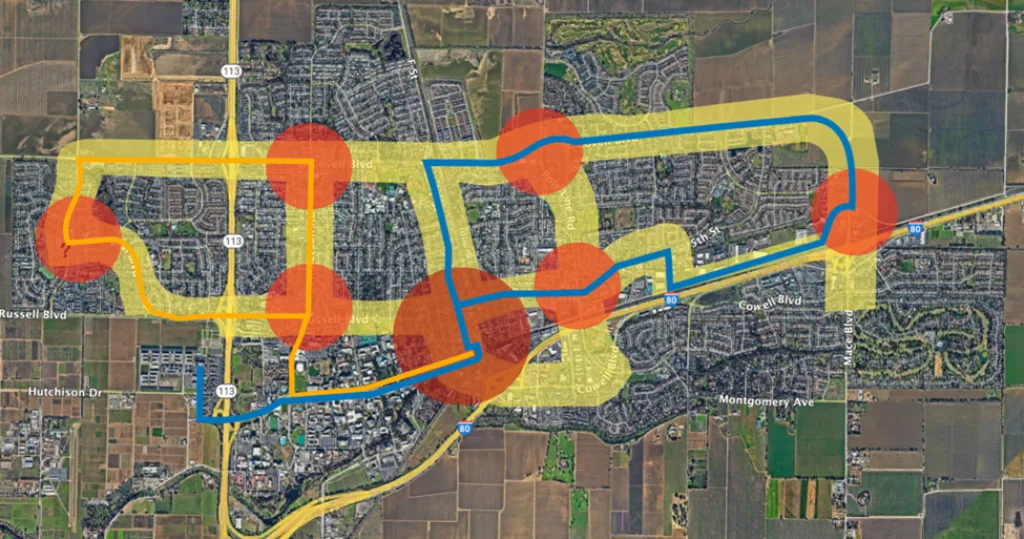
On this map, we have first identified our major arterial corridors and then planned a simplified transit system to connect them with identified the major secondary centers where we might want to concentrate shopping and most of our apartments and condos. If we followed the principles of “transit-oriented design” or “15 minute cities” our priority would be to re-zone the areas indicated in yellow for moderate-density / mixed use, and we would deliberately design the red areas to be even more intensive regional resource centers than they currently are.
This would give us a city that is efficient, low-traffic, and sustainable, both environmentally and economically.
But as they say… the devil is in the details:
- What do we mean by “densification”? How much?
- How different is this from how we are doing things now? Does this save land? Improve traffic? Reduce greenhouse gas emissions?
There are multiple ways of trying to plan a city even within this theoretical frame, and it requires us making some assumptions about how densely we want to build, what kind of population target we want to build for and how quickly we want to get there.
How much housing could we create with a “Corridor densification” strategy?
Lets create a “capacity study” in order to evaluate these concepts and start putting some assumptions on paper. This is only one scenario of course, but it helps to start somewhere and see how powerful these concepts are.
Step one in creating a land use scenario is to build a more specific map that gives us a feel for how many acres of densification we can pursue, drawing boundaries in a more deliberate way than the conceptual map shown above.
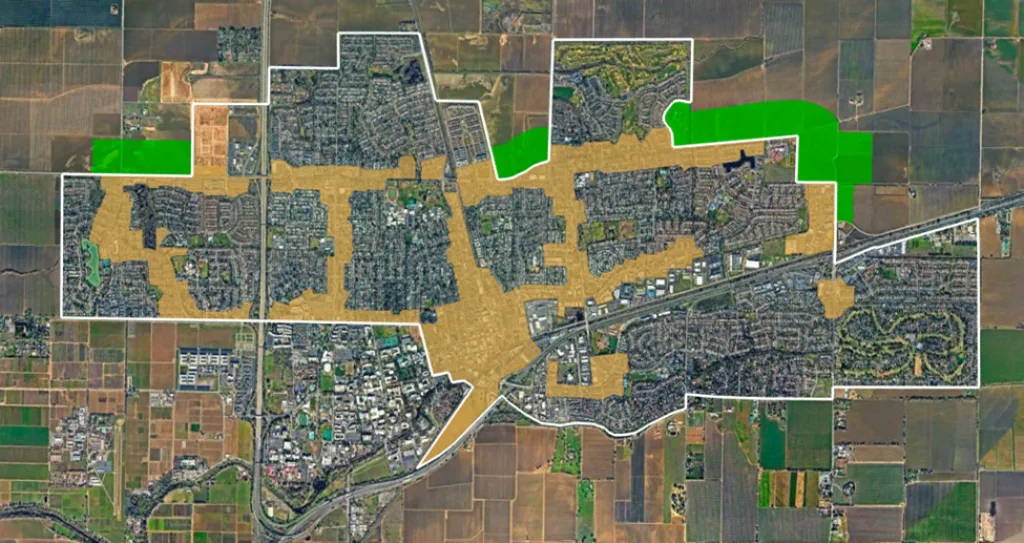
Here we have a more detailed version of the map where we have identified two types of areas:
- Yellow: Our arterial zones to be considered for densification long-term to serve an increasing population. Here we tried to find natural places / property lines to draw boundaries that were roughly ⅛ of a mile from the major street in question. Parks, schools and stormwater features are not included but commercial centers which could be turned into vertical mixed-use housing-above-retail are included.
- Green: Undeveloped areas already adjacent to major arterial corridors. Here we went out ¼ mile from the road as that is what is generally accepted as reasonable “walking distance” to transit.
Now let’s start putting some numbers on the table. Let’s assume that:
- The Yellow areas
- Are currently at 6 units per acre on average
- The properties that get redeveloped in these zones turn into townhomes, and low-rise apartments and condos average 20 units per acre
- But we also assume that only half of these properties will eventually be re-developed (its up to the will of private owners after all)
- The net expectation is that these zones will go up to an average of 13 units per acre.
- The Green Areas
- Are also built at an average of 20 units per acre. Mixed use with commercial and shopping (Larger apartments right on the corridor tapering to townhomes / duplexes and 4-plexes further away.)
- But since this is new construction, 100% of the buildings there are realized at this more sustainable density.
The yellow areas represent 1,655 acres. Increasing that density from 6 units per acre to an average of 13 units per acre gets us an additional 11,700 housing units
The green areas around our periphery total 500 acres and if developed at an average of 20 units per acre that gives us 10,000 additional housing units.
In total we have capacity for 21,700 additional housing units in this scenario.
Putting it another way: by following this pattern we could increase our housing supply by 84% while only increasing the footprint of our city by 7.3%.
But how much housing do we actually need?
We have two answers to this question:
1. In the short term. We have a back-log of housing production affordable to our local workforce, at least 17,000 university staff, students and local workers who commute in from outside every day because they are priced out. This population needs “missing middle” housing in a price category below what is possible with market rate single family homes.
It is very much in our interest to house these workers, but we are taking a conservative approach and assuming that only half of them would move here if given housing that they could afford… so that is ~9,000 housing units all of which could be absorbed in the green areas in our map in the short term.
2. For the longer term, we need to expect some level of average growth to continue. Davis will remain one of the most desirable places to live in the region, as evidenced by the current price premium compared to our neighbors, and the university should be expected to grow at least in proportion to the growth of the population in the state. For now, let’s use a somewhat conservative growth assumption of 1% per year
Combining these two timelines we have a hypothetical scenario we can analyze where we build out the green areas in our map over the next 5 years exclusively from “missing middle” housing to partially offset our latent under-supply before settling in to a 1% growth rate accomplished through densification of our targeted yellow arterial zones.
If we proceed in this manner, then we would not run out of the housing that is possible in this densification scenario until the year 2065….
That is a 40-year supply of housing accomplished through this arterial strategy alone.
If you want to think beyond a 40-year timeline, keep in mind this scenario assumes that we are only densifying HALF of the arterial zones we have identified, so further growth can be pursued through the continuation of densification of those arterials as well as more intensive densification of our core and regional centers.
(If you don’t believe that California’s population will continue to grow at 1%… that only pushes out the assumptions for when we might “run out” of housing opportunities even further into the future.)
In short, if we focus on developing our arterial zones with transit-served housing, it is very possible that we never need to exceed the city boundaries shown in our densification map in either ours or our children’s lifetimes.
What “business as usual” development will get us.
Now let’s look at the status-quo alternative.
Under Measure J/R/D, developers do the planning, and they focus on projects that are most profitable based on past conventional development: mostly higher-margin single family homes at lower densities. Let’s use Village Farms as an example which has an average density of only 4.5 units per acre.
Now let’s look at our city’s capacity for providing housing through that lens
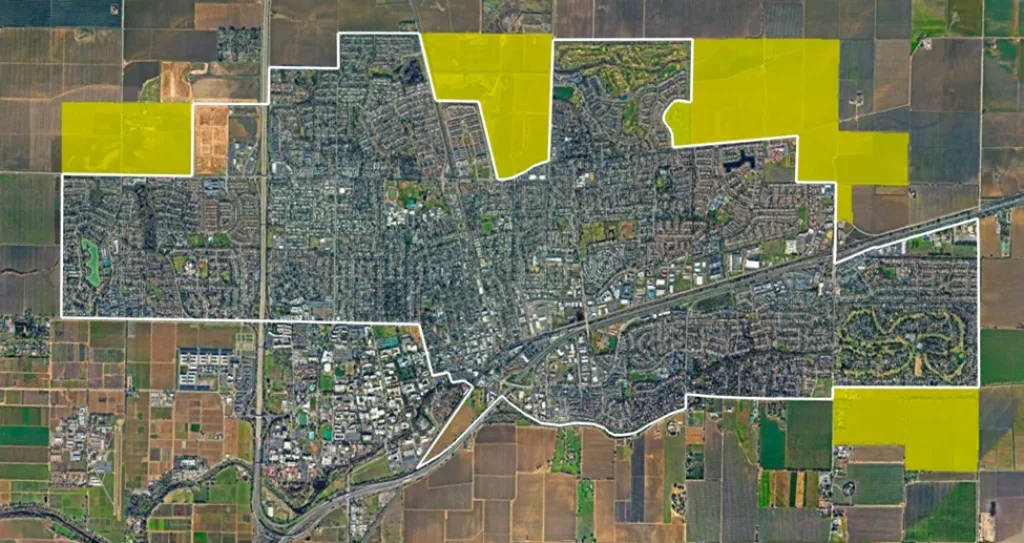
In this map, we are not re-zoning our corridors, we are just building more developments on the periphery in the areas that are logically adjacent to the arterials, including the Village Farms site, all of the Mace Curve, the formerly proposed development south of El Macero and for the sake of completeness, a development that hasn’t even been proposed above Lake Boulevard on Covell.
In total, this is an additional 1696 acres and if added at the same density proposed by Village Farms, would yield us 7,600 housing units. This would represent a 30% increase in our city population with an increase of 25% in land area.
That compares unfavorably with our other scenario, adding only one third the housing on three times more land. This scenario is still 14,100 housing units less than the corridor development plan, which means that even if all housing was the same (and it is not! – we will get to this important point later) in order to match the densification scenario in terms of units, we would also need to build another 3,100 acres of housing elsewhere.
For the sake of illustration of how much more additional land that is, we have highlighted another region in orange on our map to show just how much additional land would be needed to make both of these scenarios equal.
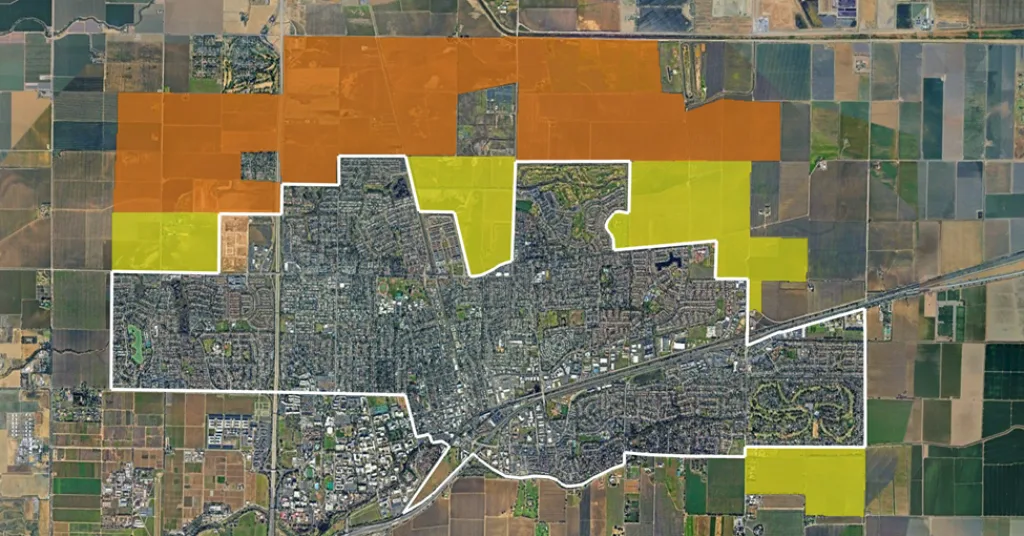
While this point largely makes itself, it is worth adding that this is only the start of it.. We would need more shopping centers, additional schools, fire stations, would need to widen our corridor streets closer to downtown and campus to accommodate all of the additional car traffic..
Now we have an apples-to-apples comparison between these two approaches to city planning, so perhaps the last thing we need to do is to put them side-by-side
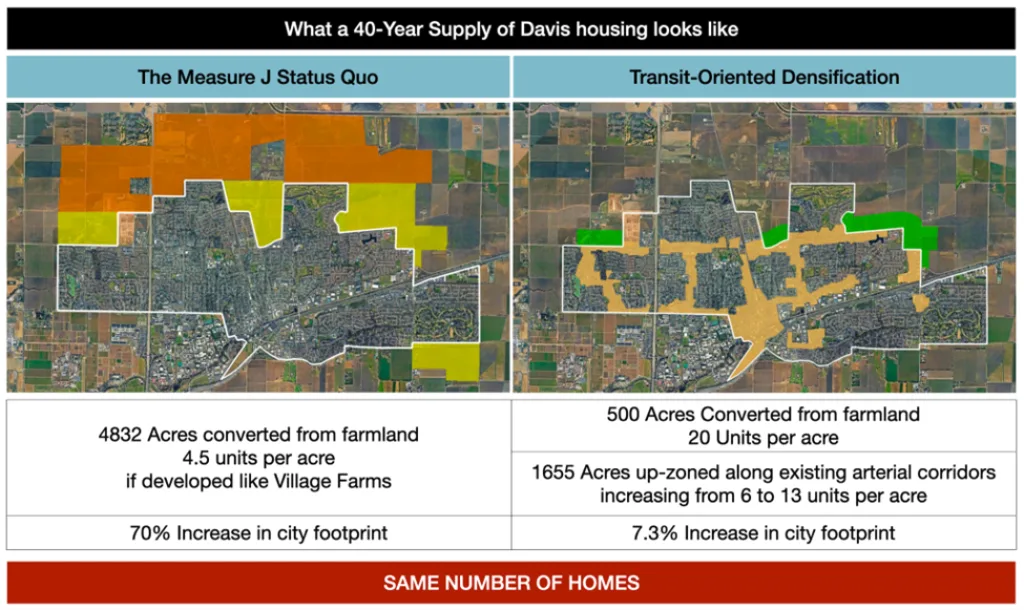
This is a powerful example of why we like to define the word “sprawl” as “failure to build with adequate density.” And we hope it’s easy to see that the only difference between the two is “proactive long-term planning”
What is sad is that this isn’t an un-realistic comparison. Low-density sprawl like this is in fact exactly what has happened in most cities across North America, and it has created an car-dependant landscape that is almost impossible to go back and fix. This is the future if we continue to follow the status quo
Additional reasons why this is important
While the superiority of the transit + densification approach should be self evident if even in terms of land conservation and an avoidance of becoming a sprawling city, there are even more reasons to want to adopt these principles, because as we hinted before, not all housing is created equal:
“Who” we are housing
Our housing crisis is about a mis-match between the jobs we have in our local economy and the housing we have failed to provide to match those jobs.
We have created primarily single-family homes over the course of the last two generations, which with the desirability of our city in general, has led to more expensive homes being occupied by more affluent professional families over half of whom commute OUT of Davis to their jobs.
In the meantime, our service sector workers, our teachers, barbers, grocery clerks, restaurant workers, university staff and many students are priced out and have to commute IN to their jobs.
We have every reason to suspect that if we proceed with more single family development, these trends will only continue: More outbound traffic with our new homeowners, and the same amount of inbound traffic leading to a higher level of vehicle miles traveled, more tailpipe emissions, more congestion—not less.
To put it simply:
- It is not in the interest of any current resident to make more expensive homes for outbound commuters. That kind of housing makes our situation worse in many ways.
- It IS very much in our interest to provide housing for our local workforce, financially, environmentally, traffic, etc.
Other Housing Impacts
Energy Efficiency Detached, single Family homes require twice the energy to heat and cool than apartments because every single side of the detached house is exposed to the elements. Even duplexes, with only one major shared wall, require about ¾ of the amount of energy of a detached house.
Water Consumption: Multifamily homes also consume half the water.
City Finances: Single family homes cost more to maintain in the long term than the property taxes + developer fees they bring in. The work of the group “Strong Towns” exposed this long ago as a “Ponzi scheme” The work of other groups like Urban3 have shown that in most cities, the denser, lower income mixed-use neighborhoods actually subsidize the wealthier single family neighborhoods.
Transit: Transit systems can be amazingly useful if (and sadly only if) they are very frequent – on the order of one arrival every 10-15 minutes. To make this worthwhile, we need an average of at least 15 units of housing per acre around our transit stations… so single-family housing and “a good transit system” are incompatible by definition.
A generational choice for Davis
Davis is at a crossroads especially with the upcoming measure J votes and General Plan process.
We can continue approving sprawling, single-family subdivisions on the periphery, sacrificing thousands of acres and locking ourselves into a car-dependent future. Or, we can embrace a smarter growth pattern that is consistent with our values of sustainability.
It should be mentioned that this has only been a “capacity finding” exercise: An attempt to understand the options before us. We have not yet gotten to the point where this qualifies as “urban planning” because we would not likely simply re-zone all of our arterials at the same density throughout, But the numbers we have generated thus far do confirm that densification as a general strategy is not only viable, it is superior.
With arterial development, Davis can meet its housing needs while staying compact, becoming more walkable and bikeable as our city gets denser and our distributed regional centers get better resourced. This is not a theoretical statement. Transit-oriented-development has been successfully been implemented in thousands of communities worldwide
As a community we have some choices to make, both at the polls with the upcoming measure J votes as well as in the upcoming general plan process.
In coming articles we will be discussing those choices and getting further into the details of what this means for the future of our city. In the meantime, we look forward to answering your questions.
The Davis Citizens Planning Group
Alex Achimore
Richard McCann
Antony Palmere
David Thompson
Tim Keller

“…but commercial centers which could be turned into vertical mixed-use housing-above-retail are included.”
But there is no market for additional commercial property especially the kind of mixed use you desire. How much vacant commercial property is vacant in Davis today? Certainly it’s enough to keep more from being built. But when doing the kind of mental experiment this group engages in economics doesn’t come into play because they have no capital being deployed or, as I like to say, no skin in the game.
These guys have been going on for over a year about how other people should live and invest without any kind of leadership by example, either in living in the kind of housing they think is superior, or, by putting any capital into a project of their own. Sadly by planning for Davis 40 years into the future they neglect the needs of the people today.
Much of that commercial property is vacant for three reasons. The first is that landlords risk defaulting on their bank loans if they offer rents that are below those specified in their loan documents. Safer to carry that debt than lose their properties. The second is that opening businesses in Davis has become overly complex and expensive. We need to streamline this process if we want small businesses to thrive. Only the big chains and franchises can bear those costs for the months and longer it takes now. The third is that much of our retail is ill placed downtown which is increasingly irrelevant to residents living further out. By putting mixed used where people live we can get livelier neighborhoods that support those businesses. All of these issues that matter TODAY.
I’m not sure what your solution is, but it sounds like you’re for an unfettered free market. What we did in the past is exactly that and it has gotten us into this fix today. We have unsustainable expensive sprawl that is killing our in town commercial centers. We can’t go that route.
What we did in the past that got us in this mess is that we stopped building new housing twenty five years ago. The solution is to build more housing. As for unfettered, unsustainable sprawl, Village Farms is closer to downtown than the subdivision where you live.
I actually don’t care that you guys want to spout off about what we should be doing to prepare for the future. What bothers me is when you start trying to dictate what that future should look like while threatening people with real capital at risk that you will work to undermine their efforts if you don’t get what you want. What bothers me is your, my way or the highway attitude, towards people who are trying to do something that seeks to address the most pressing problem we have with housing, lack of new supply.
Ron G says: “These guys have been going on for over a year about how other people should live and invest without any kind of leadership by example, either in living in the kind of housing they think is superior, or, by putting any capital into a project of their own.”
I’m going to have to get a cup of coffee just so that I can spit it out while laughing in semi-agreement with that comment.
I do find it somewhat satisfying that the developers are just totally ignoring this self-appointed group.
I do know that there’s a way for the group AND the developer to lose, however. (And for the city and environment itself to win. Trying to remember the name of the measure which provides that possible outcome – Measure K, or something like that?)
“I do find it somewhat satisfying that the developers are just totally ignoring this self-appointed group.”
You mean, other than meeting with them multiple times?
Which apparently isn’t resulting in satisfaction for this group.
They’re not going to drastically change a development proposal at the last minute in ways that would require them to create a new EIR, for example.
(Also, just noticed Don’s comment below mine – and yes, I remember that comment from Tim K, as well.)
(For that matter, Trump rolled out the red carpet for Putin and provided an air force escort, but it didn’t seem to stop the war.)
“You mean, other than meeting with them multiple times?”
Tim K: “But what is happening? The city is getting steamrolled once again by developers who have told us point-blank “we like our plan, we are willing to let the voters have their say”. So a big fat NO to any of our concerns regarding density, transit etc. Instead they put a PARK at the bottom edge of the devleopment… basically a middle finger to the idea that there could ever be a transit line down that corridor.
It shocks me how little the developers have been willing to listen. I have told them this directly…”
He said completely ignoring
David, all the images are missing in my browser…
Arf… will try to fix… hopefully that worked
In all honesty, though – the goal of densification (in general) is less-harmful environmentally than lower density.
We’ll be laughing at the “elite sardine can living” from a short distance away, however. What with our yards, three-car garages, nearby access to Costco and I-5, etc. Just make sure that you don’t make it too difficult for us to drop off our kids at Davis schools.
Meanwhile, at least half of your “dense-living” new neighbors would likely be UCD students.
But seriously, the “discrepancy” between this type of dense housing vs. what you can get 7 miles away will likely push MORE people 7 miles away – ESPECIALLY UCD employees, since it’s a straight shot down Highway 113.
On the other hand, the authors are correct that “normal” single family housing would likely be occupied by those who aren’t working in town OR at UCD – unless one member of the household is a professor, perhaps. (Is UCD even increasing its staff at all, at this point?)
Either way, you’re screwed. Personally, I like looking at tomatoes and corn growing in rich soil instead of housing developments, but I guess I’m in the minority on here regarding that.
Ron O
You’re ignoring the 17,000 workers who already commute into Davis but don’t live here. The fact that at least a 1,000 of them make the special effort to enroll their students in DJUSD indicates that many want to live here, not in “North North Davis.” Spring Lake got that moniker because so many of those resident desire to live in Davis but can’t afford to do so. And 5,000 of those commuters work at UCD–the other 12,000 work in other businesses here.
You’re derisive comments as a Woodland resident show that we may be hitting the mark–you’re feeling threatened. If you weren’t so threatened, you’d ignore what’s going on in Davis and move on.
I don’t feel “threatened”, Richard.
Mostly, I’m amused because you and the 4 other people in your group are being ignored by the developer.
And yet, didn’t you tell them that you live in Davis?
Your group seems to think it’s a problem that people are commuting to UCD (not Davis), while also viewing it as a “problem” that a bunch of other Davis residents work in places like Sacramento.
As I previously suggested, maybe they can “switch” houses, careers, or spouses (if their spouse doesn’t work where they’re “supposed to”, in your view). Maybe they can meet halfway on the causeway, and fight it out right then and there.
It’s probably not too late for you to get involved with Sacramento, in regard to building a bunch of houses near downtown Sacramento for the VAST number of workers commuting from every single regional suburb (or “exburb”) to Sacramento itself.
And then head over to places like Roseville and Elk Grove, in order to tell them where they “should” live in regard to their Sacramento jobs.
Y’all have the right idea — I’d argue about the details and the approach.
Not sure RG’s comment about ignoring today by planning for 40 years in the future — that just keeps the ‘build now with cars in mind because housing trumps everything’ mentality that is going to ruin Davis, and not everyone has to support ‘build, baby, build’ today. What is wrong with a group trying to wake people up to how stupid our car-centric planning process is? Just because someone is thinking about what Davis should look like in the future doesn’t preclude the now, but planning a bad now because there is no framework for a better Davis mobility future hurts the people living here in the future.
Thank you Alan. We hope to hear more from you with constructive suggestions. This is only a first draft of what we hope is a bigger conversation.
For the record, Our advocacy isn’t finished on these points, and they will carry through to the general plan by definition.
One of the largest challenges with our housing developers as an industry is that they are used to doing one thing and they see the world through that lens.
Remember the whistleblower at CalTrans who got retaliated against when she called out the mis-appropriation of “resurfacing” funds to start the widening project at the causeway? Her comment was that nobody in the building had any capacity to accept that anything other than just always widening every freeway was the answer. Her conclusion was that a large percentage of the existing CalTrans Staff is going to have to retire for any real change to be made.
A very similar thing is happening here. Developers like this know how to build one kind of housing, anything else is risk, and in the context of measure J, anything that complicates or makes it harder to win their election is even more risk.
We are not surprised by the lack of developers rushing to take us up on our ideas. It would be nice if they were more amenable to change, and its frustrating, but we understand why they aren’t. They need to understand that NOT improving their project is going to cost them their election at the end of the day, which unfortunately, it likely will – and for a perverse reason: The city approvals process seems to be oriented NOT towards making the projects better in any way, but towards helping the developers gain the approvals they need and “sell” a bad project to the people.
I met a long-time community activist the other day and on this particular topic, her comment was this: The problem is that only the council works for the citizens… the planning department works for the developers.
We need housing badly, but trying to force badly planned projects that offer non-solutions down our throats and guilt the citizens into approving them is a losing strategy.
Davis voters have MANY times rejected proposals like these. We should be using the time in council chambers in the next few months IMPROVING the projects so that groups like ours don’t have any obviously bad planning decisions to point out and criticize, or even find themselves liking the revised proposals enough to publicly support them.
That is the back-and-forth kind of process we need, but it doesn’t look like its the process we have.
In any case, we aren’t writing these articles for the developer’s benefit, we are writing them for the voters, because most citizens also have been raised in single family homes and lived in suburbia their whole life and they don’t see another model… even though planning like we have described is being successfully done in literally thousands of cities around the world.
When cities DO embrace better urban planning, it is only because the people ask for it, advocate for it, and make it happen. That much is clear. The developers arent going to play that role, its the community groups, like ours, like DCAN, like Interfaith, and others who organize to demand something better. That is the way these things play out, and it is NEVER easy. The Netherlands in the 70’s had a citizen movement for better city design, better traffic safety, and making Amsterdam more walkable and bike-able. There were fist-fights in the streets… the city council and the planning departments had to hire bodyguards because they recieved so many threats. Half of the city assumed that if you failed to provide easy car access to every part of the city, then nobody would ever choose to walk, bike, or take transit… but they were wrong. They showed that when you make a good transit system, people took it. When you make your streets safe for bikes and provide more parking for bikes than cars, then people use their bikes, they found people LOVE to walk around their downtown areas in zones that are designated “auto-low”.. mostly pedestrian and bike access.
The good news for us is that those pioneers have provided many many case studies for us to follow, and hopefully our journey will be less controvertial. But this is not something that the free market comes up with on its own. Its a function of good planning and it needs support from the community.
Tim says: “The Netherlands in the 70’s had a citizen movement for better city design, better traffic safety, and making Amsterdam more walkable and bike-able. There were fist-fights in the streets… the city council and the planning departments had to hire bodyguards because they received so many threats.”
Honest question: What differences exist, between Amsterdam and a place like Davis? I suspect that there’s quite a few. Is Amsterdam, for example, located in an area primarily dedicated to farming, but also surrounded by cities which are continuing to expand outward?
And in Amsterdam, was the issue related to an expansion of the city’s boundaries, or was it related to redesign within the city? There’s been similar efforts in San Francisco (which isn’t expanding its boundaries), and it’s also resulted in fights. Right now, there’s an effort to recall a supervisor who supported closing the Great Highway (along the ocean) to motor vehicle traffic. But overall, the trend is to drastically reduce motor vehicles in that city. (And yet, public transit has been declining there as well.)
Regarding public transit – it’s not “just” about frequency. (Just ask subway riders in places like New York. Or, that girl from Ukraine who was stabbed – if she was still alive).
Transit WITHIN Davis would probably be pretty safe.
Amsterdam / the netherlands in general is truly an interesting example because culturally it paralells Davis quite a bit. There was a strong bike culture, but the city planners had crammed about as much parking into their downtown areas as possible. The images of amsterdam in that time look VERY much like downtown davis… nice compact downtown almost over-run with a sea of cars.
The activism was sparked by the deaths of a few children getting run over, so it was more about child and pedestrian safety than it was sustainability. As a parent, my kids getting hit by a car is also my #1 safety concern in our town as well, so I understand that.
As for agriculture and other cites, yes, that is a direct comparison. The Netherlands is an agricultural powerhouse, they are the second largest exporter ( by value) of agricultural products in the world right after the united states. ( and they are a MUCH smaller country). Even though Amsterdam as a city is a much larger city than Davis, if you look on the map, the city ends and you are back in farmland pretty quickly. In fact the one research university in the world that rivals UC Davis is Wageningen in the netherlands…
So they are a good model for what is possible, but the concepts here are being deployed even domestiaclly with great success.
That said… developers and city planners have been saying: “We dont need to worry about transit, people will just drive their cars” for a couple of generations now, and we have laid out huge amounts of our city based on that attitude and it has created neighbhorhoods that are almost impossible to fix. The only thing we can do is make sure we arent making the same mistakes going forward, and provide some gentle incentives so that the older car-centric infractusrute gets replaced with something better when its time comes to be replaced ( such as the opportunity we missed at the U-Mall)
“We are not surprised by the lack of developers rushing to take us up on our ideas. It would be nice if they were more amenable to change, and its frustrating, but we understand why they aren’t. They need to understand that NOT improving their project is going to cost them their election at the end of the day, which unfortunately, it likely will – and for a perverse reason: The city approvals process seems to be oriented NOT towards making the projects better in any way, but towards helping the developers gain the approvals they need and “sell” a bad project to the people.”
You realize that Developers already are mostly unwilling to come to Davis because of it’s political climate (the crazy direct input citizen decision making and influence). Basically you’re saying take it or leave it when it comes to our pie in the sky ideals that don’t fit optimally with what the market wants to bare. From a developer’s standpoint…for the most part…Davis is a No Fly Zone and will continue to be a No Fly Zone.
TE, don’t be so quick to poo poo long-term alternative transit planning. This doesn’t have to negatively effect developers. All that’s needed is a framework for them to build around that is approved by the city. The concepts are pretty simple. Davis is doing none of this, from it’s interior shape to approving I-80 funds that only move cars forward. We can build, baby, build, because pants-on-fire scary crisis, or we can make a city grid for developers to plan around. Not sure a radical concept.
Thats largely the issue we are trying to fix in the long term, and why so much of our writing has been about the ill-effects of measure J. At the same time, our analysis of the electorate here is that while there is a minority that is “no growth” and that minority is loud, the voter that really matters is the one who might say: “im not anti-growth, I just dont like this project”
Certainly the people who are in the no-growth who say that as well.. and the poor quality of the projects is an excuse…. but we HAVE passed a couple of housing projects and the process for the successful ones have been lots of citizen engagement and changing things in response to the city’s needs.
its not in the cards now, because the council shied away from doing a “corridor specific plan” when that was brought up, and people got their collective tits in a bunch when the council even put the discussion of measure J on the docket… but what we are driving for is precicely a more developer-friendly environment here in davis… but the cost of that, the ONLY way that is going to happen is with really good planning.
If we can plan a better city and then either create a measure J carveout to accomodate that plan, or perhaps pass the carveout as a measure J vote itself, or do the planning during the general plan process and THEN we will still need to ratify it with a measure J vote… All of those are paths towards what you are saying: An environment in which the city has a clear eye on what kind of development they need, and developers can choose to engage in building without the chaos of a fickle electorate saying no at the polls.
I notice that you didn’t answer my question regarding whether or not Amsterdam expanded its boundaries as a result of the “revolt” you cited. Perhaps San Francisco is a better example of the type of anti-car revolt you’re referring to.
Regardless of what you come up with regarding weakening Measure J, there will be a very persuasive counter-argument.
Developers could propose what you’d prefer right now. And if it’s as popular as you claim it is, then it would pass under Measure J. And if not, the voters aren’t going to approve an exception to Measure J that would allow it (instead of a proposal). If anything, weakening Measure J to allow a series of proposals (that can’t pass individual Measure J votes) would be a MORE difficult sales job to voters, compared to a single “preferred” development proposed under Measure J.
Also, it really doesn’t make sense for the densest part of the city to be on the outskirts (outside of) a city. That’s not how cities have historically developed. It’s also highly likely that dense proposals would generate MORE opposition from neighbors, etc., than a less-dense proposal. (Especially if all it does is to preserve land for additional “subsequent” dense development. (Do you actually not see that?)
San Francisco, New York, Hong Kong, etc. – have all densified in their core areas without any meddling. But as you move away from the center of those locations, developments become LESS dense – not MORE dense.
Keith E
The problem for developers is not that Davis has specified unrealistic ideals–it’s that Davis hasn’t specified anything and the voters keep saying “bring me a rock…oh, not THAT rock, bring me another rock.” If you look at other communities in the region like West Sacramento you see developers building exactly the type of neighborhoods we’re suggesting, but they do so because they get clear guidance. Those projects are obviously profitable because they get built! We’re looking for how to change the process so it doesn’t impede the path to the better projects that Davis voters actually want.
BTW, we’ve calculated that the sales revenue per acre for our proposal is higher than for those that follow the Village Farms template.
“They need to understand that NOT improving their project is going to cost them their election at the end of the day,”
At the end of the day there won’t be another bite at the apple. Certainly not in the lifetime of the property owners. In their 80’s they will likely be over 100 the next time they try again.
Most of you guys have houses so you have no sense of urgency but by demanding something you think is better you are likely to end up with nothing. But hey, In 40 years the world will be a better place. Meanwhile the housing market in Davis will continue to suck for those families wanting to make a home here. Instead they will move to Woodland, West Sac, Dixon, Esparto, Winters and Sacramento.
Ron G says: “Meanwhile the housing market in Davis will continue to suck for those families wanting to make a home here. Instead they will move to Woodland, West Sac, Dixon, Esparto, Winters and Sacramento.”
So? (Sounds like they need their own “Measure J”.)
Also, I’d suggest that they look at the “pre-owned” housing market in Davis. I do (periodically), and found some houses for sale that are a much better deal than any new housing in ANY of those communities.
At some point, unless a city stops expanding – ANY housing market will consist of turnover of existing housing, and/or housing that is rebuilt within its own footprint.
And with the dearth of child-bearing (nowhere near replacement levels in this country), we might actually have to TEAR DOWN some existing housing at some point. Normally, I say that in jest – but it’s probably true (see Detroit, New Orleans, rust belt, etc.).
There’s some pretty fancy houses for sale in Detroit for like $1 (but they’re probably STILL not a good deal). Much nicer in their glory days than just about anything found in Davis.
RG say, “Most of you guys have houses so you have no sense of urgency . . . ”
Now there’s an insult: “You HOUSE OWNERS”.
Seriously, this is 100% the fault of poor Davis planning. If Davis actually practiced what it bloviated, the developers would already know the framework to built all future projects around. Instead, Davis caters to the loudest activists, not to best practices.
Have you looked on Zillow? Price drop! Price drop! Price drop! The market is flooded with houses for sale, so prices are dropping. That means more people can afford. What do you want, and economic collapse ?
Ron G
Now you’ve stepped over the line to claim you’re own sainthood while asserting that none of us are looking out for the community. The fact is that I’ve been advocating on a wide range of city issues for decades (I’ve never seen you on a commission or committee) and my wife and I have been at the center of several community organizations that make Davis a better place to live. Stop with your holier than thou attitude.
I honestly have no idea what you are talking about. What line have I crossed? The only thing I can imagine is pointing out that you guys don’t lead by example because you don’t live in the kind of housing that you want other people to live in. At least I’m consistent in that I live in a single family home and think we should have more of that kind of housing.
As for not serving the city in any official capacity why is that relevant? I get that you like to discredit Ron O for not living in Davis and, while I think he is mostly insufferable, I don’t understand why you think somebody unconnected to Davis shouldn’t be allowed to have an opinion on Davis. In my case all you got is that I haven’t been on a commission? Weak!
I don’t think anyone of these “Davis Citizens Planning Group” is an actual Urban Planner.
https://www.plandavis.org/who-we-are
Sometimes, that’s a good thing.
I got plenty issues with the details and approach, but the concept is thumbs up.
Who cares what credentials they have? They are a bunch of self appointed people, representing nobody but themselves. They want to make a bunch of, extraneous to the process demands, and come right out and say, if you don’t do it our way we will try to kill your project.
They offer us a vision of what a good project should look like but have no skin in the game when it comes to costs and benefits. Meanwhile the veracity of their predictions of what the future should be like is as dubious as any doomsday prophet of my lifetime, of which there have been many, who it turned out, were wrong.
Is it any wonder if the developers don’t want to deal with these people? Keith would you if it were your project?
David Thompson, Urban Planner, Affordable housing developer
He has a degree (Masters?) in Urban Planning and has worked for a municipality or county as an Urban Planner?
RG say, “Most of you guys have houses so you have no sense of urgency . . . ”
There is no urgency emanating from anyone, anywhere – other than from the “usual suspects” (which now apparently includes YIMBY politicians). Anyone moving to the area will have no trouble finding a place to live, whether it’s for sale, for rent, etc. In fact, it’s FAR EASIER, and FAR LESS EXPENSIVE to move to this area than almost anywhere else in the state!
At this point, this ease also applies to students (the only population which actually has a semi-legitimate “need” to live on campus or nearby).
Maybe it should be made “more difficult”, and “more expensive” to move to the area – instead of the opposite.
As with anywhere else, you need money to make it happen. And it may not even be a good idea in the first place.
Other than “forced growth”, why would anyone even be moving to the area? UCD isn’t increasing its staff. And anyone moving to the area could very well be moving from an area that’s environmentally superior in regard to a place to live (no need for air conditioning, more-robust public transit, etc.).
Young people aren’t having kids, so this is really just about shuffling around existing populations (e.g., from existing cities to farmland).
So what, exactly, is the actual justification to force growth – especially onto farmland?
Here’s an idea – come up with a number or range (such as the existing size of the city) FIRST, then stop apologizing for declining to exceed that number/range. The sooner that’s done, the sooner the nonsense can stop.
And if the state wants to step in with fake requirements within the city – as they’re doing across the entire state, then have at it.
1.6 kids per woman, these days – nationwide. “Replacement” level is 2.1 kids per woman.
Something is going to give, and it’s not going to be more housing. You could gut every regulation in the entire country, and developers still aren’t going to build in the face of demographics.
It will be a glut of housing, not a shortage of it. (And it’s already occurring for various reasons.)
I always find it odd that the “housing shortage people” don’t celebrate this.
Ron from the article:
“(If you don’t believe that California’s population will continue to grow at 1%… that only pushes out the assumptions for when we might “run out” of housing opportunities even further into the future.)”
There are two statements about demand here: The back-log of people who are displaced and then some rate of continued demand.
You mentioned detroit eariler… that is a city where the main employers have disapeared. Is such a sceario likely in Davis? No. That idea that the univeristy will shrink or disapear like the auto companies in Detroit is pretty extremely unlikely.
But even so, if the population levels out and california stops growing, then all we have to deal with is the mis-match between our expensive housing market, and all of the diaplaced people working those “flunkie jobs” as you call them. That is an immediate-terms shortage no matter how we slice it.
So the preferred solution is to produce a small amount of more affordable housing for our working class, and then re-zone the arterials so that growth DOES have a place to go if it is needed… Tht means that growth by definition doesnt need to be absorbed by horizontal expansion… and if the long-term growth doesnt materialize… there is literally no downside.
The people occupying “flunkie jobs” are students – who are only there temporarily. And they already have housing – lots of it at this point.
Anyone else working a “flunkie job” would be better off finding one in their own community, if they’re depending upon it to support themselves. (Even then, you aren’t going to have many options working at a Starbucks in terms of getting your own place – even in West Sacramento.)
UCD isn’t growing, regarding its staff. Those jobs aren’t “flunkie jobs”, but those people already have housing (e.g., in Davis, Spring Lake, etc.). Last I heard, UCD was planning to house more of its own employees, but (despite asking multiple times) I haven’t heard any updates regarding that.
Often times, those with careers live in a two-worker household – and they usually don’t work at the same place.
Regarding UCD itself, it does appear to be part of the “last man standing” in terms of the drastically-declining number of students in this country (also – see 1.6 kids per woman, cited above). That decline also appears to be part of the reason that Trump suddenly started courting China, in regard to poaching students from there. Though his policies seem to be all over the place regarding that. (Actually, that seems to be true of his entire presidency.)
But yeah, I really don’t think you’re going to be successful turning Covell into a “commuter line to Sacramento” – which is exactly what I see from your proposal.
“The people occupying “flunkie jobs” are students – who are only there temporarily.”
This is largely not true.
Do you have a lot of people working for you who are entirely and permanently dependent upon that salary in regard to their living expenses, and who don’t live in the city?
If so, maybe I should go into the business of career advice. Because I’d tell them to quit and find something closer to where they live (which would pay the same amount).
Unlike, for example, the Bay Area, it doesn’t seem likely that “flunkie” jobs in Davis provide enough pay differential to justify much of a commute. (For several reasons.)
Though truth be told, I’d rather work at your place than at a fast food restaurant ($20/hour to start at fast food restaurants – by law). So if you’re giving them even that much, then yeah – you might have a few commuters there.
But again, can they even afford their own place in West Sacramento, if that’s their only source of income?
The people who are priced out of our housing market include university staff, teachers, retail workers, food service, barbers. grocerly clerks and younger career professionals in our various technolgy companies. This last one is especially difficult for me as someone who works to develop our economy, becasue we need a workforce… It cant be CEO’s all the way down. We need people running pipettes, building DMG mori machines and submursibles at Schilling ( few few of their skilled workers live here in town and it IS a big issue for them)
This is the other side of why its important not just that we build housing, but that we build the RIGHT housing. McMansions dont solve the problem, they likely make it worse.
“The people who are priced out of our housing market include university staff, teachers, retail workers, food service, barbers, grocery clerks and younger career professionals in our various technolgy companies.”
Worth noting that a significant percentage of those folks are looking for housing in the rental market, not to buy, and most have given up on the prospect of ever buying a house.
Tim: A lack of “affordable” housing (specifically in Davis) isn’t holding your company (or any other company) back.
And if a two person, working household can’t afford a $700K Stanley Davis house at some point in their lives, I’m not sure what to say. No one is going to build something as substantial as those places any cheaper.
Not when they can live somewhere nearby cheaply.
You’d never know from this conversation that approximately 100 moderately-sized houses are being built right now in Chiles Ranch. How much are those going to cost?
And what about the other property at the site of the former skilled nursing facility?
Also, have you considered moving your company out of town – to a locale where it’s cheaper? You might find it less-frustrating than trying to change the town to suit your desires.
Here ya go, by the way (Chiles Ranch development). Perhaps rather than whining about Measure J, opposition to sprawl on farmland, NIMBYs, and everything else outside of an individual’s control, maybe these “houseless local workers” can get their arse on a waiting list. (Though truth be told, we never do hear from those people in the first place – just their so-called “representatives” on here.)
https://www.centurycommunities.com/find-your-new-home/california/northern-california-metro/davis/harvest-glen/
Ron O
Again, you are ignorant of fundamental economic principles (which is you appealed to by bring up the law of demand earlier).
– The fact that the Davis housing market has a 50% price premium over neighboring towns is a clear indicator that substantial demand exists for this housing market despite housing being cheaper in those other towns. If what you said was true about buyers turning to Woodland or West Sac by choice instead, the housing prices would equilibrate across all of these markets, but that’s not happening.
Richard: Your numbers aren’t accurate historically, as it’s more like 40% price differential (which existed prior to Measure J, as well).
In any case, it sounds like a reason to purchase a house in Spring Lake, for whomever is arriving (for some reason – since UCD isn’t even hiring) to this area, now. 1,600 more housing units to come, at the Woodland technology park which failed in Davis before it was even presented to voters). “Housing shortage” my arse.
But as I’ve previously noted (many, many times), the best “deal” is to purchase a pre-existing house in Davis.
But if that’s not good enough for those whom you’re “supposedly” speaking on behalf of, there’s approximately 100 modest housing units being built RIGHT NOW at Chiles Ranch. And a couple dozen more (or so) at the site of the former skilled nursing facility, on Pole Line. It will be interesting to see if those are priced in reach of the local baristas.
Truth be told, a lot of people moving to this region are moving FROM a place in which they have less environmental impact (e.g., the Bay Area – where air conditioning and lengthy commutes aren’t necessary, and where robust public transit already exists). And yet, you apparently support that, despite being a climate change expert, a professional economist, a professional environmental consultant . . .