
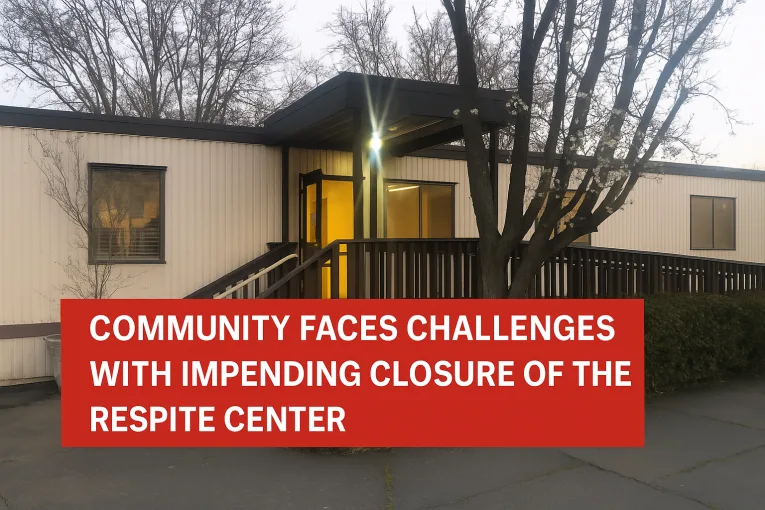
- “If we allow a gap in service, we will lose that trust, and rebuilding it will take years.” – Councilmember Gloria Partida
The Davis City Council confronted an urgent problem this week as it debated the city’s homelessness system of care and considered the looming closure of the Davis Daytime Respite Center.
With the Downtown Streets Team, the current operator, set to shut down citywide on Oct. 31, councilmembers weighed whether to keep the center open, bring operations in-house, or allow services to end.
The discussion grew more urgent as councilmembers acknowledged the center’s role as one of the only places where unhoused residents can rest, shower, receive mail, and access case management.
“We can’t let this center close without a plan,” Councilmember Josh Chapman said. “This one is right in front of us. Other issues like detox and mental health take time, but the respite center is immediate and within our control.”
Social Services and Housing Director Dana Bailey presented the staff report, which laid out the scale of the crisis.
“On August 29, Downtown Streets Team provided its Respite Center operations staff a Notice of Plant Closure/Termination letter outlining its intention to cease operations,” the report stated. “On September 2, the City received notice from Downtown Streets Team it would close its doors organization-wide on October 31, 2025.”
The report detailed the center’s impact. In 2024, 111 people engaged in case management services, with 20 securing housing and 459 barriers to stability removed. In 2025, the numbers rose to 139 engaged, 10 housed, and 627 barriers removed. The report described these outcomes as “steady progress in both direct housing support and tackling the systemic challenges that prevent stability.”
Councilmembers wrestled with how to preserve those gains. The report presented five options: seek a new contractor at the current location, explore relocation, bring operations in-house, research alternative programming, or close the site. Bailey asked for council direction, saying staff needed clarity to move forward.
Mayor Bapu Vaitla praised the commission’s work but said the city cannot lose sight of what is most pressing.
“Priority number one is short-term and in our control,” he said. He acknowledged that other recommendations, such as embedding more clinicians and expanding detox services, were constrained by county resources. “We can’t sit here and solve acute psychiatric care overnight. But we can act to keep respite services available.”
Councilmember Gloria Partida, who serves on the respite center subcommittee, stressed the importance of continuity.
“Trust has been built between case managers and the unhoused community,” she said. “If we allow a gap in service, we will lose that trust, and rebuilding it will take years. We owe it to the people relying on this space to make sure it doesn’t disappear.”
The staff report also highlighted the fiscal stakes. The respite center represents the city’s largest ongoing homelessness investment, with more than $500,000 allocated in the current budget. Other investments include $305,868 for Pacifico Housing, $223,000 for year-round shelter beds at Paul’s Place, $50,000 for the seasonal winter shelter, and more than $100,000 in CDBG grants to nonprofits. In total, the city spends about $1.8 million annually on homelessness services.
Despite those investments, the report warned of major challenges ahead. Federal and state funding streams remain volatile, and the report noted that “anticipated reductions in funding and resources at the federal, state, and local levels will have significant repercussions.”
It also cited the implementation of SB 43, which expands conservatorship criteria to include severe substance use disorders. The law, taking effect in 2026, could strain already limited psychiatric and crisis services.
Residents made impassioned pleas for the council to act. “Please don’t close this center suddenly,” a caller named Berry said. “It serves 40 to 70 people a day who rely on it for mail, medications, case management, showers, and a safe place to be. Sudden closure will do real harm. Just fix the site and keep the benefits of the program.”
Another resident, Jira, said the respite center preserved dignity.
“It’s one of the few places in Yolo or Sacramento County where people can get food, showers, and clean clothes. Why would we take that away? You are casting aside a whole group of people for your convenience.”
Case managers echoed those concerns. Manuel Montoya and Rebecca Cortez told the council that the center provides critical daily services, from medical referrals to housing navigation.
“What makes the respite center unique is the trust we build and the dignity we provide to people who are too often overlooked,” Cortez said. “This space has become a vital hub for stability, hope, and creative solutions. Without it, our community loses an essential support system.”
Some residents acknowledged concerns about neighborhood impacts but said closure was not the solution.
“The respite center has been an incomplete and imperfect solution,” said Paul Larrick. “But it currently provides services to 40 to 70 people each day, including access to mail, medication, court documents, showers, food, and laundry. Paul’s Place is not large enough to serve the dozens who will be left in the lurch.”
Others warned about financial risk if the center closes.
“Would this trigger a state or federal audit in regard to funds for the unhoused?” asked resident Joan Smith. “The respite center has done so much. I hope the council can come up with something to keep it open.”
The staff report also highlighted other fragile programs. The city’s safe parking pilot, operated by HEART of Davis, began in June and serves five people who live in vehicles. Participants report feeling safer and more stable, but costs are rising. “It is unlikely that donations will continue at a level to sustain the pilot long term,” the report stated. Bailey told the council that, while the program had promise, it would require city support to expand or even to sustain through winter.
Councilmembers praised the program but admitted it was not enough.
“This is one small piece,” Vaitla said. “We need a spectrum of services, from safe parking to shelters to supportive housing. But we can’t do any of it if we allow existing programs to collapse.”
The Social Services Commission subcommittee report added urgency by identifying critical service gaps. It concluded that Davis should not create a volunteer navigator program but instead invest in shelter, mental health crisis care, detox programs, and senior-specific housing.
The report described shelter needs as “the top identified barrier to addressing homelessness” and urged the city to “support existing daytime shelter access and increase or stagger service hours at the respite center and Paul’s Place.”
As the meeting closed, Mayor Vaitla acknowledged the weight of the testimony.
“This is a lot,” he said. “We heard directly from residents, from service providers, from case managers. The message is clear—this center matters, and we have to find a way forward.”
No final decision was reached, but staff were directed to return with cost analyses and options for interim operations. The respite center subcommittee will continue reviewing providers and locations. With the Downtown Streets Team set to shut down in weeks, the council must act quickly.
For Davis, the decision will shape not only the future of the respite center but also the city’s broader approach to homelessness. The choice is whether to preserve fragile lifelines or allow them to fray, leaving the most vulnerable residents without shelter, stability, or dignity.
“We heard directly from residents, from service providers, from case managers. The message is clear — this center matters, and we have to find a way forward,” Mayor Vaitla said.

Alan Miller calmly suggested that the Respite Center be rotated through each of the five districts, with each taking the respite center for five years each, starting with the shores of Stonegate Lake from 2026 through 2030. In the name of social justice, the respite center will be then continue to be rotated through the most expensive real estate in Davis: North Davis Farms, Alhambra Lake, and Willowbank. The rich of Districts 4 and 5 shoved the Respite Center up District 3’s arse, District 3 is now shoving the respite center up all the other district’s arses. THAT is social justice.