
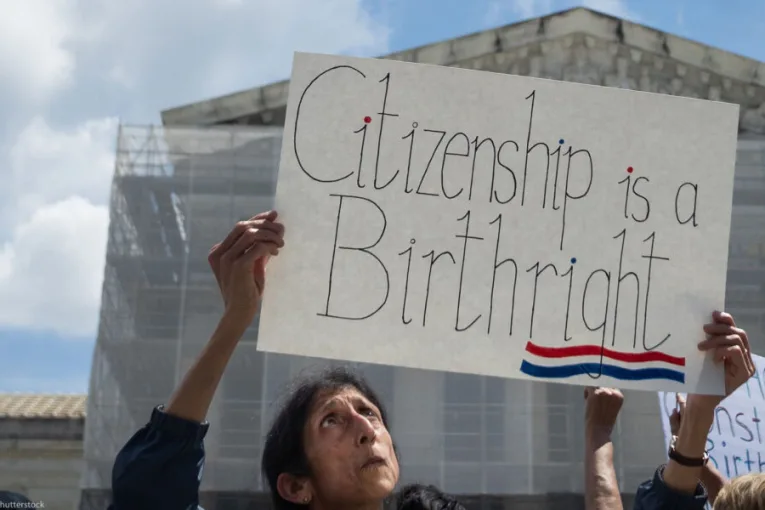
- “We are glad that the courts have continued to protect Americans’ fundamental rights. However, the fight does not end here. We will continue to oppose this executive order until the President’s attempt to unmake the Constitution is blocked completely.” – California Attorney General Rob Bonta
By Vanguard Staff
OAKLAND — California Attorney General Rob Bonta on Friday praised a federal appeals court ruling that upheld a nationwide injunction against President Donald Trump’s attempt to end birthright citizenship.
The U.S. Court of Appeals for the First Circuit affirmed a Massachusetts district court’s order blocking enforcement of Trump’s executive order, which sought to deny U.S. citizenship to certain children born in the country to noncitizen parents. The lawsuit was co-led by California, New Jersey, and Massachusetts and joined by a coalition of more than a dozen states, civil rights organizations, and immigrant advocacy groups.
“Today’s decision upholds a nationwide injunction in our lawsuit challenging the President’s attempt to end, with the stroke of a pen, the constitutional right to birthright citizenship,” Bonta said. “The First Circuit reaffirmed what we already knew to be true: The President’s attack on birthright citizenship flagrantly defies the Fourteenth Amendment of the U.S. Constitution and a nationwide injunction is the only reasonable way to protect against its catastrophic implications. We are glad that the courts have continued to protect Americans’ fundamental rights. However, the fight does not end here. We will continue to oppose this executive order until the President’s attempt to unmake the Constitution is blocked completely.”
The executive order, issued in January, declared that children born in the United States would not automatically receive citizenship if their parents lacked legal status or if their fathers were not U.S. citizens or lawful permanent residents. Multiple lawsuits were filed within days, arguing that the order violated the Citizenship Clause of the Fourteenth Amendment as well as longstanding federal law.
In February, a Massachusetts district court issued preliminary injunctions halting enforcement of the order. The district court found that the plaintiffs were “exceedingly likely” to prevail on their claims that the order was unconstitutional and contrary to federal law. The government appealed, but the First Circuit on Friday upheld the injunctions.
Chief Judge David Barron, writing for the panel, made clear that the central issue was not complex. “The analysis that follows is necessarily lengthy, as we must address the parties’ numerous arguments in each of the cases involved. But the length of our analysis should not be mistaken for a sign that the fundamental question that these cases raise about the scope of birthright citizenship is a difficult one. It is not, which may explain why it has been more than a century since a branch of our government has made as concerted an effort as the Executive Branch now makes to deny Americans their birthright.”
The court traced the history of the Fourteenth Amendment, ratified in 1868 to ensure citizenship for formerly enslaved people and their descendants, and reaffirmed that the amendment was intended to enshrine the principle of birthright citizenship. The opinion pointed to United States v. Wong Kim Ark, the 1898 Supreme Court decision that held children born in the United States to noncitizen parents are U.S. citizens.
The First Circuit rejected the administration’s claim that the plaintiffs lacked standing and dismissed arguments that the injunction should not apply nationwide. The judges emphasized that a sweeping injunction was necessary because partial relief would not prevent widespread harm.
The ruling was also shaped by recent Supreme Court decisions addressing the scope of federal courts’ equitable powers. While the high court has expressed skepticism about so-called universal injunctions, the First Circuit concluded that nationwide relief was the only way to ensure complete protection for states and individuals affected by the order.
Civil rights advocates welcomed the decision as a decisive rebuke to efforts to restrict birthright citizenship. The plaintiffs had argued that the executive order would cause chaos, stripping newborns of legal recognition as citizens and denying them passports, Social Security numbers, and access to critical federal programs. The appeals court agreed, writing that denying citizenship in this manner would have profound consequences for both families and state governments.
Follow the Vanguard on Social Media – X, Instagram and Facebook. Subscribe the Vanguard News letters. To make a tax-deductible donation, please visit davisvanguard.org/donate or give directly through ActBlue. Your support will ensure that the vital work of the Vanguard continues.
