
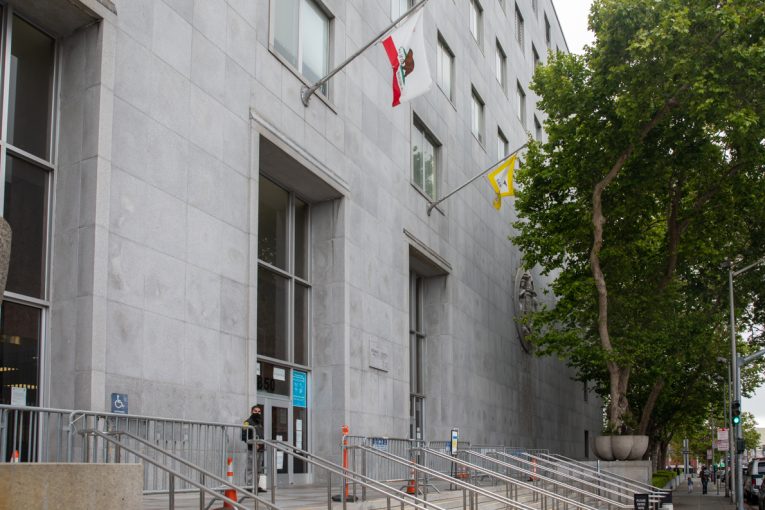
SAN FRANCISCO — The San Francisco Public Defender’s Office responded sharply to District Attorney Brooke Jenkins’ recent announcement that eight of eleven people charged with narcotics trafficking in the Tenderloin had been released.
The office criticized the DA’s rhetoric as a “fear mongering” tactic that threatens judicial independence and would further overcrowd jails.
“Our legal system is based on the presumption of innocence. This fear mongering is another attempt by the District Attorney to attack the independence of the judiciary, further pack our already crowded jails, and put her thumb on the scale of these pending cases,” the statement read.
In its formal response, the Public Defender’s Office urged decision-makers to recognize that people may miss court dates for reasons such as work, childcare, or scheduling miscommunications, and added that such missed appearances are often remedied in subsequent hearings.
It argued that public safety would be better served by investing in education, healthcare, housing, and opportunity rather than relying on a jail system that “drains resources and doesn’t leave anyone better off.”
The Office also cautioned that pretrial detention carries serious collateral consequences: loss of employment, housing instability, disruption of healthcare access, and harm to family caregiving capacity.
The statement noted that San Francisco’s jails are currently holding nearly 1,300 people and described the conditions as inhumane, citing overcrowding, lack of sunlight, restricted access to fresh air, and lengthy delays in transporting detainees to their legal visits or court appearances.
Jenkins’ press release, issued Wednesday, outlined the charges against eleven individuals allegedly involved in narcotics trafficking in the Tenderloin, stating that eight had been released by the court.
The release said one person, freed pre-arraignment by a duty magistrate, failed to appear for arraignment on September 30, prompting a bench warrant.
The release detailed the arraignments: four on September 29, three on September 30 and three on October 1.
All pleaded not guilty in San Francisco Superior Court. The DA’s Office said six of the defendants’ complaints include enhancements under newly-passed laws enacted by Proposition 36.
In three of those cases, the defendants allegedly committed offenses while released on separate felony narcotics cases.
The DA’s Office moved to detain seven individuals without bail and sought revocation of felony probation for another. At present, three remain in custody under bail, while seven were released with stay-away orders and one placed on electronic monitoring.
In the Prop 36-enhancement cases, the press release said bail was set for three who remain in custody, two were released outright, and one was released with electronic monitoring.
In the case of Kevin Sanchez Avila, 30, the DA’s Office said he allegedly sold 2.4 grams of fentanyl to an undercover officer on September 24 and later transferred a bag of suspected narcotics via Raylene Waddell, 29. Waddell is accused of possessing 114.1 grams of fentanyl, 49.4 grams of methamphetamine, 5.6 grams of cocaine base, 14.2 grams of suspected alprazolam, packaging materials, a scale, and a smoking device. Waddell was said to be on felony probation for a prior narcotics case and to have an open bench warrant.
The court set her bail at $30,000, and she remains in custody. Avila, despite having an open warrant and a prior pending felony narcotics case, was released on his own recognizance with electronic monitoring and ordered to stay away from the arrest location. Their preliminary hearing is scheduled for October 10.
Another case highlighted involved Joel Medina, 19, who was arrested at the intersection of Ellis and Market on September 24 after allegedly selling 2.6 grams of fentanyl to an undercover officer.
Law enforcement reportedly found over 370 grams of fentanyl, 54 grams of methamphetamine, $106 in additional cash, a scale, and shears. Medina was released in a pending felony narcotics case, and the court set bail at $40,000. He remains in custody pending the October 10 preliminary hearing.
The DA’s Office added that, as of September 27, San Francisco had 1,152 defendants with pending felony narcotics cases, more than half of whom (681) had had bench warrants issued for failure to appear.
Among those, 173 individuals had more than one case in warrant status, and two had five cases each. The release also said that of the 1,152 open narcotics cases as of September 25, 129 individuals were held in custody, 100 had more than one pending case, 53 had more than two, and one person had nine.
Public Defender leaders point to broader empirical research that challenges the assumption that detention deters absconding or nonappearance.
A Prison Policy Initiative blog post noted that, although short jail stays may seem intuitive as deterrents, studies show that detention can exacerbate absence risk. In one cited example, detained individuals were 6 percent more likely to miss court after one day, and 26 percent more likely after eleven days.
Further scholarship warns that spending even a single day in jail can have profound consequences: “spending any more than one day in pretrial detention can have devastating consequences,” researchers at the Harvard Kennedy School wrote, citing diminished employment, housing, social ties, and well-being.
The Public Defender’s critique is buttressed by reports about jail conditions in San Francisco. A 2022 article in The San Francisco Standard reported that inmates get so little sunlight “they’re prescribed vitamin D supplements,” with many only seeing daylight during transport to court.
That finding echoes a subsequent ruling in 2023 in which a federal magistrate judge ordered daily sunlight access for inmates, citing evidence that lack of exposure impairs circadian rhythms and immune function and increases risks for colon or breast cancer.
The Public Defender’s Office contends that despite the DA’s emphasis on public safety, crime in San Francisco is on a downward trajectory. It warns that Jenkins’ approach—linking fear with pretrial detention and raising bail and enhancements—risks undermining due process and consigning more people to the same crowded jails the Office argues are already failing in health, oversight, and rehabilitative capacity.
In urging policymakers to reconsider reliance on pretrial incarceration, the Public Defender’s Office insists that “to address public health and safety in meaningful ways, we need more resources to go to education, healthcare, housing, and opportunity.”
Follow the Vanguard on Social Media – X, Instagram and Facebook. Subscribe the Vanguard News letters. To make a tax-deductible donation, please visit davisvanguard.org/donate or give directly through ActBlue. Your support will ensure that the vital work of the Vanguard continues.
