
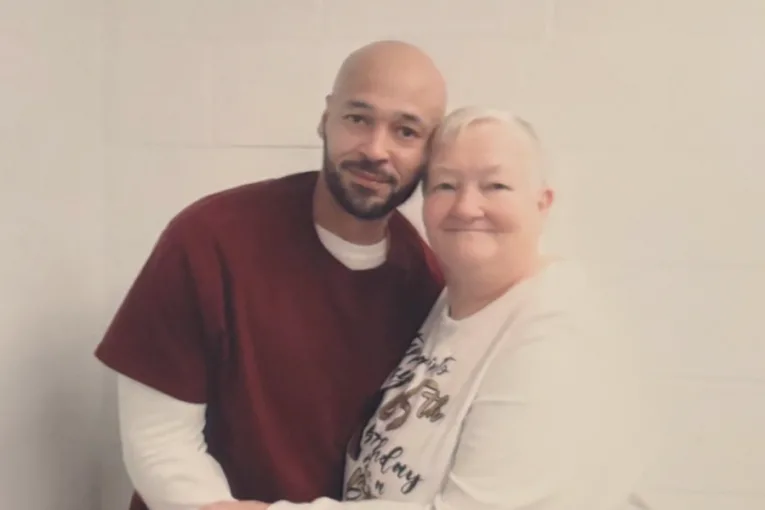
- “I wish the state prosecutors and courts had the same enthusiasm for fundamental fairness and the rule of law that it appears to have for executing its own citizens.” – Amy Knight, counsel for Representative Humphrey
By Vanguard Staff
OKLAHOMA CITY, OK – Death row prisoner Tremane Wood has petitioned the United States Supreme Court to review claims that Oklahoma County prosecutors lied to the jury and withheld witness deals in his 2004 capital murder trial.
The petition also urges the Court to examine undisclosed emails between Oklahoma Attorney General Gentner Drummond and the Oklahoma Court of Criminal Appeals (OCCA), which allegedly prejudiced Wood’s request for a new trial.
Wood was sentenced to death for his role in the 2001 robbery and killing of Ronnie Wipf, although his older brother and co-defendant, Jake, admitted to being the one who fatally stabbed the victim. Jake Wood received a life sentence, while two other co-defendants received lesser terms.
During an evidentiary hearing earlier this year, one of the prosecutors admitted under oath that the state withheld from the jury information about benefits provided to witnesses who testified against Wood.
A previously undisclosed agreement with a key witness surfaced during the hearing, confirming that the prosecution concealed the deal that helped secure Wood’s death sentence.
While the OCCA was considering Wood’s motion for a new trial, leaked emails revealed private communications between Attorney General Drummond and Presiding Judge Gary Lumpkin.
In the emails, Drummond allegedly accused Wood of misconduct in prison and asked the court to delay Wood’s execution to undermine his clemency petition. Wood’s attorneys sought sanctions against Drummond’s office and requested Judge Lumpkin’s recusal, but both motions were denied. Days later, the OCCA rejected Wood’s request for a new trial in an opinion written by Lumpkin.
Wood’s petition argues violations under Brady v. Maryland and Napue v. Illinois, claiming that prosecutors in the Bob Macy-era Oklahoma County District Attorney’s Office hid evidence of witness deals and allowed false testimony.
The petition states, “This case is a repeat of Glossip v. Oklahoma, 604 U.S. 226 (2025). Like Glossip, this case involves a decades-long effort by Oklahoma County prosecutors to keep their rewards to cooperating witnesses hidden from prisoners whom the state seeks to execute.”
The petition further alleges that “while [the OCCA] was considering Mr. Wood’s case the presiding judge of that court received ex parte communications alleging that Mr. Wood had recently committed serious misconduct in prison, and how to shield that evidence from him so as to advantage the state’s case against clemency and to keep Mr. Wood’s execution on schedule.”
Representative J.J. Humphrey is expected to file a brief supporting Wood’s petition, highlighting systemic misconduct within the same prosecutor’s office that handled Wood’s case.
The brief contends that Oklahoma courts have “swept the misconduct under the rug.”
Amy Knight, counsel for Representative Humphrey and attorney with Phillips Black, Inc., said, “I wish the state prosecutors and courts had the same enthusiasm for fundamental fairness and the rule of law that it appears to have for executing its own citizens.”
Knight previously represented death row prisoner Richard Glossip before the Supreme Court.
Wood’s case is also marked by ineffective legal representation, racial bias, and unpresented mitigating evidence. His trial attorney later admitted to abusing alcohol and cocaine during the trial and failing to adequately investigate or prepare the defense. The penalty phase lasted just one afternoon. Meanwhile, his brother—who admitted to the killing—had a full legal defense team and avoided a death sentence.
Wood’s jury was composed of ten white jurors, one Black juror, and one Hispanic juror. The Black juror later said she felt pressured by white jurors to vote for death. Studies have shown that Black defendants accused of killing white victims in Oklahoma are two to three times more likely to be sentenced to death.
Wood’s attorneys argue the jury never heard critical mitigating evidence, including his remorse, traumatic upbringing, and the coercive influence of his abusive brother. Witnesses described Wood as “sobbing uncontrollably” and “so distraught that he threw up” after the crime, repeatedly saying, “No one was supposed to die!”
Wood remains remorseful, and his attorneys state he has earned the respect of correctional staff during his two decades on death row. His Supreme Court petition contends that Oklahoma’s capital system continues to operate under a pattern of prosecutorial misconduct, racial bias, and disregard for fairness that undermines the legitimacy of death sentences in the state.
Follow the Vanguard on Social Media – X, Instagram and Facebook. Subscribe the Vanguard News letters. To make a tax-deductible donation, please visit davisvanguard.org/donate or give directly through ActBlue. Your support will ensure that the vital work of the Vanguard continues.
