
- “The thing that I think we learned is that federal housing policy is stuck in a really weak equilibrium.” – Jared Bernstein
- “The core of the problem is simple: Too much money chasing too few homes.” – Ezra Klein
- “One reason we don’t build enough affordable housing is we’ve made affordable housing unaffordable to build.” – Ezra Klein
New York— New York Times columnist Ezra Klein is warning that America’s housing problems are not just about high prices but about a deep structural shortage that decades of federal and local policy have failed to fix.
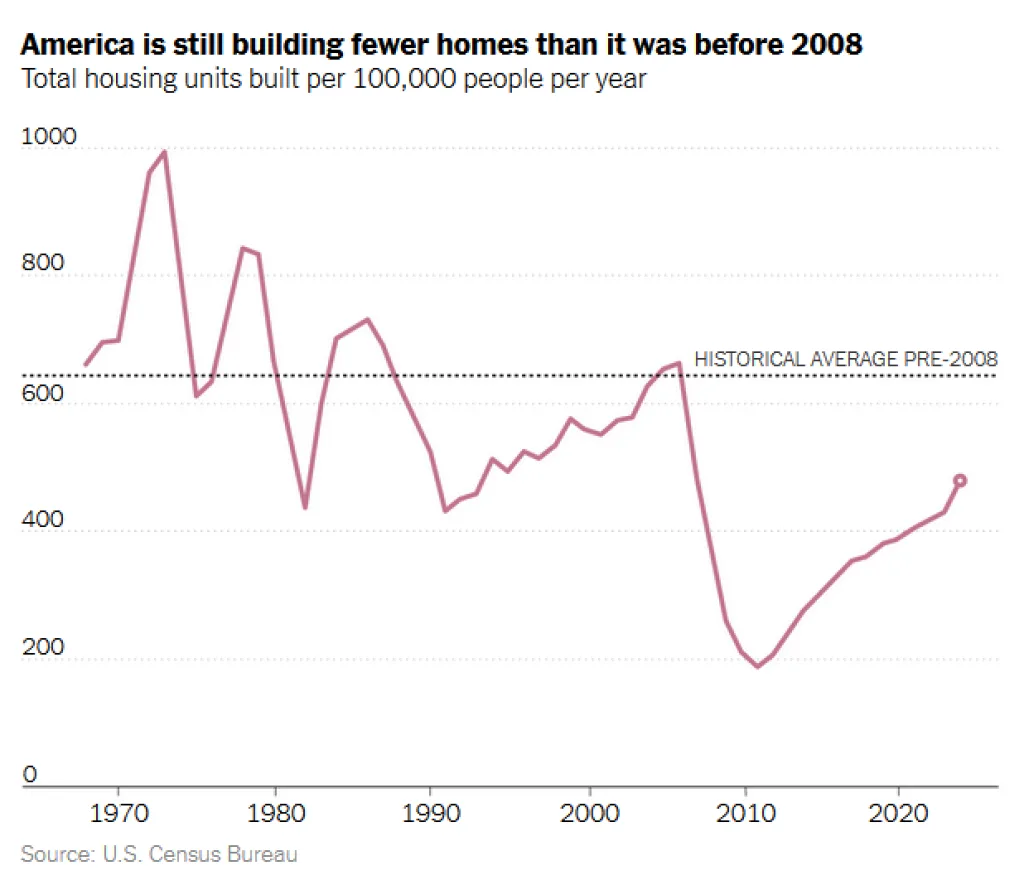
In a Nov. 23 opinion piece titled “America’s Housing Crisis, in One Chart,” Klein argues that the United States has allowed a housing deficit to build for generations while productivity in construction has stagnated and political incentives have favored people who already own homes.
Klein opens with a set of stark indicators. He notes that home prices have risen more than 50 percent since the pandemic and that about a third of American households now spend more than 30 percent of their income on housing. He adds that “in 2014, the median age of a first-time home buyer was 31. In 2025, it was 40 — the highest on record.”
For Klein, the basic diagnosis is straightforward. “The core of the problem is simple: Too much money chasing too few homes,” he writes, citing estimates that the U.S. is short between 2 million and 5 million homes after decades of underbuilding. He points out that in 2025, America built fewer homes per 100,000 people than it did in 2005, 1995, 1985 or 1975.
New York Times Chart
Klein argues that presidents from both parties have recognized the problem but have not meaningfully shifted outcomes. He writes that every White House since Barack Obama has acknowledged the need to build more homes, but that the results have been “anemic” under both Democrats and Republicans.
He notes that even when then–Vice President Kamala Harris promised to build three million new homes, housing experts he spoke with did not believe her plan could come close to hitting that target.
A key voice in the column is Jared Bernstein, who led President Joe Biden’s Council of Economic Advisers and is now a senior fellow at the Center for American Progress.
“The thing that I think we learned is that federal housing policy is stuck in a really weak equilibrium,” Bernstein told Klein. “There is just far too little asked of cities and states. They won’t do much to push back on the barriers that are blocking affordable housing.”
Bernstein is one of the authors of a new housing plan from the Center for American Progress that Klein highlights as an attempt to match the scale of the problem.
At the heart of that plan is a proposal called “Rent Relief for Reform.” Under the idea, places with housing shortages would face a choice: build more housing and receive federal support that could give renters in that city up to $1,000 off their rent, or refuse to build and lose access to certain federal grants.
Klein pairs that concept with a similar proposal from the Searchlight Institute, a new Democratic think tank. In that model, cities and other jurisdictions that hit ambitious housing targets would qualify for a federal rebate that would give every household — both homeowners and renters — a check equal to the average increase in rent over the last year.
In both cases, the federal government would be tying tangible, short-term financial rewards to local decisions to allow more housing.
Those designs, Klein writes, are meant to grapple with the political reality that local housing policy is dominated by people who already own their homes and often fear change.
He quotes Jenny Schuetz, who leads housing policy at Arnold Ventures, on how these incentives might change who shows up.
“You can put this kind of crassly as you’re incentivizing renters to show up at local elections and push their elected officials to do things that are renter-friendly, which I don’t hate as a strategy,” she told him.
Schuetz added that “if most renters showed up in the primaries and demanded that their mayor and City Council actually do good things, we could have some pretty different outcomes. But mostly renters don’t show up — particularly in the primary — and so you get these homeowner-dominated coalitions in cities that make it hard to build.”
Klein notes that even when governments adopt policies that expand housing supply, the politics are difficult because the benefits arrive slowly. It takes years to plan, approve and build new homes, and more time for the new supply to meaningfully soften prices.
Aaron Shroyer, who served as special assistant to Biden for housing policy and co-authored the Searchlight plan, told Klein, “If you’re a politician and you have a four-year term, you really need to do all of your housing stuff in year one if you want to have people feel the benefit within that single term.”
Polling highlighted by Searchlight and cited by Klein underscores the political challenge.
Large majorities of Americans say housing costs are too high and that it has become harder to find housing they can afford, but only a small minority believe that building more housing in their own communities would actually lower costs.
Klein argues that this gap between public perception and economic reality pushes policymakers to design tools that turn the long-run, indirect benefits of growth into visible, immediate gains for local residents.
Beyond politics, Klein devotes a substantial part of his piece to how the nation builds housing.
He contrasts construction with manufacturing, noting that between 1950 and 2020 productivity in manufacturing — how much can be produced with the same number of workers — rose by more than 900 percent, helping make many goods cheaper over time. By comparison, construction productivity has fallen over that same period.
Klein turns again to Bernstein to make the point vivid. “If you go back to 1910, somebody showed up with a toolbox and a hammer to build a house,” Bernstein told him. “And if you go to 2025, it’s the same damn thing. This is the one sector where productivity has been literally falling for five decades while everything else has been going up.”
Klein argues that one promising alternative is to treat housing more like manufacturing by embracing modular and factory-built construction. He notes that the United States actually helped pioneer this technology when George Romney, Mitt Romney’s father, served as secretary of housing and urban development during the Nixon administration. But he writes that the country “never figured out the rules nor the financing to make an industry out of it,” while other countries moved ahead.
In Sweden, Klein notes, more than 40 percent of new homes — and more than 80 percent of single-family homes — are now fabricated off-site in factories and then assembled on-site.
The Center for American Progress plan he describes calls for major federal investment in research and innovation in housing construction, using federal purchasing power — including possibilities like upgrading military base housing — to create stable demand for modular builders, and modernizing building codes, insurance rules and financing so modular projects qualify more easily.
Klein also points to the ways publicly subsidized “affordable” housing in the United States has become extremely expensive to produce. He cites a RAND study showing that, in California, affordable housing cost more than one and a half times as much per square foot to build as market-rate housing.
He also cites a Washington Post investigation into a subsidized development in Washington, D.C., where affordable units cost about $800,000 each to build, even as the same developer was building market-rate units next door for $350,000. “One reason we don’t build enough affordable housing is we’ve made affordable housing unaffordable to build,” Klein writes.
As a potential test case, Klein looks to New York City and Mayor-elect Zohran Mamdani’s housing plan.
“New York was once a beacon of creative, public sector-led, affordable housing production,” the plan says. “But decades of disinvestment and shrinking government capacity have left us waiting on the real estate industry to solve a housing crisis from which they profit.”
Mamdani has proposed investing $100 billion to build 200,000 “publicly subsidized, permanently affordable, union-built, rent-stabilized homes” over the next decade.
Klein asks whether New York could become a leader in modular construction by ordering large volumes of public housing from unionized factories, bringing down per-unit costs and speeding up delivery.
He sketches the math of what would happen if modular techniques could bring down unit costs from $500,000 to something closer to $350,000, allowing far more homes to be built for the same money.
Klein acknowledges that some of these ideas may sound ambitious or even unrealistic. “Perhaps that’s fanciful,” he writes. “But our thinking on housing — both public and private — has been far too small for far too long.”
He closes by arguing that the country cannot simply focus on allowing more units under existing systems and methods.
“At this point, making it possible to build more housing just isn’t enough. We need to change how we build housing. I don’t know if modular housing is really the answer. But it’s worth trying.”
Follow the Vanguard on Social Media – X, Instagram and Facebook. Subscribe the Vanguard News letters. To make a tax-deductible donation, please visit davisvanguard.org/donate or give directly through ActBlue. Your support will ensure that the vital work of the Vanguard continues.

“If you’re a politician and you have a four-year term, you really need to do all of your housing stuff in year one if you want to have people feel the benefit within that single term.”
In 2023, year one of his term, Mayor Vaitla participated in a housing subcommittee that decided no Measure J project should be on the ballot in 2024.
Ron, are you saying that all the talk about affordable housing from the dais is little more than “virtue signaling”?
It isn’t just Measure J reform. Davis used to have a rule on the books that said that the issuance of market rate building permits for a project was tied to the measurable progress in the issuance and completion of Affordable housing building permits. DJUSD just raised its development fees, making new housing even more unaffordable.
I’m sure there are more impediments to housing affordability that have been implemented, please feel free to add them.
“DJUSD just raised its development fees, making new housing even more unaffordable.”
That’s impossible – DJUSD is on the side of “affordable” housing for the downtrodden and in the name of equity – they say so, themselves. :-)
I’m not talking about virtue signaling. What I’m saying is that the current Mayor can’t run for re-election on getting anything built during his first term because of the choices he made in 2023.
Supply and demand has been put out of whack by the surge of immigrants into this country during the Biden administration. Housing prices has been stabling out and actually dropping in many areas due in part to the Trump administration’s securing our borders and deportation policies. Democrats hate to admit that immigration has had a negative effect on available housing.
“The United States is currently experiencing a crisis of housing affordability, with estimates
indicating that millions more housing units would be required to meet market demand.1
Constrained supply and high prices exclude American citizens from access to jobs, quality
education, and economic stability. This shortage is a product of both underbuilding and artificial
demand generated by mass immigration, legal and illegal. Because housing construction and
existing stock are insufficient to meet the needs of the public, access to housing has become a
zero-sum game.
Housing acts like any other good subject to inflation. High levels of immigration to the U.S.
generate constant demand for housing, which raises prices and maintains them at unnaturally
high levels relative to natural increase. In addition, immigration causes a “spillover effect”
where citizens fleeing high immigration increase housing demand in surrounding areas.
Decreased immigration would allow the housing market to operate more “normally”, without
external demand propping up unsustainably high prices.”
https://www.fairus.org/sites/default/files/2025-11/Housing-Affordability-is-an-Immigration-Issue_FINAL.pdf
Keith, very few of those immigrants purchased a home. So Klein’s statement “The core of the problem is simple: Too much money chasing too few homes” doesn’t apply to homes. However, a version of the same statement may actually apply to rental housing, “ The core of the problem is simple: Too much money chasing too few rentals/apartments” but without breaking the Times graph into two graphs, one for each segment, it will be hard to know.
You got many millions of immigrants that came in during the Biden administration that have to live somewhere. Don’t you think that has put a huge dent in any available housing units, either apartments or homes?
Two separate issues … home ownership and residential rental. Two distinct segments of the overall housing market.
With that said do you believe Davis has a meaningful contingent of immigrants … especially the immigrants Trump is concerned about?
A lot of money has gone from China into US real estate. Who can blame people wanting to diversify out of China? But this incessant blaming of immigrants about every problem in the country is a cop out. Not every problem is solely because of immigrants.
Neither Keith O nor Ron O are correct about either population surging due to immigrants or falling due to a lower birth rate. Over the 2015-2025 period there is no discernable change in the population growth trend. https://www.statista.com/statistics/263762/total-population-of-the-united-states/
From article: “Klein opens with a set of stark indicators. He notes that home prices have risen more than 50 percent since the pandemic . . .”
So, just to be clear – the so-called “shortage” is reflected in prices that have “risen 50 percent since the pandemic”?
In other words, there was no “shortage” prior to the pandemic, but that a “shortage” developed since the pandemic ended? (Does that make sense to anyone? And yet, policy is being based on this?)
Do these people even listen to (or analyze) their own claims?
I’m really curious. Why all the articles on housing for the last several years?
Because nearly every major challenge facing Davis — school enrollment decline, affordability, homelessness, aging demographics, workforce shortages, business stagnation, racial and economic segregation, even climate impacts — traces back to one underlying reality: we haven’t built enough housing for more than 20 years.
We haven’t built enough affordably priced housing. The inventory of unaffordable housing is currently robust, more robust than in Woodland, West Sac, and/or Dixon. Builders have built affordable housing in those communities. Builders in Davis have built unaffordable housing … see Grande and The Cannery e.g.
I was sitting in SF earlier today waiting for an event and saw this tweet and thought of you: “I think the basis of the left NIMBY housing argument is frustration that we don’t have a command economy where SF can force private companies to build affordable units at a loss…” Substitute Davis for SF and I think it’s about right.
The companies building in Davis don’t have to build small “a” affordable houses at a loss. They can get their needed $500 per square foot and achieve an affordable house by reducing the number of square feet in the house and reducing the lot size so that greater density is achieved.
I realize this question is for David (and I see that he responded as I was typing this), but the underlying reason (beyond the Vanguard) is that corporate interests have exerted their influence even further into the political system, via the YIMBYs, etc. There isn’t much difference between Democrats and Republicans regarding this, though the Republicans in coastal cities are more likely to protect “their” city from excessive development, compared to Democrats these days.
Plus, it does seem to be true that the cost of living (not just in regard to housing) is higher (compared to salaries) than it was for previous generations. And this latest generation is not finding the same type of career opportunities, despite taking on massive student debt loads (that weren’t a factor, for prior generations). When my Dad was young – a college degree (in just about any subject matter) meant something. By the time I came-around, its value was already declining. And now, it’s actually COSTING more than it brings in, regarding student debt and missed wages.
These younger generations, however, will inherit every bit of the wealth of their parents (including their houses), one way or another. It’s occurring now. Most of them know this, and it might even be a disincentivizing factor for younger generations to aggressively pursue wealth (compared to prior generations, which didn’t have fat inheritances awaiting them to the same degree). Plus, earlier generations dropped dead sooner, so they didn’t have time to wait around for an inheritance.
Now compare that to what I just drafted…
Alan, here’s the simplest way I can explain why we cover housing so heavily:
People ask, “Why are people sleeping in parks?”
“Why are people using doorways as bathrooms?”
“Why are police and social services overwhelmed?”
The answer isn’t mysterious: because they don’t have housing.
When someone doesn’t have stable housing, they also don’t have:
• A bathroom
• A safe place to store medication
• Access to regular mental health care
• A reliable place to sleep or recover
• Stability to address substance use or trauma
Yes, mental illness and addiction are part of the story — but those issues didn’t suddenly appear. What did change over the last 10–15 years is the cost of housing. When housing was affordable, many people now living outside were housed, working, or at least stable. Once housing costs skyrocketed, the floor dropped out — and the same people who used to quietly get by are now visible, struggling, and surviving in public.
So when we cover housing, it’s not because it’s trendy or because it’s the only issue — it’s because housing is connected to everything else. Crime, schools, homelessness, public safety, mental health, economic diversity — they all tie back to whether a community has enough homes people can actually afford.
If we want fewer people living outside, fewer people cycling through jails, and fewer street-level crises, then housing isn’t just another topic — it’s the root cause that keeps showing up in every other problem.
That’s why we cover it.
Homeless people have been around since (and before) the days that Charlie Chaplin (the “ultimate” homeless character himself) hired a bunch of them to act as extras during the filming of the Gold Rush on Donner Summit.
One difference nowadays is that mental institutions were shut down, and nothing really took their place.
As far as the “working poor” that you might be referring to – I watch programs regarding that quite often. They are not necessarily congregated where housing is expensive. These people can’t afford ANY housing – anywhere – regardless of supply.
Has to do with increasing wealth disparity (partly resulting from global competition and resulting American job loss and depressed wages), and (frankly) bad personal decisions as well for the most part. (Whenever I see some family on YouTube crowded into an extended-stay hotel, with their 3 kids and a dog while working at McDonald’s, I don’t view that as a “housing” crisis. I view it as an “ignorance” crisis, despite how such programs are apparently “intended” to be viewed.)
Same thing regarding places like West Virginia – cheap housing in an area that’s actually quite beautiful, but still “unaffordable” to those making bad decisions (which in that case, should include a decision to leave).
Which might be a good response if the question was why Ron doesn’t think we need housing rather than why the Vanguard does cover housing.
Your last comment was in response to mine, so I responded to that.
What do you think of the substance of my responses? (And would you care to explain how you view that in context with Alan’s question – or expand upon your response to Alan or me?)
Seems like you could flush out your comment a little more than you have, given your daily obsession with this issue.
Go ahead – it’s not a “trap” (to quote that lizard man/fighter in Star Wars). (Sorry, I was watching that meme/video the other day.)
I did to show that your answer was widely divergent with mine (an unacknowledged point btw)
The substance of your response misinterprets the data. For example, the homeless population initially surged in the 1970s and 1980s in response to deinstitutionalism (also the cutting of the safety net in 1981 and 1982). It then leveled out. It surged again in 2015 or thereabouts. The most comprehensive study of the rise of homelessness came out of UCSF and found that the rise in rents put people who were mentally ill and substance users who were housing insecure over the edge. That’s one example of where I think your analysis falls short – it doesn’t look at timing and inflection points.
Thanks.
Wasn’t housing still relatively cheap in 2015? (The lowest point of the housing crash, right before it started slowly turning around was in approximately 2012.)
But also (according to your own response) – these people were ALREADY mentally ill AND were abusing substances. (This is the population whom you believe can “compete” for jobs, housing, or anything else?)
Would also have to look at the study to see what it analyzed, the location, how it was conducted, etc. And how city policies changed, in regard to “allowing” what had previously been more “invisible”.
And again, how does this negate the fact that wages haven’t been keeping up – due to global competition and resulting job loss/depressed wages, etc.)?
And how does illegal immigration factor into this, since we’re told that they do the jobs that “no one wants” at a lower wage than anyone else? (You and the researchers don’t believe THAT has an impact on wages, job availability AND housing availability – especially for the population you’re referring to?)
Just some of the questions that might be asked.
Another question I might ask is if homelessness increased right before the 2008-2012 housing crash, as housing was comparatively expensive in 2006-2007, for example (despite a massive building boom during the years leading up to that).
And if homelessness decreased DURING the housing crash of 2008-2012, when housing prices collapsed.
Per the theory put forth (that high housing prices are the primary cause of homelessness) – there should be a direct correlation regarding housing price fluctuations, over time. Since housing prices are declining again in many locales now, there should also be a corresponding reduction in homeless people in those locales (but no change, or an increase in the homeless population in places where prices are stable or still rising).
Homelessness peaked in 2007 just before the housing market crisis. However many of those who lost their homes in the Great Recession became homeless. Homelessness is again peaking as we reach an affordability. More here: https://www.huduser.gov/portal/sites/default/files/pdf/2024-AHAR-Part-1.pdf
David
I think Ron O’s comment is better as response to himself as to why we need more housing in Davis! You just need to make the correction you pointed out that the supporting mental health institutions were closed decades ago. I am so confused in Ron’s threads that lead to his conclusions. He’s set up arguing against himself.
The going rate for a shared room with all meals is 800$ a month in sac. We could house 50 people a year for the price of the respite center. Davis does not have the infrastructure of supportive housing. Sac does. Why reinvent the wheel here?
I tend to agree on this point – we should have done what Woodland did and build permanent supportive housing and that’s not a knock on Paul’s Place, we just need about five of them.
If Davis builds “five” Paul’s Place(s), it would then need five more, and another five, and another five . . .
The reason can be found in the word “homeless” itself. Home ends up being where the services are.
Build them where they’re cheaper to do so, have more space to do so, etc. These folks aren’t exactly attending engineering courses at UCD, so they don’t need to be on campus OR in Davis.
According to state law, they are only eligible in their county of origin
Seems difficult to believe that they’d investigate that. Regardless, a county usually encompasses more than one city/locale. Surely, there’s a difference in cost, available land, nearby neighbors, etc., between (for example) Davis vs. Woodland or West Sacramento.
Truth be told, the money for this would be better-spent (and would go farther) in say, Houston (a city that you like to hold up as an example). Maybe California can give Houston $30K per year or so, for each homeless person they’re willing to house who claims they’re from California (up to some nonsensical limit).
By the way, have you noticed that we’re no longer talking about a “housing shortage” in regard to this topic? Despite the fact that you’re the one who brought up homelessness in regard to housing?
We’re now talking about supportive facilities – not normal “housing”. And certainly not market-rate housing, at least.
“DCMH offers permanent supportive housing at three locations in Davis, California. In order to qualify for housing, all applicants must be homeless, be a resident of Yolo County, and have a source of income.”
They have to get funding which means they have to check residency. Please stop arguing about things like this, not helpful
The individual whom I know (who is living at the facility in Woodland) had no home in Yolo county. No address, other than perhaps the nursing facility he temporarily stayed in prior to that.
His address (almost) became “123 Under-the-Overpass”, though the potential overpass might have been in Yolo county.
I believe that the facility actually found him an option in another county at first, as well. (Would have to verify that.)
I don’t know and I have no way to verify. If you are truly concerned, you can file a request with the YOLO Grand Jury to investigate practices. As I understand it, these places are routinely audited.
I’m not actually “concerned” if some homeless person comes from another locale. I’m concerned when some people claim (without any real evidence) that they’re “from” the locale that they’re in, now, since it then feeds into their false arguments.
In any case, we’re primarily referring to people whose address is a cardboard box (for which there are no “residency” requirements at all). Though perhaps that itself establishes residency, in regard to the “requirements”.
Ron O
If Davis wants to build housing for the homeless, you have no say in this because you’re an outsider from Woodland. This is a local decision to which you are not a party.
And this is a multi-factored problem needing multiple solutions. But you’ve always preferred simplistic.
“Klein also points to the ways publicly subsidized “affordable” housing in the United States has become extremely expensive to produce. He cites a RAND study showing that, in California, affordable housing cost more than one and a half times as much per square foot to build as market-rate housing.”
Yet I’ve been criticized for wanting the free market to work without all the pie in the sky interventions by people who have no investment in any project. Meanwhile Davisites want to amend Measure J to a 50% Affordable standard that is unlikely to pencil out.
My guess is that a 50% Affordable exemption to Measure J will produce as many Affordable units as the current 100% Affordable exemption because 2×0 =0.
Agree
If the affordable units are “capital A” affordable, I agree with you. If they are “small a” affordable, I disagree.
However, to achieve small an affordable, the City will need to modify the way it charges for its various new construction fees. Right now those fees are charged per unit, so twelve units on an acre pays twice as much as six units on that same acre. That creates a huge disincentive for builders to construct dense housing.
Sacramento families run group homes as businesses. They don’t require a million from the city to bridge the gap like Paul’s place did. Group homes provide potentially permanent shelter and meals (and often medication administration) for much cheaper than we can do it in Davis. It is much more financially feasible and ethical to help get some folks out of the cold and fed NOW by using Sacramento resources. Are we sure that everyone who needs services in Davis originates from Davis? How many people are we going to serve?
Sure there are cheaper ways to deal with the homeless but unfortunately much of it has turned into a money making industry with CEO’s and other high paid positions.
Such as?
75% of the homeless in Yolo County originate from here.