
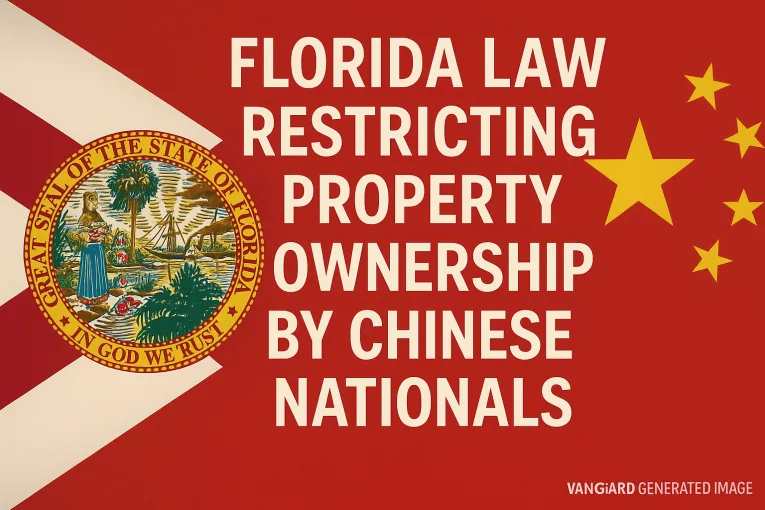
MIAMI, Fla. — In a ruling that civil rights advocates say echoes America’s history of discriminatory “alien land laws,” the 11th U.S. Circuit Court of Appeals has allowed Florida’s controversial SB 264 to remain in effect. The law prohibits many Chinese nationals from buying property in the state under the guise of protecting national security.
According to the American Civil Liberties Union, SB 264 bars individuals who are not U.S. citizens or permanent residents and whose “domicile” is in China from purchasing property in Florida. The organization explained that those with non-tourist visas or who have been granted asylum may buy one residential property under two acres that is not within five miles of a military installation—the only exception provided by the statute.
The court ruled that the plaintiffs lacked standing to challenge SB 264’s property restrictions. However, the ACLU noted that the court acknowledged the restrictions do not apply to certain Chinese immigrants who live in Florida and intend to remain there indefinitely.
The ACLU said this ruling fits a broader pattern of discrimination justified through “false claims of ‘national security’ against Asians and other immigrants” that have persisted throughout U.S. history. The organization pointed to decades of anti-Asian policies, including state-level “alien land laws” that denied Chinese and Japanese immigrants the right to own land. “Throughout the country, there has been a resurgence of these alien land laws—further eroding the rights of immigrants under the guise of protecting national security,” the ACLU stated.
While the appeals court declined to block the law, advocates emphasized that Chinese immigrants who intend to stay in Florida permanently are exempt. Nonetheless, civil rights and legal organizations have pledged continued support for Asian communities impacted by the law. Those groups include the ACLU, ACLU of Florida, DeHeng Law Offices PC, the Asian American Legal Defense and Education Fund (AALDEF), the Chinese American Legal Defense Alliance (CALDA), and Quinn Emanuel Urquhart & Sullivan LLP. Together, they represent Chinese immigrants who live, work, study, and raise families in Florida, as well as Multi-Choice Realty, a local firm whose business has been harmed by the law.
“SB 264 explicitly discriminates against Chinese immigrants, and it has broader chilling effects on Asian Americans in Florida who simply want to buy a home. We will continue to fight SB 264 and similar ‘alien land laws’ across the country,” said Clay Zhu, president of CALDA.
“SB 264 is not just unconstitutional—it harkens back to discredited century-old alien land laws that told generations of Asian Americans that this country was not their home. But our communities survived those past assaults on our rights, and we remain. We will continue to fight back for the dignity and belonging we deserve,” said Bethany Li, executive director of AALDEF.
“All people, regardless of where they come from, should be free to buy homes and build lives in Florida without fear of discrimination. Although today’s decision is disappointing, we’ll continue to fight laws like these that blatantly target immigrants based on their national origin and ethnicity,” said Ashley Gorski, senior staff attorney with the ACLU’s National Security Project.
Follow the Vanguard on Social Media – X, Instagram and Facebook. Subscribe the Vanguard News letters. To make a tax-deductible donation, please visit davisvanguard.org/donate or give directly through ActBlue. Your support will ensure that the vital work of the Vanguard continues.
