
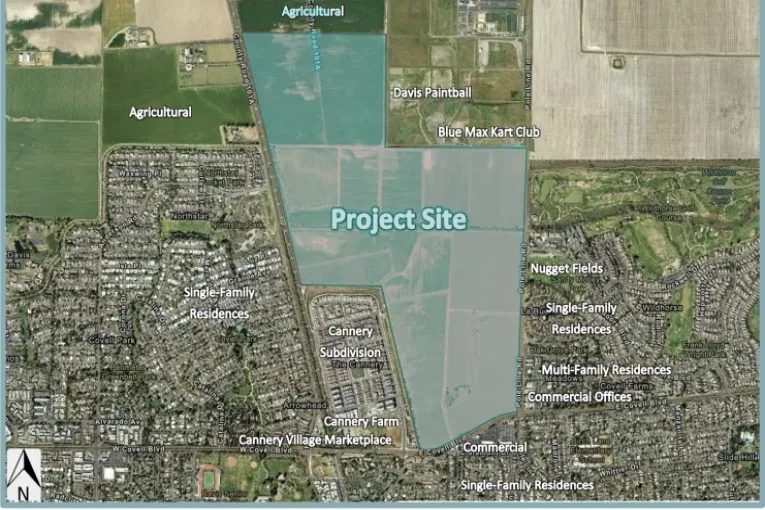
- “I couldn’t be more opposed to this affordable housing plan.” – Mayor Bapu Vaitla
DAVIS, CA – The Davis City Council sent a clear message at last week’s Village Farms workshop: the project will not move forward unless it delivers firm, enforceable commitments on affordable housing, housing mix, farmland restoration, and transparency.
Though no formal votes were taken, the discussion on November 6 made it clear the council expects major revisions before the proposed development heads to the June 2026 ballot. What was billed as a workshop quickly evolved into a decisive round of direction from a council determined to link any approval to measurable outcomes.
Mayor Bapu Vaitla was blunt.
“I couldn’t be more opposed to this affordable housing plan,” he said. “I don’t like this. I couldn’t be more opposed to this particular approach as opposed to what was initially offered by Village Farms.”
He went further, calling for a complete reset: “I would rather just go back to the initial offer that was really exciting from Village Farms, initially proposed saying it’s our responsibility to get these 280 units constructed. Put that in the baseline project features full stop.”
Vaitla’s comments reflected a broader consensus on this issue across the dais. Councilmembers agreed that the current proposal—offering land dedication and $2 million toward affordable housing without a construction timeline—was insufficient. They wanted to see enforceable guarantees that units will actually be built.
Councilmember Josh Chapman captured the consensus: “I think what we’re hearing tonight… is that certainty of construction is at the top priority.”
The council directed staff and the applicant to return with a plan that includes a performance schedule binding the developer to specific timelines. Whether through a Project Implementation Plan or municipal code provisions, councilmembers made clear that promises would no longer be enough—delivery must be guaranteed.
At several points, Chapman pushed back against public confusion about the purpose of the meeting and the process ahead.
“These conversations, this hearing that is here, we’re not voting on that this evening,” he said. “You’re here to hear our feedback and workshop like you did with the planning commission and with the community.”
He added, “Whatever that is. It’s not tonight. It’s not tonight. So my point to that is there’s all this conversation… but historically that information is not provided in set in stone in a meeting that happens tonight.”
The council’s feedback will shape a finalized development agreement and baseline project features for later hearings. In the meantime, members made it clear they expect the project to be ready for the June 2026 ballot and instructed staff and the developer to move quickly to meet that timeline.
A second theme ran through nearly every councilmember’s comments: the project includes too many large-lot homes and not enough smaller, more affordable options.
“This really is an opportunity for us to step back a little bit and look at the big picture,” said Vice Mayor Donna Neville. “This development has too many single-family homes on lots of 5,000 square feet or more.”
Vaitla echoed that position. “We want to push this as far as we can for starter homes, first time home buyers, families, but keeping an eye on obviously is that viable?”
Councilmember Linda Deos added, “It is very important that we look at when these maps are getting done… we look at more attached units, smaller lots, getting more units in there like that and fewer of the 5,000.”
The direction to staff and the council subcommittee was clear: rebalance the project’s housing mix toward smaller and denser units without undermining the project’s financial feasibility.
Councilmembers also demanded that farmland restoration and mitigation measures be made enforceable. They focused on the “borrow site,” an area where topsoil had been removed, calling for language that ensures the land will actually be restored to farmable condition.
“I’m fine just having the specific restoration language be in the development agreement,” Neville said. “I don’t know that it rises to the level of needing to be a baseline feature.”
Deos pressed for stronger assurances: “I just want to make sure that it’s fully protected that this will happen and I want to assure the voters that this will happen.”
The council agreed to include restoration language in the development agreement, along with a five-year follow-up requirement to verify the land’s condition. Deos supported the agricultural designation for the borrow site and said it should be exempt from additional mitigation because the restoration requirements already address the intent.
Attention also turned to the developer’s proposed dedication of 2.5 acres for a public-use site—most likely for a future fire station. While the council expressed appreciation for the offer, members noted that it only included land, not construction funding. Staff clarified that the developer is expected to contribute a fair share toward future construction, though details have yet to be negotiated. The council requested clearer commitments before finalizing the agreement.
Public comment again raised concerns about alleged toxins and flood risk at the site, claims that have circulated in the community for months. Several councilmembers pushed back against what they described as misinformation.
Chapman directly addressed the issue, saying, “There’s this constant drumbeat out there that the site is toxic or somehow poisoned. That’s just not true. The EIR addressed that. There are no toxics on this site. We’ve got to stop repeating misinformation because it just confuses and scares the public.”
Vaitla joined Chapman in calling on staff to issue a straightforward summary of the environmental review findings to restore public trust. “It’s just that all of us, I think you hear all of us on council wanting to get you on that June ballot,” Vaitla said, emphasizing the need to move the project forward transparently and with credible information.
That call for clarity extended beyond environmental issues. Throughout the evening, councilmembers emphasized transparency in the city’s Measure J/R/D process and rejected claims that the project was being “rushed” or “pre-decided.”
Chapman pushed back on that narrative.
“The idea that the city is driving this train when it’s a privately owned piece of property who put in a proposal that we then have to process is not the city driving this,” he said. “Our job is to put the best project forward to the voters and it’s their job to run a campaign whether you’re for it or against it.”
Councilmember Gloria Partida voiced cautious support for the land dedication approach but raised questions about how the remaining affordable housing obligations would be met.
“I’m actually okay with the land dedication because we’re going to get the number of units that meets the percentage for what we’re requiring,” she said. “What I question is the rest of the land dedication… there’s another nine, almost 0.3 acres that they still have to meet. And so then we’re coming up with all of these, well what about this and what about that and is that equivalent?”
Partida also questioned the proposed down payment assistance program, saying, “I also feel that the down payment assistance program, I don’t know how much local workforce that’s really going to address.”
The conversation underscored both the complexity and the stakes of the project. Every councilmember endorsed the broad goals of affordability, sustainability, and accountability—but all agreed those principles must be backed by binding commitments.
In practical terms, the council directed staff and the applicant to revise the project to guarantee timely affordable housing construction, pursue smaller-lot and attainable housing, finalize enforceable development agreement language covering soil restoration, agricultural mitigation, and the fire-station site, and keep the project on schedule for the June 2026 ballot.
The tone of the meeting was unmistakable. The council wants a project that not only meets legal standards but restores public trust in how major developments are proposed and reviewed under Measure J/R/D.
“Our job is to vet this and then put it to the voters to decide,” Chapman said near the end of the discussion.
Vaitla summed up the challenge ahead.
“This seems like the kind of issue that the subcommittee is well suited to have discussions with the project team,” he said. “We want to push this as far as we can for starter homes, first time home buyers, families… but keeping an eye on obviously is that viable?”
Follow the Vanguard on Social Media – X, Instagram and Facebook. Subscribe the Vanguard News letters. To make a tax-deductible donation, please visit davisvanguard.org/donate or give directly through ActBlue. Your support will ensure that the vital work of the Vanguard continues.

Davis is lucky that the owners want to pursue this project. If it was my land and I had enough other assets I’d tell them to go to hell.
We got Measure J because too many developers thought they could just run roughshod over broader community interests. We got unsustainable sprawl that is affordable only to wealthy commuters. We can continue to have developments rejected by voters because the developer is in total control, or we can actually get new housing that fits our community’s needs because the Council steps up and gives the developer good direction. It looks like the latter is now happening.
This hole in your understanding of development. For the most part; new home tend to target the upper end of a market….and in fact tries to stretch it. Why? Because it makes more profit….or another way to look at it is that the more upside the greater protection of the initial investment. It’s been said by me and by articles printed here that new homes push existing homes into the “affordable” range….or less than the top end of the market range. But new supply rarely if ever drives prices down….due to builder efforts to add amenities to the project that drive up the price….as well as they’re not going to build at a rate that will significantly impact the housing supply that will negatively effect local housing market prices.
“If it was my land and I had enough other assets I’d tell them to go to hell.”
I, on the other hand, am glad to see the City Council showing some backbone and making clear that what the community needs is more important than what the developer wants.
“community needs is more important than what the developer wants.”
That goes exactly as far as when the developer throws up their hands and says ‘enough’.
If the developers sees that submitting to the Council’s wishes is the only way forward, the developer won’t walk away. The votes of the last two years are showing that citizens are saying “enough” to kowtowing to corporate interests.
I’ve walked away from plenty of projects. I know many developers and builders that walk away from projects.
That’s why land contracts/option agreements exist. Most of the time I don’t have to commit to a project to actually buy the land or put in significant capital (if it’s a J/V deal) until after a tentative map is approved.
But I’m sure the land owners will find plenty of other developers that are line up out the door ready to build in such an easy to work with and accommodating community like Davis.
Maybe, probably and I have no inside information. But I wonder if the property owners are as committed to getting something on the ballot as people think. My guess is that the property owners are only pursuing this out of deference to and respect for one of the remaining senior partners. While its probably a long shot it wouldn’t be a surprise to me if the project owners said to hell with it.
They waited twenty years to bring this back. AKT has owned property east of El Macero for 15 years. The Cannery property owners made their position clear (nothing but housing) until the council gave up on mixed-use for that site.
Land developers can be very patient.
My guess is that nothing that transpired at the council meeting surprised them.
In fact, I believe they were actually pleased by what transpired
“Attention also turned to the developer’s proposed dedication of 2.5 acres for a public-use site—most likely for a future fire station. While the council expressed appreciation for the offer, members noted that it only included land, not construction funding. Staff clarified that the developer is expected to contribute a fair share toward future construction, though details have yet to be negotiated.”
The problem is how to pay for the ongoing cost of staffing another firehouse without blowing up the structural deficit.
The already blown structural deficit. Chunks of pavement, anyone? I’ve got a collection.
From article: “Chapman pushed back on that narrative.”
“The idea that the city is driving this train when it’s a privately owned piece of property who put in a proposal that we then have to process is not the city driving this,” he said. “Our job is to put the best project forward to the voters and it’s their job to run a campaign whether you’re for it or against it.”
(And yet, there’s this):
From article: “In the meantime, members made it clear they expect the project to be ready for the June 2026 ballot and instructed staff and the developer to move quickly to meet that timeline.”
(Sounds contradictory to the first statement.)
Ron, contradiction seems to be a theme today on the Vanguard.
Chapman is saying “this is on the developer if they want to get this on the June 2026 ballot.” I don’t see that as contradictory, just turning the table as to who’s responsible for getting there.
Council member Chapman apparently has not read the Draft EIR. The Hazards section clearly documents the high level of toxaphene (a carcinogen and neurotoxin at 1,200,00 micrograms/of soil and lead up to 93 mg/kg in the soil where Heritage Oak Park is. Residential soil should not have higher than 450 micrograms/kg and lead should not be higher than 80 mg/kg. Then there are the carcinogenic PFAS’s in levels exceeding Maximum concentration levels and other chemical contaminants leaking from the adjacent unlined Old City Landfill and Sewage Treatment Plant.
I am very glad to learn that the Council has push-back on the affordable housing component.
I have pointed out the vacuous non-committal statements of the developer.
Much needs to change and much needs to be legally assured and the City needs to get back to 18 acres for affordable housing.
Where is the “tofu” as they say in Davis.
NO – the City Council (Chapman said “There are no toxics on this site. “) is ignoring the risks identified in the EIR. One example: To summarize, the EIR should be considered the death certificate for Village Farms.
1. Toxaphene: 1,200,000 μg/kg That’s 2,667× the legal residential limit. One playground = one Superfund site.
2. Lead: 93 mg/kg in the sandbox zone CDC says zero is safe. One gust of wind = one poisoned toddler.
3. Asbestos: still locked inside the water tank house No interior test = no safe hammer swing.
4. PCB transformer: unlabeled, 50 ft from the tot-lot. One cracked bushing = 50 gallons of cancer oil.
5. Mitigation math: 500,000 yd³ of poison × $180/yd³ = $90 million. Developer budgeted $11 million. They will cap it, pray, and walk away.
6. Oversight: DTSC has 0.6 staff per 1,000 sites. The file closes the day the ribbon is cut.