
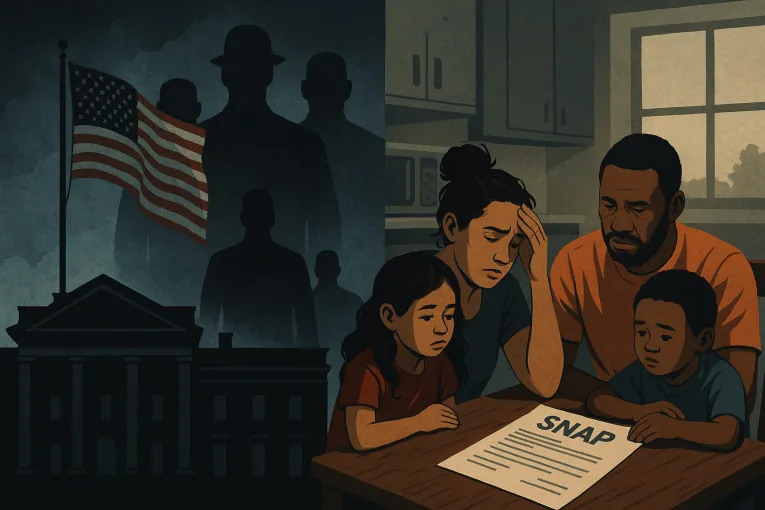
WASHINGTON, D.C. — Although the federal shutdown has now ended after more than 43 days, critics warn the decision to withhold Supplemental Nutrition Assistance Program (SNAP) benefits for millions of people set a dangerous precedent for using food access as political leverage.
According to The Hill, SNAP benefits — which feed 42 million people — should never again be vulnerable to partisan brinkmanship. “Politicians in D.C. must snap out of the gridlock and end the shutdown. And in the future, SNAP should not be allowed to become a casualty of anyone’s political food fight,” the outlet wrote.
Fear-based narratives about misuse of public benefits spread throughout the shutdown, creating public distrust and distancing voters from the reality that federal nutrition programs are essential and widely used by working families. Most people receiving SNAP work at least one job, and many work multiple jobs.
The Hill reports that “SNAP amounts to just $6.17 per day, which means that there remains plenty of incentive to work.”
Research continues to show that access to food directly impacts public safety. According to The Hill, “Economist and crime expert Jennifer Doleac noted that when Chicago improved the timing of its SNAP distributions, a study found that grocery store thefts dropped by a third.” When food assistance is reliable, crime decreases, the outlet states.
While highlighting the importance of community institutions, The Hill noted that “strong families and a strong economy that generates good jobs, along with churches and charities, are the first line of defense against poverty.” The outlet argues that when the government invests in jobs, reduces incarceration, and addresses poverty with policy rather than punishment, communities become healthier and more stable.
To prevent future harm during potential fiscal disruptions, The Hill suggests that “lawmakers should adopt design cues from this research to make food aid schedules more crime resilient, particularly during fiscal disruptions.” When subsidy programs are protected rather than paused, public safety improves.
According to The Hill, “President Trump has made reducing crime a key priority, so it’s no surprise the administration has continued to pay ‘essential’ law enforcement officers during the government shutdown.” Critics argue that cutting essential support programs such as SNAP and Medicaid while increasing funding for enforcement contradicts claims of prioritizing public safety.
Poverty continues to correlate with crime trends. The Hill explains that “when people can’t feed themselves or their loved ones, the risk that they will turn to financially motivated crimes goes up. That’s bad for families, and it’s also bad for public safety.” Critics note that instead of investing in prevention, the administration prioritized military and police spending as a response to crime.
In one of the most significant legal disputes of the shutdown, The Associated Press reported, “The Supreme Court on Friday (Nov. 7) granted the Trump administration’s emergency appeal to temporarily block a court order to fully fund SNAP food aid payments amid the government shutdown.” The administration continued resisting court directives to restore benefits, leaving millions uncertain about access to food.
AP reported that the administration also urged states that had already distributed November SNAP benefits to reverse those payments, despite the legal confusion. “Even before the Supreme Court put the rulings on hold, the Trump administration was refusing to reimburse them for those legally ordered SNAP payments,” the outlet stated.
As government operations resume, advocates and policy experts say safeguarding food access must be a priority, warning that the shutdown revealed how quickly hunger, instability, and crime can rise when essential programs are politicized.
Follow the Vanguard on Social Media – X, Instagram and Facebook. Subscribe the Vanguard News letters. To make a tax-deductible donation, please visit davisvanguard.org/donate or give directly through ActBlue. Your support will ensure that the vital work of the Vanguard continues.

“Fear-based narratives about misuse of public benefits spread throughout the shutdown”
Because there is wide spread abuse of public benefits, SNAP being one of the programs that is abused.
Ag Secretary Brooke Rollins on the SNAP fraud being reported:
Rollins stated, “29 states, mostly the red states, responded with their data sets, February, March, April. … But here’s the most unbelievable news I have really, just over the last few days: That 5,000 dead people, that was just one month, the number is closer to 186,000 deceased men and women and children in this country are receiving a check. Now, that is what we’re really going to start clamping down on. Half a million are getting two. But here’s the really stunning thing: This is just data from those 29 mostly red states. Can you imagine when we get our hands on the blue state data, what we’re going to find?”
She continued, “It’s going to give us a platform and a trajectory to fundamentally rebuild this program, have everyone reapply for their benefit, make sure that everyone that’s taking a taxpayer-funded benefit through SNAP or food stamps, that they literally are vulnerable and they can’t survive without it. And that’s the next step here.”
“SNAP Was Weaponized, Fueling Poverty and Crime”
In one week, max? This isn’t like air traffic, where the effect cascades for weeks; the money just came back.
I agree that the funds shouldn’t be held up during gov’t shutdowns. But then again, the annual charades themselves shouldn’t occur.
SNAP likely could use a good clean sweep, but a gov’t shutdown isn’t the tool for that.
A good starting point would be to call them food stamps again. A lot of people don’t even know what SNAP is (“Oh, food stamps, really?”), or didn’t until the shutdown brought attention to the program.
“SNAP likely could use a good clean sweep”
That’s the plan, Ag Secretary Brooke Rollins said that everyone on SNAP was going to have to reapply so they can root out all of the dead people and cheaters.
You have to apply every six months anyway