
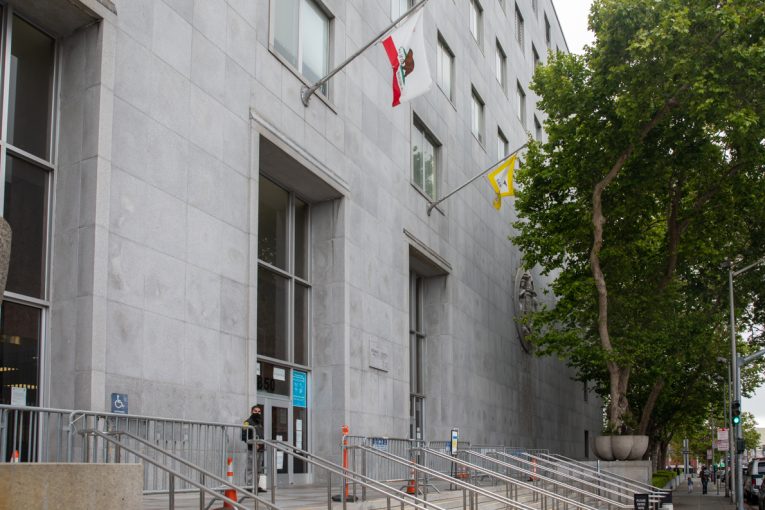
SAN FRANCISCO, CA – During the 11th session of ongoing unavailability hearings before Judge Harry Dorfman, Assistant District Attorney Ana Gonzalez continued her argument that the San Francisco Public Defender’s Office improperly declared itself unavailable to take on more cases.
Gonzalez reiterated her argument from Monday that rising caseloads were not the result of increased filings from the District Attorney’s Office, but rather from cases failing to resolve. She argued many cases result in diversion, which takes longer and delays resolution. Vanguard coverage of the prior hearing can be found here.
Gonzalez told the court that diversion cases have caused the median time for resolving felony cases to increase, resulting in larger caseloads. She said many of these cases are “backburner” cases requiring less time and attention and that, while case numbers have grown, the work required does not reflect an equivalent increase.
Judge Dorfman challenged her, asking whether Gonzalez was “in the best position to tell me what the burdens are of the Public Defender’s [Office]?” noting defending clients is fundamentally different from prosecuting them.
Gonzalez argued the Public Defender’s Office has not been transparent. She accused the office of being “opaque,” adding, “The curtains have not been pulled back, it’s more like little slits.” She also accused the office of inflating its caseload numbers by including individuals who are not in active criminal proceedings.
Gonzalez claimed staffing decisions made by the Public Defender’s Office “reflect an abundance of personnel,” citing the “second chair phenomena,” where a second attorney assists on major trials. She said former Public Defender Jeff Adachi did not use second chairs and argued the practice shows excess staffing and creates delays when attorneys are tied to long trials.
Gonzalez also argued the Public Defender’s Office assigns too many attorneys to juvenile cases. She said the District Attorney’s Office staffs only three attorneys in juvenile court, while the Public Defender’s Office assigns seven senior attorneys who are not involved in every juvenile case, calling it a misallocation.
Judge Dorfman responded that juvenile cases require greater care, stating, “The law treats juveniles with more care, and the Public Defender’s Office needs to do the same with their clients.”
Gonzalez pushed back, saying, “Attorneys are not tucking them in and driving them to school,” adding much of juvenile casework falls to probation or other programs. Dorfman replied that defenders still need to monitor the case to adequately report to probation.
Gonzalez ended her testimony arguing the DA’s Office is also overburdened but is not seeking relief. She said “the data does not support their claim of an emergency, and the law doesn’t support what they’re doing.”
Judge Dorfman again noted the fundamental difference between the work of the two offices, adding, “It doesn’t take as much to rebook a case, to look at a police report and charge someone as it does to represent them.”
Assistant Chief Attorney Hadi Razzaq from the Public Defender’s Office took the stand next and responded directly to Gonzalez’s juvenile court criticisms. “Representation doesn’t end after adjudication, the Defender is an advocate for the youth with probation,” he said, explaining that legal work extends beyond the courtroom. When asked whether that was office policy or a legal obligation, he replied, “The latter. The law requires it, that representation continues.”
Razzaq said he has consulted with nearby counties to compare workloads and staffing, stating that, based on Contra Costa County’s staffing ratios, San Francisco “would need to double the number of felony attorneys.”
Razzaq noted other jurisdictions have declared unavailability more frequently, citing Richmond, which declared unavailable five days a week for multiple weeks in 2018-2019, and Los Angeles Alternate Defenders, who declared unavailable for 80 homicide cases this year. He contrasted that with San Francisco’s practice of declaring unavailability only twice weekly and only for specific cases.
When Judge Dorfman questioned the practice of having Razzaq visit clients before arraignment rather than taking more cases, Razzaq replied, “In a modern Public Defender Office, we want to have best practices.”
Judge Dorfman challenged that, asking, “Why do we have best practice for some, while others are sitting in jail without a lawyer?” He emphasized the situation is an emergency and said best practice standards may not be feasible.
Razzaq said the crisis “has no end in sight” and assigning managers to take on additional cases would only provide a temporary fix. He said, “Managers should be focused on management, not pulled away on other cases,” adding their current work “brings more value than having one more arraignment a week.”
No ruling has been issued, and hearings will resume Tuesday, Nov. 25, with Razzaq expected to present more information on how other counties are handling similar workload crises. Judge Dorfman said he remains open to additional information and that the testimony so far has helped him better understand the situation.
Follow the Vanguard on Social Media – X, Instagram and Facebook. Subscribe the Vanguard News letters. To make a tax-deductible donation, please visit davisvanguard.org/donate or give directly through ActBlue. Your support will ensure that the vital work of the Vanguard continues.
