
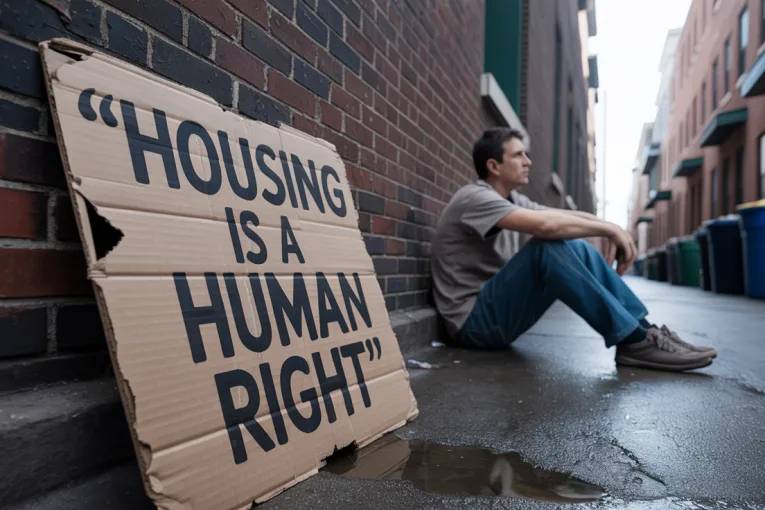
Over the past decade, the cost of living in Winters has outpaced the means to sustain it. What was once a quiet agricultural town known for its stability now faces a housing reality that mirrors much larger cities: people are camping along the creek, vehicles have become homes, and local wages no longer align with the price of staying housed.
The numbers tell a steady story. In 2015, Winters’ median rent hovered just below $1,400. By 2019, it had climbed to about $2,292, the highest among all Yolo County jurisdictions at the time. Since then, costs have continued to rise while the supply of housing, particularly affordable or multi-family units, has lagged. The city’s 6th Cycle Housing Element, adopted in 2022, confirmed what residents already knew: most of Winters’ housing stock is single-family, ownership-oriented, and financially out of reach for much of its workforce.
During that same ten-year span, local wages have grown far more slowly. Service and agricultural positions, two of Winters’ most common employment sectors, typically range from $17 to $22 an hour. At those rates, even a full-time worker spends well over half of their income to rent a modest apartment, assuming one is available at all.
The result of that arithmetic has become visible. The 2024 Yolo County Point-in-Time Count identified approximately 75 unhoused individuals within Winters, a modest number compared to regional cities, but significant for a town of this size. Countywide, homelessness has increased roughly 26 percent since 2022, reflecting broader economic pressure throughout the region.
Several affected residents I’ve spoken with, all of whom requested anonymity, pointed to the same core issue: paychecks that no longer meet basic housing costs. None mentioned addiction or personal decline as the cause; they cited affordability first. However, addiction and substance use have since become part of the local challenge, often developing after housing loss rather than preceding it. Service providers working in and around Winters confirm that loss of connection and homelessness create conditions that make recovery or stability harder to achieve.
City documents acknowledge these realities in measured terms. Winters’ Housing Element lists homelessness, rental cost burden, and a shortage of diverse housing types as key issues for the 2021–2029 planning cycle. It also highlights compliance with state mandates allowing emergency shelters and supportive housing by right in specific zones. These are necessary legal steps, but they haven’t yet translated into visible on-the-ground capacity; there is still no permanent shelter or transitional housing facility within city limits.
That gap leaves most response efforts to county agencies and nonprofits operating out of Woodland or Davis. For unhoused residents in Winters, that distance often means inaccessibility. Without local shelter beds or navigation services, the default has become encampments along the creek or informal arrangements in vehicles.
The economic roots of this problem are clear. Housing construction has not matched demand, and when projects do move forward, they often target middle- and upper-income buyers. The lack of multi-family zoning in older neighborhoods limits options for working families. Accessory dwelling units, while helpful, address only a fraction of need.
Meanwhile, inflation, tariffs, and post-pandemic market adjustments have raised construction costs, further discouraging builders from producing lower-cost housing. It’s a cycle that has compounded over the past decade, one that’s particularly visible in smaller communities like Winters, where even a few dozen households pushed into homelessness are immediately noticeable.
Local government is not ignoring the issue. The city has maintained compliance with the State Department of Housing and Community Development, participates in the Yolo County Continuum of Care, and continues to list housing affordability as a core policy goal. But a decade of incremental progress has not been enough to offset structural imbalance.
The past ten years in Winters have shown that the margin between stability and homelessness can narrow quickly. What used to take years of hardship can now happen in a few missed paychecks. The data show this… The people living along the creek confirm it through their presence.
Addressing homelessness here requires more than regional coordination, it requires local infrastructure and sustained attention. That means developing land specifically zoned for supportive housing, expanding affordable rental options, and aligning wage expectations with the actual cost of living in the area. It also means recognizing that homelessness is not an imported problem or a passing phase; it’s a measurable outcome of a decade-long economic pattern.
Winters has always been known for its sense of community and resilience. The test now is whether that same sense of community can extend to those living just outside the margins, residents who, ten years ago, were likely renting or owning within city limits.
The city’s next housing cycle will be measured not by compliance or paperwork, but by how many of those people find their way back into stable housing.
Follow the Vanguard on Social Media – X, Instagram and Facebook. Subscribe the Vanguard News letters. To make a tax-deductible donation, please visit davisvanguard.org/donate or give directly through ActBlue. Your support will ensure that the vital work of the Vanguard continues.

There is the assumption here that all who are homeless lost their homes while in Winters because their wages could not keep up with their rent. Is there evidence of this, or just an assumption? I assume some are / some aren’t, but the implication is clear.
Apartments.com shows the average annual rent in Winters to be $744/month, as of November 2025. (54% below the national average.)
https://www.apartments.com/rent-market-trends/winters-ca/
Zillow shows it to be $1,700 per month for an equivalent one-bedroom unit.
https://www.zillow.com/rental-manager/market-trends/winters-ca/
In any case, whatever the number is – one should probably compare it to the general rate of inflation for a given period of time. (Not sure why some people seem to expect that housing prices don’t rise along with all other costs. The main difference is that it comes from a higher “starting place” than a gallon of gas or milk.