
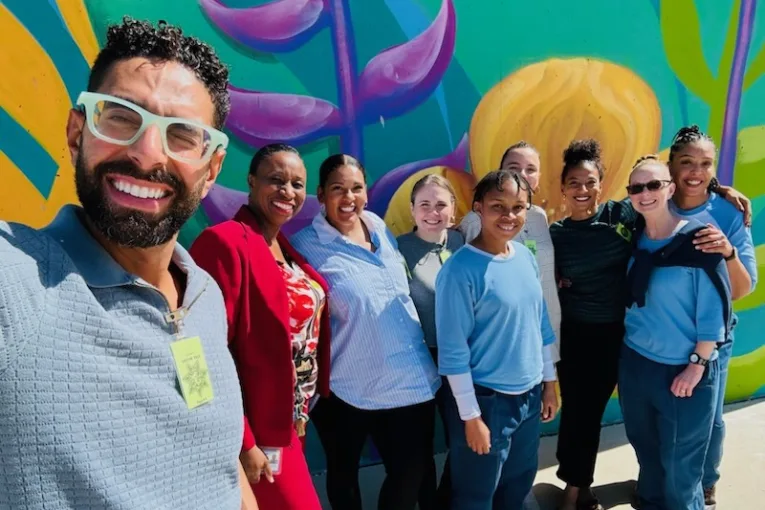
When word came to me in September that one of our nation’s leading carceral studies experts, and one of the most respected female mass incarceration historians involved in critical prison studies, wanted to meet with me to discuss the formation of a CCWF chapter of the Yale University-sponsored Carceral Studies Journalism Guild, I became nervous. I’ve had the honor of spending time with Reginald Dwayne Betts to discuss literature, and sharing space with Oprah Winfrey, but Dr. Elizabeth Hinton — the woman entrusted with the Angela Y. Davis archive at Harvard, who traveled the Harvard debate society into MCI Norfolk prison for an inside-out debate while teaching at Harvard, and is building an uncensored journalism program with our brothers across the street at the men’s prison at Valley State (where I once lived) from Yale, where she teaches now — hit me differently. I felt compelled to devour her life, chew on it thoroughly, and become worthy of her confidence in me.
I was tasked with recruiting a squad of thinkers, feelers, and experienced women, capable of observing this human experiment they call prison, recognizing its patterns, being curious, and bringing a diversity of lived experience to a project I didn’t feel quite worthy of. Over the course of the next few weeks, I probed the yards, took the measure of my community, and invited into this effort those who move with integrity, live in peace, and radiate a sincere capacity for empathy. Writers are really observers, and to do that well, one has to shed the self, imprint upon the other, and pour into that outside-the-self perspective. Not everybody is built for that — I wondered if I was.
Some people impact you with so much emotional force, they alter your being — you become changed in a fixed way that reorients how you think about your purpose. When I met and embraced Hinton, along with her team of justice warriors, it felt like we’d known each other for years — like family.
That is what Hinton brings to the room — when she looks at you, nothing else matters to her — you are all she sees and hears, and you feel completely seen and heard. I’d never felt like that with a stranger, and it made me think about how much more present I could be with, and for, the people we share this place with. Just in the way she made herself small, and focused upon us, Hinton taught us something quite profound about empathy — our first journalism lesson.
My struggle sisters Adanna Ibe and Crystal St. Mary joined me, for what was a tear-filled circle of unfiltered expression about art, healing, and possibility, shared with Hinton, the founder of the Yale Institute on Incarceration & Public Safety (YIIPS), and YIIPS Executive Director Yaseen Eldik. They were accompanied by Elizabeth Ross, managing director of the Challenging Discrimination in the Law Project (CDLP), Elsa Lora, case manager for the CDLP, and Dr. Tanisha Cannon, the managing director of Legal Services for Prisoners with Children (LSPC). It was extremely gratifying.
“I was intimidated at first,” St. Mary admitted. “How many California prisoners get visited by a legit roster of Harvard and Yale law grads, who travel across the country to selflessly learn about us? They fully engaged us with such intense attention – I was truly amazed – the experience of just being in community together, really evoked deep emotion in me. It was powerful.”
“For them to travel so far, just to see us, was really an honor and a privilege,” Ibe reflected. “They completely validated who we are – mothers, writers, artists – Dr. Hinton, her team, they were fully present, truly. I feel really inspired and motivated to be a part of this CSJG project.”
We took pictures together, plotted a course for building out content for the Witness platform, and planned the curation of the stimulating resident brain food recipes we will deliver for YIIPS’s forthcoming Inside Knowledge channel on Edovo, where all of our work will become accessible to over one million people living in confinement via DOC-issued tablet device. Publishing free from censorship, via the Witness platform, affords us an opportunity to not have to compromise our measured critiques of the prison media apparatus unlike prison-sanctioned newspapers, including The Paper Trail, CCWF’s official prison newspaper.
“We arranged for this gathering with our sisters at CCWF,” said CSJG founder Ghostwrite Mike, “because honestly, without the women, both inside and out, there would be no critical prison studies scholarship, no abolition movement, no Justice Now!, no radical Black feminist praxis, no All Of Us Or None, and no substantive solidarity in the struggle movements that are braided by the work of women – point blank period – full stop. Prison and Vietnam built Etheridge Knight, but Gwendolyn Brooks made him viable. Similarly, there would not have been a Soledad Brother, San Quentin 6, or Critical Resistance to fight for – not in the manner in which these struggles came to be knowable – without Angela Y. Davis.”
“Everything we do in this space,” Ghost explained, “is enabled, by women of conscience who have leaned into our concern for the health and safety of all people caged. We owe it to those who lived here at VSP before us – those now at CCWF – who endured needless hysterectomies, suffered sexual abuse and had the bravery to report those state crimes, but were ignored, silenced, and retaliated against. Uncensored truth, is the antidote for the propaganda toxin that oozes from the prison media complex. CSJG is that medicine, and Inside Knowledge will be our inoculation against the virus of state secrecy Michelle Jones said we need to protect ourselves from. We can’t wait to see the women historicize their own prison’s origin story – we know Paper Trail won’t do it.”
The Paper Trail publishes here at CCWF – I’ve shared a cell with its editor-in-chief, and debate team duties with one of its better contributors – and I have, along with St. Mary, Emily Gonzalez, and other women we will work alongside, been featured, quoted, mentioned, or photographed therein; however, where there is politics, territorialism, and censorship, there can’t be freedom.
Take, for example, the Paper Trail’s lackluster coverage of the sexual abuse trial of former CDCR officer Gregory Rodriguez. The Paper Trail published about Rodriguez in August, seven months after he’d been convicted. In its report, the paper did not include any quotes from Rodriguez’s victims, but rather included quotes from two residents — one of whom is a contributor to the paper — that framed some residents as “choosing to entertain his advances.” In the story, one resident referred to incarcerated women as “broken,” saying “people want attention.” That is how the Trail decided to frame the motivations of the women in our community who were brave enough to accuse Rodriguez.
By comparison, All Of Us Or None — the newspaper of Legal Services for Children, which operates outside the purview of CDCR — went to press about Rodriguez in March. AOUON printed what The Trail did not, citing how CDCR “often ignored or mishandled the complaints, allowing the abuse to persist unchecked” with complaints dating back to 2014. CDCR’s ignoring of the misconduct mirrors how a gynecologist who sadistically sterilized residents at VSPW/CCWF was allowed to work at CCWF, even after being reported while we were still housed at VSPW. In its report on Rodriguez, AOUON links these events as “unchecked abuse” facing incarcerated women.
The narrative published in the Paper Trail, from a reader’s perspective, largely discounts the possibility that any of Rodriguez’s accusers were true victims of his predation as opposed to willing participants. That sort of narrative can dissuade future whistleblowers, and avail bad state actors the sort of implicit cover they are not entitled to. The article is lacking in terms of its coverage of details about the allegations from the prison’s investigation and the victim’s lawsuits, which are reported in The Guardian. Over years of unchecked abuse, women were isolated and abused during the time they were supposed to have legal visits, in rooms without cameras; these are off-yard attorney visits via Zoom, where women take legal phone calls by appointment, for which women are summoned to a small office alcove and are often alone, oftentimes with a single male officer setting up the room. With parole suitability and freedom in the balance, this is the most vulnerable a female life prison will ever be to officer abuse.
Why is pursuing reparations for slavery not disqualifying, but defending our bodily autonomy is?
Ours is a journalistic calling, rooted in the praxis of struggle solidarity, tethered to the questions posed by Critical Resistance, and the life of the thought leader who asked us all to consider the role of prisons, by examining the harm they cause beyond the loss of liberty. In 2000, Angela Davis invoked our community’s pursuit of health care justice in Social Justice. A year later, Davis and Cassandra Shaylor described inadequate health care conditions and sexual abuse at CCWF in a Meridians article titled “Race, Gender, and the Prison Industrial Complex: California and Beyond,” which you can read via EBSCO. These writings, in addition to reporting here and in AOUON, illustrate how these are longstanding, unresolved struggles. It was AOUON, via Legal Services for Prisoners with Children, who rallied to enact the legislation that addressed that same medical neglect and feminine hygiene status quo of dehumanization Davis cited. Though there was a full circle advocacy arc to celebrate concerning our community, The Trail has not covered the visit to CCWF by Hinton, Lora, or Ross.
It was Hinton who, along with Lora, shared the Angela Davis archive at Harvard with female prisoners, before the public had access to it. It was Ross who joined Hinton to beat back the imposition of a mandatory minimum federal sentence against Kendall Johnson, via 21 U.S.C 860(a), using the historicization of the legislative intent and racially disparate impact of the law (United States v. Johnson, 40 F3d 436, 440 D.C. Cir. 1994). Their work, published in The Harvard Law and Policy Review and searchable via EBSCO by title:“The Discriminatory Purpose of the 1994 Crime Bill,” dared the federal government to brief its case on motion, and risk an adverse decision. The legacy of concern for people in confinement, particularly women, extends from Davis, to the very women who abandoned the comforts of the Ivy League, left their children with caretakers, traveled to the armpit of California, stayed in that dingy Holiday Inn down the street, and sat with us, in order to build a freedom of expression vertical The Paper Trail doesn’t allow.
I have never felt more honored to learn, be of service, and pursue justice – for everybody.
