
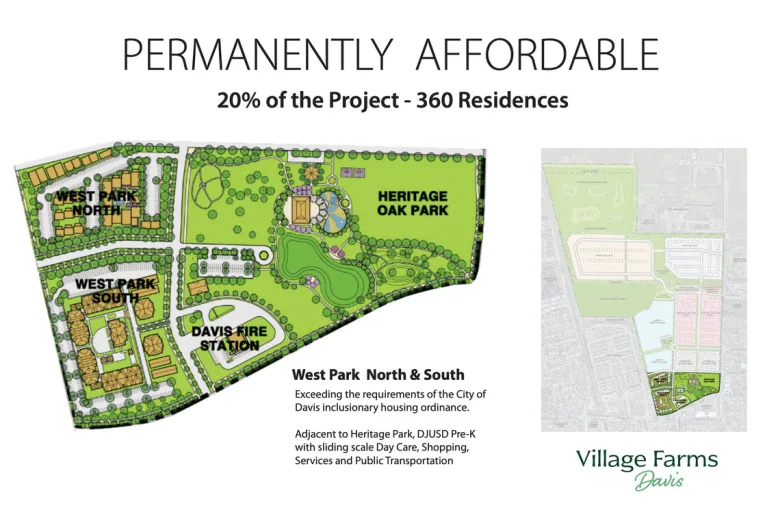
DAVIS, Calif. — A prolonged and at times tense Davis City Council discussion on Tuesday laid bare sharp differences of opinion over how affordable housing should be guaranteed in one of the city’s largest proposed developments, with councilmembers sharply divided over whether the project, as structured, offers a credible path to producing income-restricted housing or risks repeating past failures.
At the center of the debate was whether affordable housing commitments should be locked into the project’s baseline features — the elements voters would approve under Measure J/R/D — or handled through a development agreement that could be amended in the future.
Councilmember Bapu Vaitla repeatedly warned that without baseline guarantees, the city could approve a project that delivers land and funding but ultimately produces no affordable units.
“If we accept this, no units will be built,” Vaitla said. “No units will be built.”
Under the proposal before the council, the developer would dedicate 16 acres of land and contribute up to $6 million toward affordable housing. City staff and members of the project team argued that this approach, which would place responsibility for securing financing and partnering with an affordable housing developer on the city, offered the most realistic chance of success given current market conditions.
Vaitla strongly disagreed, citing conversations with regional affordable housing developers who estimated the cost of building the proposed 280 low-income units at roughly $150 million. Even assuming multiple successful rounds of competitive 9 percent tax credits, Vaitla said the remaining financing gap would be far beyond what the city could reasonably fill.
“That cuts that $75 million to $69 million,” he said. “That’s a $69 million financing gap for the city to fill. There is no scenario in which we do that. None.”
Vaitla argued that voters would reasonably believe they were approving 280 affordable units, not a land dedication and partial funding with no enforceable obligation to build. “If that’s what is in front of them, it should be clear that what they’re voting on is to receive 280 units, not that they’re voting on to receive 16 acres, $6 million and zero units,” he said.
As a compromise, Vaitla proposed placing at least 100 affordable units into the project’s baseline features, with a trigger that would shift responsibility back to the developer if the city failed to deliver the units within a defined timeframe or by a later construction phase. “I’m a voter, I’m going to the ballot,” he said. “I want to know that if I’m voting on affordable housing, that somebody has responsibility for getting that affordable housing and it’s not the city in perpetuity.”
City staff acknowledged the uncertainty surrounding affordable housing finance but defended the proposal as the most viable option available. Social Services Director Dana Bailey said staff could not guarantee outcomes but emphasized that affordable housing developers increasingly require visible city partnership to compete for scarce funding.
“There are no guarantees,” Bailey said. “What we can bring forth are our best efforts.” She said developers “need the city in partnership with them to show that they’ve got local support to get the units built.”
Bailey added that while some past projects had relied on land dedications to private affordable housing developers, market conditions have changed. “The affordable housing developers are looking to the city to partner because the climate has changed,” she said. “The way that we show that we’re partnering is by being a part of the initial application.”
Vice Mayor Donna Neville said the revised proposal followed extensive negotiations after the applicant team concluded it could not feasibly build the affordable units itself.
“The overarching goal is get the units built, do what makes the most sense,” Neville said. “Where all staff and subcommittee on council landed was the greater likelihood of these units getting built is this proposal rather than a proposal where this development team tries to build the units itself.”
Neville praised the scale of the concessions negotiated, noting that the proposal increased the land dedication from nine acres to 16 acres and tripled the city’s financial contribution. She said the deal exceeded what the city would receive under a strictly code-compliant approach. “We are in a far better place,” she said.
Other councilmembers expressed optimism that the partnership model could succeed.
Councilmember Gloria Partida emphasized that the process had unfolded over several years and that unresolved issues remained.
“This is not a fast process,” Partida said. “This process has been going on for at least two years.”
Partida acknowledged concerns that affordable housing might never be built but said she was not convinced failure was inevitable.
“I hear that concern and I think that this is a concern of a lot of folks in the community,” she said. “I am hopeful that things will change and that people are beginning to understand that affordable housing is something that has to be invested in.”
City Attorney Inder Khalsa cautioned that placing rigid affordable housing obligations into baseline features could create unintended consequences if financing proves infeasible for any party.
“If it’s infeasible for the city to build, then it’s likely infeasible for the applicant to build at that point as well,” Khalsa said. “What actually happens is that when the trigger is met, the project simply ceases to move forward.”
Khalsa said the legal issue was not whether such triggers could be drafted, but whether the city was prepared to accept the risk of stalling market-rate housing if affordable housing conditions could not be met.
“That’s a trade-off that the city should be focused on,” she said.
The discussion grew more contentious when a representative of the development team said the project already exceeded city code requirements and suggested returning to a ministerial land-dedication approach if consensus could not be reached. Vaitla pushed back, noting that Measure J/R/D makes the approval discretionary and arguing that the code’s intent was to ensure affordable units are actually feasible to build.
“I’ll fight you every step of the way,” Vaitla said, disputing the interpretation that land dedication alone satisfied the city’s affordable housing goals.
Vaitla also raised broader equity concerns, arguing that the project, as proposed, primarily benefits higher-income households while placing the burden of affordable housing on the city. He cited consultant estimates showing that some homes in the project could exceed $740,000, requiring incomes well above area median levels.
“There is no universe in which I would call those affordable to normal people,” he said.
Rochelle Swanson, speaking for the development team, framed the affordable housing proposal as a good-faith effort grounded in financial reality rather than an attempt to evade responsibility.
She noted that the project was not coming forward “empty handed,” pointing to the combination of a 16-acre land dedication and up to $6 million in funding as a substantial commitment in the current market. “It’s 6 million, it’s not zero,” Swanson said, arguing that the proposal brought real resources to the table even if it did not guarantee unit construction in the baseline features.
Swanson repeatedly cautioned against embedding unit guarantees in the baseline project features if they could later prove infeasible. She said it would be easy to promise specific numbers to secure political support, but doing so could ultimately stall the project and prevent any housing from being built.
“It would be an easy throwaway to be like, sure, let’s throw it in there and see what happens,” she said. “But the key here is the integrity. There’s no empty promise. It’s what is feasible, what can be done.”
Addressing concerns about accountability, Swanson said the development team had already made significant investments of time and money and was deeply tied to the community. She noted that the property had been held for decades and that years of planning, consultant work, and public engagement preceded the current proposal. “These aren’t empty promises,” she said.
“These are hard fought, digging down deep looking at where they can get the funding to do it.” She pushed back on the idea that the developer would simply walk away, stressing that the team remained committed to seeing the project succeed.
Swanson also questioned the practicality of time-based triggers, calling a proposed 10-year deadline “a number pulled out of the sky.”
She argued that large, multi-phase developments are better governed by phasing-based triggers tied to actual construction and cash flow rather than arbitrary timelines. Rigid deadlines, she warned, could freeze a project if conditions shift, creating unintended consequences that leave neither market-rate nor affordable housing built.
Throughout her remarks, Swanson underscored that affordable housing production is a shared responsibility and cannot be solved by a single project or developer.
She referenced the loss of redevelopment funding and the increasingly constrained state and federal financing environment, saying these structural challenges explain why developers often return to cities seeking assistance.
Framing the proposal as a realistic path forward, she said the goal was to “put the city in the best position to get these units built,” even if that meant resisting demands for baseline guarantees the development team did not believe it could deliver.
Despite his criticism, Vaitla said he wanted the project to succeed and win voter approval, provided enforceable affordable housing commitments were included.
“It’s hard for me to imagine a scenario in which you agree to everything that you’re giving us, put those 100 units in baseline project features, agree to a trigger that’s time- and permit-based and me not support it,” he said.
As the debate stretched on, councilmembers discussed whether to send the issue back to the council subcommittee for further negotiation.
Vaitla made a motion directing staff and the applicant to explore including a specific number of affordable units in the baseline features with a trigger mechanism. Neville seconded the motion, though some members expressed concern that reopening negotiations could stall or jeopardize the project.
Councilmember Josh Chapman said he was reluctant to take actions that could effectively kill the project but shared concerns about whether the current proposal would result in built units.
“At the end of the day, we talked about that we wanted to see units getting built,” Chapman said.
The council did not resolve the issue during the meeting. Staff indicated that tentative dates were available in early January if additional council direction was needed before a formal public hearing. Further negotiations are expected as the city weighs how much risk it is willing to assume — and how much certainty voters should demand — before placing the project on the ballot.
Follow the Vanguard on Social Media – X, Instagram and Facebook. Subscribe the Vanguard News letters. To make a tax-deductible donation, please visit davisvanguard.org/donate or give directly through ActBlue. Your support will ensure that the vital work of the Vanguard continues.

If state-mandated affordable housing targets can’t be met under prevailing financial conditions, then I see no reason to approve the project. The developer says he can’t build the affordable units and still make money, and I don’t doubt that. The city clearly can’t come up with the money to build them. So why even consider the project? We don’t need more executive homes for Bay Area refugees.
As a voter, the *only* reason I would vote in favor of a Measure J project is if it fulfills a significant portion of our next-cycle RHNA affordable requirements, which means that the commitment has to be in the baseline features. A “cross your fingers and hope some miracle happens” development agreement isn’t going to get my vote.
And what if that means that the state says, you have to build the housing?
“And what if that means that the state says, you have to build the housing?”
City to state: “Build it with what?”
To be clear, the city doesn’t build it, the city approves the project to be built. Remember it took about 20 years to fill out Mace Ranch’s affordable housing. It took a long time, but eventually that housing was built and fills a vital need.
Mace Ranch had access to redevelopment funds, even if indirect, that no longer exist.
“And what if that means that the state says, you have to build the housing?”
City to state: “Build it with what?”
State to city: “remove the impediments to getting it built, such as voter approval requirements.”
Last night’s meeting made it abundantly clear that Measure J is not standing in the way of affordable housing, the economics of affordable housing is the problem. If the state intervenes and says, “You’re obstructing the creation of affordable housing, so we’re imposing the builder’s remedy (7% ELI, 10% VLI, 13% LI),” how many projects do you think will get built? I put that number at zero.
Bottom line: I don’t think Bapu was right.
The builder’s remedy requires that the developer build/fund 20% affordable housing. That’s a bigger burden than what Bapu was proposing. The state will have to rescind its own Affordable requirements to force Davis to build with a smaller amount.
Richard, I believe Builders Remedy only applies to parcels that are within a jurisdiction’s boundaries (in the City Limits).
Sounds like Bapu and Josh are “impediments” to getting it built, and that (if forced to do so) – it still wouldn’t address the state’s Affordable housing “requirements”.
Councils aren’t always “automatic approval machines”, either.
Maybe the state SHOULD get directly involved in approving developments that don’t address its own requirements. And that way, the state could sue itself (or maybe some YIMBY group would do so, as they’re doing with Newsom’s suspension of SB-9 in Pacific Palisades).
Maybe councils themselves can be entirely eliminated as “impediments to sprawl” (that doesn’t address the state’s “requirements” in the first place).
Bottom line is that this is yet another example of the unrealistic, unachievable nature of the state’s “requirements”.
How was Josh an impediment?
Josh ultimately agreed with Bapu – he wanted to see some mechanism where some minimal number of Affordable housing units are included in the baseline features.
In any case, I gained a newfound respect for Bapu Vaitla, even though “my” issue isn’t Affordable housing. His manner of speaking reminds me of Obama (stacatto, and to-the point – and is aligned with an issue that’s important to him).
To the point where he said “go ahead and withdraw the project, if you want to. We have other applicants/potential developments in the pipeline, anyway” – paraphrasing). I was almost shocked to hear him say that, and it reminded me of the days when councils actually meant something.
Of course, he also ran on a platform of “infill”.
But for Josh, the process would have come off the rails completely. I would argue (and may argue in a future piece) that Josh occupied a narrow but decisive space between Vaitla’s demand for enforceable baseline guarantees and the applicant team’s insistence that such guarantees were infeasible, using process, pacing, and clarity to keep negotiations alive.
Bapu ran on a platform of infill FIRST. The current Housing Element filled up the available slots so now we need to look beyond current city boundaries. Bapu was clear that was his strategy.
Infill in Davis isn’t “complete” either, Richard. It never is.
That’s what every city along the coast is dealing with in regard to the unfeasible housing “requirements” as well.
Even Trackside is just sitting there (not to mention the theater, Hibbert’s, etc.).
But again, there’s ALWAYS room for more infill – in regard to fake plans. And just about every plan submitted to the state (in regard to cities along the coast) is fake. The next round of plans will be even more “fake”.
Are you checking up on where/when I voted, still? Do you do that with Don, as well? And what makes you think that’s a determining factor regarding how to define “infill” vs. “sprawl”?
Bapu ran on a platform of infill, but has been trying to attack Measure J ever since.
I watched part of this meeting. It was rather astonishing to learn that (not even 100 units on a portion of the small 16 acre site – within the larger 400 acre site) are realistically going to be built under the current proposal.
Really? They can’t make that “pencil out”?
The justification for sprawl in this case includes no realistic path for Affordable units – potentially for decades? THAT’s what’s being presented here?
It was also quite surprising to see Bapu Vaitla firmly “hold the line” on that minimal goal, especially after council member Donna Neville was practically gushing over the proposal.
It was also interesting to hear that the developer of the Affordable component of Bretton Woods is now begging the city for money.
I think the message here is that affordable housing is extremely expensive, construction costs increasing massively have made it even more extremely so, and someone has to pay for that. Developers can only concede so much before they won’t make a profit that is worth it, and at some point won’t even be able to secure financing.
Let’s face it folks, it’s really expensive to live in California, and it’s even more expensive to live in Davis, and we can chase highly-subsidized schemes to try to get a small number of people who can’t afford to live in Davis, to live in Davis; but in the end, the well-off will always be able afford to live here, and subsidization will just knock off some of the lower-middle class people from living here so that a few people from the next rung down on the economic ladder can live here, and overall with all the time and money spent on all the schemes less housing gets built overall and it hurts more people. The reason the state doesn’t have all the so-called ‘redevelopment’ money to give away is that was extremely expensive and ultimately we all paid for that too, filtered also through money-skimming bureaucracies.
As for affordable at V.F. — ten years out, and even that couldn’t be guaranteed, and wasn’t acceptable, and the affordable units proposed were declared to not be remotely affordable. And Nishi still hasn’t been built, which kinda illustrates my overall point. Wouldn’t maybe the best path forward to achieve more housing in Davis be to stop trying so hard?
Nishi hasn’t been built because of Measure J. To pass a Measure J vote the owners gave up access to Richards Blvd.
Ron G
In a nutshell, yes.
Just to close the loop on an issue I raised a few days ago, council verbally confirmed last night that all references to inclusion of a costly fourth fire station or a public safety center are being removed from the Village Farms project documents. I am grateful that this matter has been revolved. This will allow the city of start with a clean slate in deciding what to do with that 2.5 acres so that, if the voters approved the project, that land would be dedicated to the city for a public use to be determined in the future. For example, with zoning adjustments and additional environmental review, it is possible it could be considered as an additional site for affordable housing or the cooperative housing project considered earlier in the process. It also presents voters with a project that, on the basis of an independent fiscal analysis by a respected local consulting firm, now clearly would have a net positive fiscal benefit to the city rather than aggravation of the city’s already serious fiscal problems. I’m grateful that folks at City Hall listened to us on this issue.
” He cited consultant estimates showing that some homes in the project could exceed $740,000, requiring incomes well above area median levels. ”
$740,000 is below the median home price in 95616 proving that adding supply lowers prices.
When asked at his last press conference about the increasing average age of first time buyers Federal Reserve Chairman Jerome Powell stated “Housing supply is low… also we haven’t built enough housing in the country for a long time and so a lot of estimates suggest that we just need more housing of different kinds.”
This is all so sad. Instead of building more housing of the kind they prefer Vaitla and his friends want to reinvent what is being proposed and seem willing to scuttle projects that don’t pass muster with their vision of the future. The sad part is instead they should be planning more projects that meet the needs of more people instead of trying to engineer a market reality that doesn’t exist. You want to lower housing prices build more homes. Seems simple to me and to Jerome Powell too.
The developers aren’t planning to build the housing that we prefer. Instead its more housing for the wealthy commuters who increase our traffic and pollution, and don’t have children. We need the developers to revise their proposals to include more housing at lower price points. We don’t need what they are offering right now.
Who is we? And how do you know the future buyers don’t have children?
I agree with you Ron G. (Relatively) wealthy people have children, too.
Don’t know why, however, that’s a “preferred population” – other than for the oversized school district.
For sure, families with children seek out housing that addresses their needs/desires. And they’ll find it outside of Davis pretty easily – at a better price. Actually, they’ll find it pretty easily in Davis as well – it just costs more. (And not that much more, when comparing something like Stanley Davis houses to “new” junk houses in Woodland for example. All new houses are made from junk/garbage, when you come right down to it.)
In general, families are among the most “impactful” in regard to driving, costs to support school districts, libraries, soccer fields, etc.
Ron G. “$740,000 is below the median home price in 95616 proving that adding supply lowers prices.”
How does that “prove” anything, unless that’s the actual sales price? And what do those units consist of (e.g., single-family vs. attached, lot size, garage space, etc.)?
Stanley Davis houses (larger lots, 2-car garages, better location, better materials, mature landscaping, sufficiently-wide streets) go for about that much now.
Alan M. “Let’s face it folks, it’s really expensive to live in California, and it’s even more expensive to live in Davis . . .”
Actually, I think the median price in Davis is right-around the California median, possibly even a little lower than the California median at this point (haven’t checked lately). Davis is a “bargain” compared to the entire Bay Area. Those people probably look down on Davis as the “poor man’s” Berkeley – the place to stick some “cows from Berkeley (mooo)” – reference to a commercial from long ago.
It’s much better to get guaranteed funding for a smaller number of Affordable housing than to leave an open ended obligation on the City for a larger amount. That said, the funding for the smaller amount would still need to be a Baseline Feature that can’t be negotiated away.
The rest of the solution then is to require higher density housing that will be more affordable to lower income households than the current target market. This housing also will be better aligned with the City’s workforce housing requirements and the climate action plan objectives.
I propose a friendly amendment to Richard’s comment above. If smaller units are built on smaller lots so that they have $500,000 price, affordable units will be the result … “small a” affordable rather than “big A” affordable … but affordable nonetheless.
https://davis.granicus.com/player/clip/1902
THE most fascinating, relevant and jaw-dropping statement from the Village Farms discussion last night came from Sandy Whitcombe of the development team:
“I want to be clear that 16 acres of land is worth tens of millions of dollars once we’ve put all of the infrastructure in. That’s incredibly costly. This extra four acres and the six million is maybe a $30 million contribution. Just want that to be very clear.
Nobody has ever in this town done anything close. Nothing even close! And nobody will. You’ll see that very soon. Nobody will. We are talking so for over what anyone has done. So it is incredibly disappointing to have people come back and ask for more more more !
Bapu! We talked. I wanted to make you happy. I had something that we discussed, and you know what it is, and that’s our line in the sand. We are not willing to go into the baseline features because we are already donating so much to get these 360 units done, that we are not willing to confuse voters and say: ‘oh, we’re going to do a hundred’. That makes no sense, and we are not willing to kill our election because of your fancy.
Basically we are willing to work in the development agreement and put in a provision that I worked on. There cannot be timing: ‘Oh in ten years if we don’t have it done we have to build it’. You’ll have another family of homeless people and that will be me — if you do that — my family. We have no ability to come up with $50 million dollars. I’m sorry.
So you can’t put timing in. I already told you what we would do, and that is our line in the sand. We’ve already said we will accept your dissent. And we will. We will accept your dissent. If we can get three of you, that’s fine. If we can’t, that’s fine.
You have to understand, this is an incredibly generous offer to the city. And I don’t think many other developers are going to come back with something like this. I really don’t. So that’s it. If you want to do the motion to include a conversation about the development agreement, we’re all in.”
***This can be found at 3:17:40 — this is a must watch, as her tone on several of the words is relevant.
Wow – I didn’t hear all of those comments. I only heard the part where she claimed that the 16 acres is worth “millions of dollars”.
I’d like to ask her what Whitcombe paid for the ENTIRE 400 acre site as farmland.
I didn’t hear where she essentially didn’t care how Bapu (and presumably Josh) might vote.
This proposal is going to lose, especially since they’re apparently not even agreeing to PAY FOR the grade-separated crossing, let alone the Affordable housing.
It really does seem like the development team is not on the same planet. (I’m not saying that as someone opposed to the proposal – the NORMAL supporters of this type of proposal apparently have significant concerns.)
If I was the development team, I would not like my chances at this point. (Again, that’s an “objective” conclusion.)
The focus is likely to shift to Shriner’s (though I personally think that’s an even worse location).
“If we can get three of you, that’s fine. If we can’t, that’s fine.”
And if they can’t, there would presumably be a YIMBY and/or state lawsuit to dismantle the YIMBY-oriented council itself, for not going along with the program.
Turns out that Whitcombe didn’t purchase this site (probably for less than he claims the 16 acres is worth) for farmland.
And this, by the way, is the reason that middle-class workers aren’t wealthy. Another example might be the cost that Fouts paid for the site that’s currently being developed next to the cemetery, vs. what he sold it for.