
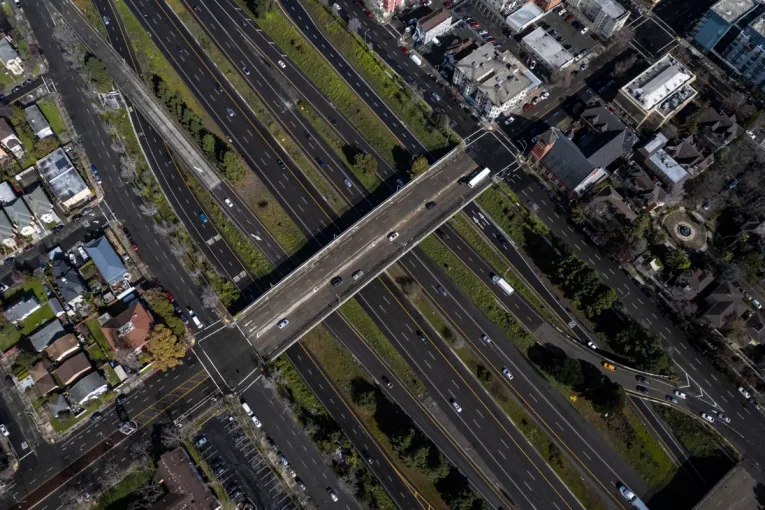
By Yesenia Perez and Hana Creger, Special for CalMatters
Freeway expansion isn’t just a transportation issue; it’s one of the most overlooked drivers of California’s housing crisis. It didn’t arrive as a sudden catastrophe; it has been a slow erosion, a quiet form of displacement that has pushed thousands of families from their homes. And it isn’t just a legacy of the past; new projects planned across the state are continuing to displace families.
In San Mateo, for instance, 33 families near the proposed Highway 101/92 expansion are facing forced removal from their homes. Versions of this pattern are unfolding across California: The California Department of Transportation, known as Caltrans, forces families from their homes to widen freeways, then it demolishes what remains.
In other cases, the agency buys up neighborhoods for projects that stall or are canceled, leaving the community trapped in limbo. For many of the affected families, there is no real choice — only eminent domain, pressured buyouts or the slow dismantling of livable conditions.
A stark example is the 710 freeway project in Los Angeles County. Caltrans displaced 460 families for a freeway that was never built, after decades of community opposition, environmental lawsuits and soaring costs. But the damage was done, suspending an entire community between displacement and decay. Caltrans has spent more than $17 million since 2020 just to guard the empty properties.
“Because they never built the freeway… hundreds of properties fell into disrepair. A lot of them are blighted,” said Raymond Gutierrez, an architect and community advocate, “It feels like the neighborhood is a slum, but it’s not. These buildings could have been housing people.”
His words reflect a harsh reality: state policy has repeatedly chosen freeways over people staying housed.

Recent state data shows that from 2018 to 2023, Caltrans demolished 623 homes and businesses to make way for 13 projects to expand freeways. The vast majority of the lost homes were in low-income communities of color, primarily in Los Angeles County.
New data from the state shows an additional 248 homes and businesses were demolished for freeway expansion in 2024, primarily in the Inland Empire region.
And that’s only during a narrow window of time. Before 2018, California required no public reporting on displacement, but Los Angeles Times research has found that more than 10,000 families were displaced by freeway projects over the past 30 years.
The lack of transparency is exactly why The Greenlining Institute created its Homes Before Highways interactive mapping tool, which brings data to life, showing where highway expansion has destroyed homes and businesses across California in recent years.
Freeway expansion destabilizes entire communities. Tearing down homes shrinks the housing supply and limits affordable options for families.
Families displaced by freeway projects face soaring rents, fewer housing options and longer commutes to jobs and support networks. As residents are pushed farther from job centers, they’re forced to spend more on transportation, now the second highest expense after housing.
Yet the justification for road expansion and displacement — traffic relief — rarely materializes. The expansions don’t reduce traffic; they make it worse by inducing more driving.
The Interstate 405 expansion, for example, cost $1.6 billion. Located in the western and southern reaches of the Los Angeles area, the project went wildly over budget and caused the demolition of 20 homes and three businesses. It also made traffic and commutes worse after completion.
California has better, proven options. Investments in public transit, walking and biking infrastructure, and electric vehicles reduce transportation costs and take cars out of gridlock, without forcing families from their homes and dismantling communities.
California’s elected leaders face an urgent and fundamental choice: They can continue spending billions on expansions that exacerbate the housing crisis but never deliver meaningful traffic relief; or they can invest in a transportation system that reflects values Californians champion: affordability and community wellbeing.
This article was originally published on CalMatters and was republished under the Creative Commons Attribution-NonCommercial-NoDerivatives license.
Yesenia Perez – Yesenia Perez is senior program manager for climate equity at the Greenlining Institute
Hana Creger – Hana Creger is associate director of climate equity at the Greenlining Institute
Follow the Vanguard on Social Media – X, Instagram and Facebook. Subscribe the Vanguard News letters. To make a tax-deductible donation, please visit davisvanguard.org/donate or give directly through ActBlue. Your support will ensure that the vital work of the Vanguard continues.

This is backwards: Without freeways, there wouldn’t be anywhere near 40 million people living in the state. Freeways enable sprawl.
The relatively small number of people displaced by freeways pales in comparison to what freeways have enabled regarding sprawl (housing). I’d guess that freeways enable the construction of something like 10 buildings, for every one that is removed.
Freeways are the YIMBYs’ best friend, besides Scott Wiener.
I think most YIMBY’s would question that statement. They generally oppose freeway expansions and instead advocate for policies that focus on dense, infill housing development and improved public transportation, including the potential removal of urban highways
“California YIMBY backs California Forever in Solano County vote”
“Advocacy group calls proposed city of 400K “a welcome break” to “status quo” in state”
https://therealdeal.com/san-francisco/2024/06/20/california-yimby-backs-vote-for-new-city-in-solano-county/
(That mentality is also behind the local push to eliminate Measure J, the destruction of Lagoon Valley, all of the ongoing sprawl throughout the region, etc.) The housing laws that they pushed are also being used to justify sprawl in places like Nevada City – in high risk fire zones, as well as the local effort to overturn Measure J in order to build on farmland.)
https://www.sfchronicle.com/projects/2025/california-wildfires-housing/
Although they rarely come right out and acknowledge that they’re advocating for sprawl (as they’re doing in regard to California Forever), the laws that they pushed are then used to justify sprawl (which at best, they’re “silent” about). This is not an “oversight” on the part of the YIMBYs – it’s a predictable result that we see in action every day on the Vanguard itself.
There’s a few things on which I agree with California YIMBY, but their support of that project is absolutely disgusting.
A single anecdotal note about one project is not “evidence.” Further, there is counter evidence in the very article you cite that its anomalous. “A former executive of California YIMBY challenged the project as “comically ill-advised.””
And yes, the state has failed miserably on discouraging housing in the wildland-urban interface. Most YIMBYs would agree with that statement. The problem is that rural residents are unwilling to accept responsibility for the risks and costs they impose on everyone else and they are the proponents of sprawl, not YIMBYs. The short lived effort to create state-funded rural fire protection districts is a salient piece of evidence.
Ron is right, freeways add fuel to the continual sprawl. A new hundred homes are cited per year as being displaced due to imminent domain. Just one new development being built because it’s accessible to freeways more than dwarfs any lost homes.
First line of the article: “Freeway expansion isn’t just a transportation issue; it’s one of the most overlooked drivers of California’s housing crisis. “
The “crisis” being too many homes built, as a result of freeways? Resulting in 40 million people living in the state, perhaps half of whom (or more) would not be doing so – if not for freeways?
Perhaps enabling the baby boom itself, to some degree?
If you doubt that freeways “cause” development – I’d invite you to look at the patterns of continuing development (sprawl) across the entire country.
Maybe not what Eisenhower had in mind, regarding the freeway system. As I recall, one of the primary/initial purposes was to enable rapid deployment of military vehicles, and exodus from cities in the event of a nuclear attack.
But resulting in a clear case of, “if you build it, they will come”.
David, what does repeating that line have to do with what I wrote?
David
You’ve misread that line, and CalMatters has grossly overplayed the purported impact described in the article. Removing a few hundred houses in a state of nearly 40 million people is not going to have a perceptible impact on housing prices. The article completely misses the boat on the true implications. I was very disappointed in this when I read it elsewhere.
Yes, freeways enable sprawl. This article focuses on the trivial impacts whereas the real impact is in enabling high priced commuter housing that forecloses lower income households from owning a home. But this is exactly the OPPOSITE of what YIMBYs want. YIMBYs advocate for increased development near jobs with enhanced density within urban areas. Freeways inhibit that type of development. You’ve got this totally backwards.
YIMBYs have NEVER met a development that they didn’t like – whether it’s traditional sprawl, or insane infill.
Name one that they’ve opposed, if you claim otherwise – there’s lots to choose from in this area alone (e.g., Lagoon Valley, all of the sprawl heading up 505 from Vacaville, Woodland, Natomas, Elk Grove, Rancho Cordova, Folsom, etc.
Heck, they didn’t even object to the sprawling development in a high risk fire zone in the Grass Valley/Nevada City area that’s under construction right now.
Then there’s places like Cajon Ranch, in Southern California.
Important, but no discussion about physiological or psychological displacement related to freeway proximity.
Yet if we rightfully condemn all housing that’s within 1,000 ft. of a freeway, it’s lower income housing that’s going to be disproportionately removed.
Googling reveals that 45 million people in the United States live within a couple hundred ft of a freeway or major road,.. and in Los Angeles, 1.2 million people live within 500 ft of a freeway.
“… in Los Angeles, 1.2 million people live within 500 ft of a freeway.“
I had never heard that before and it seemed a bit high for LA so I looked it up. It turns out that the 1.2 million figure is for all of Southern California, not just Los Angeles. It’s an interesting figure nonetheless. That’s about 5% of the 25 million people who live in Southern California. It’d be interesting to see similar estimates for other parts of the state.
“More than 1.2 million people already live in high-pollution zones within 500 feet of a Southern California freeway, with more moving in every day. Between 2000 and 2010 — the most recent period available — the population within 500 feet of a Los Angeles freeway grew 3.9%, compared with a rate of 2.6% citywide.”
https://www.latimes.com/projects/la-me-freeway-pollution/
Craig
You must be from LA! My wife is from LA and complains everytime someone describes Disneyland as being “in LA”! But to almost everyone who lives outside of Southern California, SoCal is LA… LOL!
One additional fact of interest: Caltrans’ own study does not support adding lanes to freeways as a way to reduce congestion, yet they’ve been adding lanes to I-50/I-80 through downtown Sacramento for years now.
The Southern California Council of Governments mathematically modeled all congestion remedies up to and including double-decking freeways. The only thing that made a significant difference was making mixed-use neighborhoods (so people can shop and/or work locally).
Pedestrian-friendly, mixed-use neighborhoods are so desirable that people pay premiums to live there. The area around McKinley park in Sacramento is like that, and is the most valuable (per-square-foot) real estate in the region.
The resistance to such developments comes from existing zoning practices–although that’s changing–and from lenders. Local governments also understand that with denser building they’d have to provide more robust public services–like solving, not just talking about homelessness.
Nevertheless, we could implement the pedestrian-friendly, mixed-use paradigm in all new development in five minutes if FNMA changed their lending standards to require it for all new development. The County of Sacramento has such guidelines in its General Plan (LU-44) but, of course, ignores them completely.
This is what the Davis Citizens Planning Group has been advocating for in Village Farms and Willowgrove. We need to change our paradigm in Davis.
Gawd this article p*sses me off. It’s everything that is wrong with the pro-housing YIMBY idiots. The focus is on people displaced by freeways adding to the housing crisis – seriously ??? Like, that’s a tiny number of people. Let me first say, I am horrified by the displacements all over the country when a freeway tears through and destroys what is virtually always a lower-income neighborhood. I think it’s done irreparable harm to US cities. Compare for example to Vancouver BC, where the freeways disperse into the road system instead of ripping out the heart of the City, and they are rebuilding their rail transit. The problem is the freeways and the obsession with the automobile have decimated Los Angeles and the Bay Area and neighboring Valley towns on a scale unimaginable, and permanently ruined the state, because the density is so low in the sprawl that there is no efficient way to serve them with rail. And to think: Los Angeles less than a century ago had one of the most extensive urban rail transit systems in the world — and they ripped it all out!
The only solution is to stop expanding freeways, yes, we agree on that basic fact. But the solution isn’t to spend billions on housing subsidy and densification, the solution is to offer people an ALTERNATIVE, which is frequent, fast, electrified rail transit, and that is TENS of BILLIONS of dollars in investments. Instead “build housing” and a token “improve public transit” from this author. NO! What is needed is a revolution in thinking, and mainly in spending. We have rail plan for the state, but at the current rate of spending, the build-out to achieve that will take 100-150 years, and to reach the level of rail-service per-capita of England would take 200-300 years. You can’t just do ‘parking maximums’ and apartments without parkiing, you have to give people an efficient and fast and frequent way to get around. Once you do that, people will cluster around rail stations, densification will occur there, and you won’t have to force people to live without a parking spot in some misguided fantasy world.
California Forever is THE WORST. They have an old intercity trolley line running right through their project that ran Chico-Sacramento-San Francisco in the early 1900’s before being abandoned. But instead of rebuilding that and modernizing it, which because we didn’t invest in rail like Europe/Japan did so it would cost tens of billions, they just want to further burden the already overwhelmed highways system with some lane expansions. Their support of California Forever just proves that YIMBY is a movement backed personally by Satan.
“The focus is on people displaced by freeways adding to the housing crisis – seriously ??? Like, that’s a tiny number of people. ”
Yup. That’s how I see it too.
We need to both add electric trains AND densify. This is going to take coordinated planning–it’s not going to happen spontaneously. Despite Adam Smith’s now antiquated assertion, the “invisible hand” only gets us so far because too often the true costs are also “invisible.”
I don’t know what, if any, “freeway mitigation fees” they charge new, sprawling developments – but it’s apparently not enough to either discourage them. Maybe if they had to pay for the additional demand for freeway capacity that they create, we’d see less of the actual “cause”.
In other words, not just the cost of installing an additional stop sign on some local road leading up to the freeway – which ALREADY creates a cost (in time, wear and tear, gas) for existing residents, but a charge in regard to the additional demand they’re creating for freeway usage, to serve their new developments.
Probably wouldn’t be much problem on freeways, if they charged the new developments accordingly.