
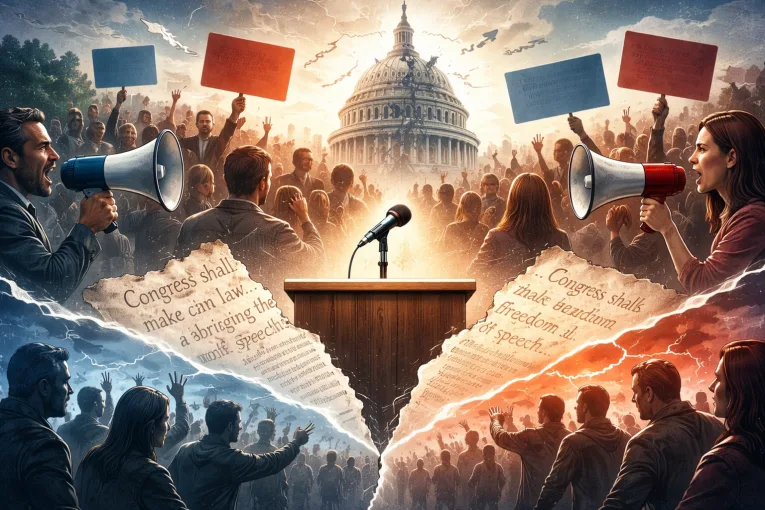
- “The erosion of principled, across-the-board support for free speech is weakening democratic norms and deepening mistrust.” – Suzanne Nossel
For decades, the late journalist Nat Hentoff warned that support for free speech is often conditional, extending only to views people already agree with. When expression protects allies, it is celebrated as a democratic virtue; when it shields opponents, it is recast as dangerous, irresponsible or intolerable.
That selective commitment, Hentoff argued, poses one of the greatest long-term threats to a society that depends on dissent, argument and the freedom to be wrong.
It is against that backdrop that Suzanne Nossel’s book Dare to Speak: Defending Free Speech for All enters the current political moment, marked by polarization, online outrage and rising pressure to punish controversial expression.
Nossel argues that the erosion of principled, across-the-board support for free speech is weakening democratic norms and deepening mistrust, particularly as debates over equality, harm and power increasingly frame expression as a zero-sum conflict rather than a shared civic obligation.
Nossel, a former CEO of PEN America, frames her book as a response to an era defined by ideological entrenchment, social media outrage and expanding calls for punishment of controversial speech. Rather than siding with absolutist defenses of free speech or endorsing broad restrictions in the name of harm prevention, Nossel advances a case for reconciling expression with inclusion through social norms, institutional responsibility and sustained civic engagement.
“This book is intended for all who seek to voice controversial viewpoints, hear them out from others, and keep their boardrooms, classrooms, dormitories, and dining tables open to fruitful conversations between people whose beliefs differ,” Nossel writes.
She argues that contemporary speech disputes are often framed as a zero-sum conflict between protecting marginalized groups and preserving free expression. That framing, she contends, is flawed.
“The route to resolve these tensions, I believe, lies in explaining how concerns of diversity and inclusion can—and must—be reconciled with robust protections for speech,” Nossel writes. “The quest for a diverse, inclusive society is in fact fortified by the defense of free speech.”
A core premise of the book is that most modern speech controversies fall outside the scope of constitutional law. Nossel notes that the First Amendment restricts government action but offers little guidance for conflicts arising in workplaces, universities, cultural institutions and online platforms.
“Because its language is confined to governmental infringements, the First Amendment is silent on many of the free speech conflicts of our time,” she writes.
In those settings, Nossel argues, free speech cannot be sustained by law alone.
“The First Amendment is framed to ensure a ‘negative right,’ the right to be free from government interference,” she writes. “But free speech also entails an affirmative right to speak out, a liberty that cannot be fully guaranteed in law and must be enabled by society through education and opportunity.”
That emphasis shapes Nossel’s conception of free speech as a civic practice rather than a purely legal entitlement. At PEN America, she writes, the organization sees itself “not just [as] champions of free speech but also guardians of open discourse.”
This approach prioritizes social norms that encourage debate while discouraging coercion, intimidation and reflexive punishment.
Nossel devotes significant attention to hate speech, acknowledging its capacity to cause real harm while warning against expanding government authority to police expression. She draws a firm distinction between hateful ideas and criminal acts motivated by bias.
Citing federal law enforcement guidance, she notes that “hate itself is not a crime,” while explaining that courts have upheld enhanced penalties when crimes are motivated by hostility toward protected characteristics.
She challenges the assumption that speech bans effectively protect vulnerable communities.
“When propagators of hatred style themselves as free speech champions,” Nossel writes, “true free speech guardians need to demonstrate that unfettered argument can expose and discredit their invidious lies.” Rather than silencing hateful expression, she argues, societies should confront it openly and deny it legitimacy through public challenge.
The book emphasizes counterspeech as a primary response to hate.
Nossel cites legal scholar Nadine Strossen’s definition of counterspeech as “any speech that counters a message with which one disagrees,” and points to research suggesting that collective responses can be faster and more adaptable than censorship. She argues that driving hate underground can make it harder to expose and contest.
At the same time, Nossel rejects the growing tendency to describe offensive speech as equivalent to violence. “Speech is never the same as physical violence, nor a justifiable provocation for it,” she writes. While acknowledging that words can wound and intimidate, she warns that collapsing speech and violence into a single category erodes moral distinctions and can legitimize coercive retaliation.
She notes that ensuring physical safety should not be conflated with insulating individuals from discomfort or offense.
“While our goal as a society should be to ensure that all people feel physically safe,” she writes, that objective should not become “a guarantee of psychological safety, or freedom from uncomfortable or offensive ideas.”
Nossel introduces a framework for evaluating speech harms, distinguishing between injurious harm, which targets dignity and reputation; instigating harm, which encourages criminal or violent action; and intercommunal harm, which undermines social cohesion. She argues that only the narrowest category — speech that poses a clear and imminent danger — warrants legal restriction.
Beyond hate speech, the book scrutinizes institutional responses to controversy. Nossel describes a growing reliance on punishment, public shaming and professional exile in response to speech-related missteps. She argues these practices often escalate conflict rather than resolve it, particularly in online environments where private and public speech blur together.
She advocates what she calls a “duty of care” in speaking, urging individuals — especially those with power — to consider context, audience and impact. However, she cautions that this duty “is not absolute” and warns that excessive self-policing can chill expression and discourage dissent.
Nossel also emphasizes the responsibility of listeners. She argues against treating offense as strict liability and urges consideration of intent and context before assigning blame. In the media, she writes, journalists have a special obligation to verify claims and avoid amplifying decontextualized remarks that can inflame outrage.
A recurring concern in the book is the politicization of free speech itself. Nossel observes that speech protections are increasingly viewed as a conservative cause, particularly on college campuses and among younger activists. That shift, she argues, reflects a retreat by liberals from defending expression they find offensive.
She warns that this dynamic leaves free speech vulnerable to manipulation by political actors who invoke it selectively. Reclaiming free speech as a shared democratic value, she writes, requires leaders across the ideological spectrum to defend it consistently. “Reversing the dangerous trend toward politicization of free speech will require both the left and the right to adapt,” she writes.
The book also addresses forgiveness and accountability, urging restraint in permanent punishment for speech-related transgressions. “We should be willing to consider forgiving errant speech, rather than insisting on punishment or holding a grudge forever,” Nossel writes, while emphasizing that forgiveness must be earned through sincere engagement and acknowledgment of harm.
Throughout Dare to Speak, Nossel argues that democratic societies cannot escape conflict over ideas, values and language. Attempts to suppress those conflicts, she suggests, risk empowering authorities and institutions to control discourse in ways that ultimately harm dissenters and marginalized communities.
By situating free speech as a practice that must be cultivated rather than assumed, Nossel advances a case for enduring democratic tension rather than resolving disagreement through silence. In a political climate increasingly shaped by absolutism, her argument is that open discourse — imperfect, contested and often uncomfortable — remains essential to confronting hate, inequality and authoritarianism.
Follow the Vanguard on Social Media – X, Instagram and Facebook. Subscribe the Vanguard News letters. To make a tax-deductible donation, please visit davisvanguard.org/donate or give directly through ActBlue. Your support will ensure that the vital work of the Vanguard continues.
