
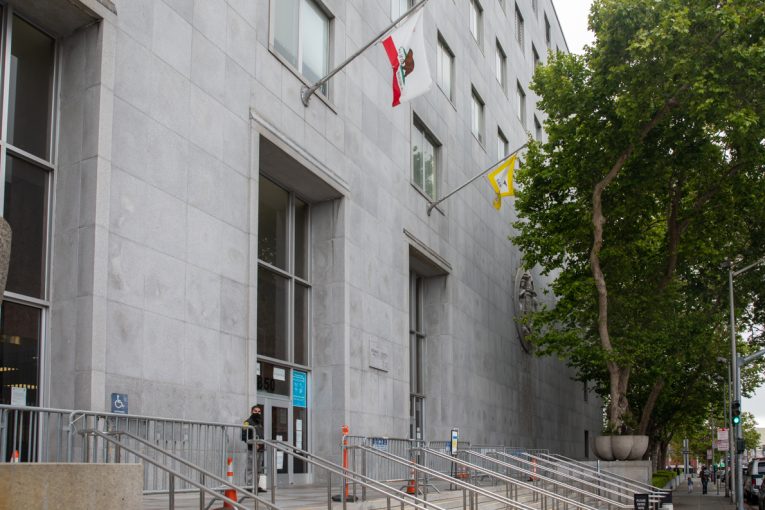
SAN FRANCISCO — A San Francisco Superior Court judge has dismissed all felony drug charges against Kenneth McCurry after finding that two San Francisco police officers acted with implicit racial bias during the stop, use of force and arrest, violating California’s Racial Justice Act.
Judge Patrick Thompson dismissed all three felony drug charges against McCurry on May 8 after concluding that the officers’ conduct at multiple decision points was tainted by implicit racial bias, according to the San Francisco Public Defender’s Office.
The case centered on an April 29, 2024, encounter near Civic Center, where McCurry, 33, was riding a non-motorized scooter on the sidewalk when San Francisco Police Department officers John Quinlan and Chiluugin Tumurchudur began following him.
According to the Public Defender’s Office, after McCurry crossed UN Plaza, a designated city skate park where people regularly ride non-motorized scooters, Quinlan shoved McCurry into a wall without warning.
The defense argued the officer failed to comply with the department’s use-of-force policy, which requires officers to use de-escalation techniques and use the minimum amount of force necessary.
After McCurry fell to the ground, a shopping bag hanging from the scooter’s handlebars dropped, narcotics fell out and officers arrested him.
The Public Defender’s Office said the officers later claimed in their reports that McCurry had been ducking, fleeing and evading them before the arrest. However, body-worn camera footage showed McCurry riding toward the officers rather than away from them.
Deputy Public Defender Aaron Pressman, who represented McCurry, said the ruling reflects the purpose of California’s Racial Justice Act.
“The Racial Justice Act was designed for just this type of case, where the officers’ conduct at every decision point was infected by racial bias,” Pressman said.
Deputy Public Defender Lilah Wolf, who litigated McCurry’s Racial Justice Act claims, said the dismissal was the appropriate remedy under the statute.
“We’re grateful the court dismissed the charges—as the RJA empowers courts to do—because it is the proper remedy for these harms,” Wolf said.
California’s Racial Justice Act prohibits the state from obtaining a conviction or sentence based on a person’s race, ethnicity or national origin. Unlike earlier legal standards, the law does not require proof that police officers or prosecutors intentionally acted with racial bias. Instead, evidence that racially biased policing, charging or sentencing occurred may entitle a defendant to relief.
To prevail on an RJA claim, a defendant must first persuade a court to grant an evidentiary hearing. If the hearing is granted, the defense must present convincing evidence of racial bias, while prosecutors have the opportunity to present evidence rebutting those claims.
In McCurry’s case, the defense relied on expert testimony, statistical evidence, body-worn camera footage and the officers’ own reports.
Among the defense’s arguments was that the San Francisco Police Department’s policy governing pretext traffic stops acknowledges that “pretext stops are disproportionately carried out against people of color and return negligible public safety benefits.”
The defense also presented evidence that before the department adopted its Pretext Stops policy, Black men made up approximately 3 percent of San Francisco’s population but accounted for about 14 percent of police traffic stops.
At the evidentiary hearing, University of Southern California law and sociology professor Camille Gear Rich testified for the defense regarding implicit bias.
According to the Public Defender’s Office, Rich testified that the officers demonstrated implicit bias at several critical decision points. She described the officers’ decision to follow McCurry for several blocks despite only a minor traffic violation as a “textbook” example of the type of enforcement pattern the department’s Pretext Stop policy seeks to limit.
Rich also testified that the officers’ immediate use of force without warning was consistent with research showing that implicit racial bias can distort officers’ perceptions of Black people, contributing to unnecessary and disproportionate uses of force.
She further testified that the officers’ reports characterized McCurry’s otherwise non-threatening conduct as suspicious and criminal. According to the Public Defender’s Office, research has shown that police officers sometimes describe neutral behavior as “furtive” or “evasive” to justify their actions after the fact.
San Francisco Public Defender Mano Raju said the ruling demonstrates the significance of the Racial Justice Act as a legal remedy.
“Our office has been at the forefront of enforcing the Racial Justice Act because our clients deserve more than a recognition that racial bias occurred. They deserve meaningful remedies,” Raju said.
“We’re encouraged by the court’s decision in this case, which reinforces that the RJA has real power to hold our justice system accountable when racial bias taints a prosecution. I’m proud of our team for securing that result for Mr. McCurry.”
McCurry’s defense team included Deputy Public Defenders Aaron Pressman, Lilah Wolf, Ilona Yañez, Madeline Walsh and Nikita Saini, along with Paralegal Sandra Reyna and Investigator James Faulkner.
Follow the Vanguard on Social Media – X, Instagram and Facebook. Subscribe the Vanguard News letters. To make a tax-deductible donation, please visit davisvanguard.org/donate or give directly through ActBlue. Your support will ensure that the vital work of the Vanguard continues.
