
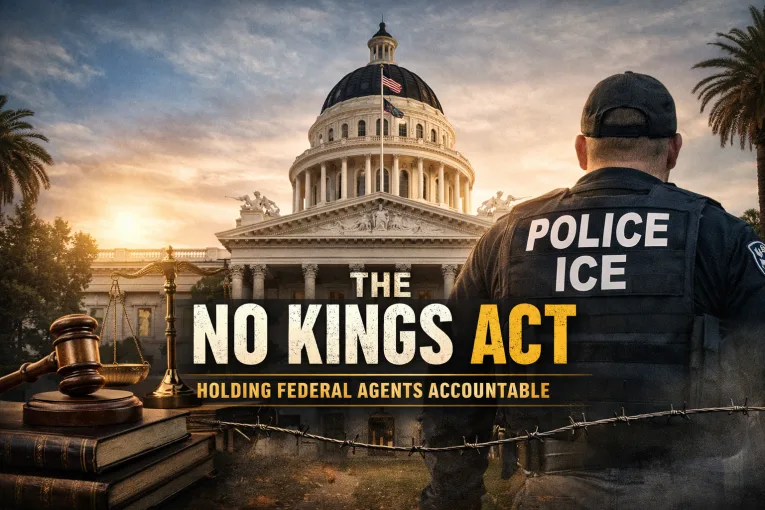
- “This bill is based on a very basic concept that no one is above the law.” – Senator Scott Wiener
- “If you violate the law, if you violate the U.S. Constitution and harm someone, you should be accountable.” – Senator Scott Wiener
- “We must close the loophole that makes it almost impossible for the families of Renee Good and Alex Pretti — who were executed in broad daylight — to seek justice for their family members.” – Senator Scott Wiener
SACRAMENTO, Calif. — The California Senate voted 30-10 on Tuesday to pass SB 747, known as the No Kings Act, a first-in-the-nation measure designed to allow people in California to sue federal law enforcement officers for violations of their constitutional rights.
Authored by Senator Scott Wiener, the legislation aims to close what supporters describe as a longstanding accountability gap that has made it nearly impossible to hold federal agents — including officers with Immigration and Customs Enforcement and U.S. Customs and Border Protection — civilly liable for unconstitutional conduct.
The bill now moves to the California Assembly for consideration.
Speaking at a press conference Tuesday ahead of the Senate vote, Senator Wiener said the legislation is rooted in a basic principle of constitutional governance.
“This bill is based on a very basic concept that no one is above the law,” Wiener said. “That the rule of law matters. That if you violate the law, if you violate the U.S. Constitution and harm someone, you should be accountable.”
Under current law, state and local law enforcement officers can be sued under federal civil rights statutes for constitutional violations, but recent Supreme Court rulings have severely limited the ability to bring similar claims against federal officials.
Senator Wiener said that imbalance has effectively given federal agents “complete impunity” for serious misconduct.
“If a police officer shoots your mother in the face or publicly executes an ICU nurse or kidnaps a preschooler and then holds the preschooler hostage as leverage to get the parents to come into custody, you can sue those police officers,” Wiener said. “Right now, you can’t sue federal agents effectively. It is almost impossible to do so, and SB 747 will change that by making clear that we’re going to treat all law enforcement the same.”
Senator Wiener tied the legislation to recent high-profile incidents involving federal agents, including the killing of Renee Nicole Good and Alex Pretti in Minneapolis.
He said the federal government’s refusal to investigate those deaths underscored the urgency of closing what he described as a legal loophole.
“We must close the loophole that makes it almost impossible for the families of Renee Good and Alex Pretti — who were executed in broad daylight — to seek justice for their family members,” Senator Wiener said.
The No Kings Act would create a new state-law cause of action allowing individuals to seek monetary damages from any government officer — federal, state, or local — who violates clearly established constitutional rights while acting under color of law.
Supporters say the bill effectively restores a remedy once available under the Supreme Court’s 1971 decision in Bivens v. Six Unknown Named Agents, which has since been sharply curtailed by the high court.
Wiener said the bill does not impose new substantive obligations on federal officers, but instead ensures that existing constitutional duties can be enforced in court.
“We’re not creating a new obligation,” he said. “We’re just saying you’re obligated to follow the U.S. Constitution, which you swore an oath to uphold, and you can be sued if you don’t follow it.”
The measure is co-authored by Senator Aisha Wahab and supported by multiple Democratic lawmakers.
At the press conference, Wahab said the bill responds to what she described as widespread violations of civil rights by federal law enforcement agencies.
“We are seeing violations of our rights left and right throughout this nation,” Senator Wahab said. “This is about very plainly giving people an opportunity to sue based on the fact that their rights were violated.”
Wahab said she believes civil liability is essential to deterring future abuses. “Without the lawsuits, without that potential legal obstacle, this organization will go and continue to violate the rights of many people,” she said.
Another lawmaker speaking Tuesday said the issue is personal as well as professional.
Senator Susan Rubio, who previously authored legislation requiring de-escalation by local police, said unchecked federal enforcement has eroded trust between communities and law enforcement.
“When immigrants come here, many times they don’t understand what their legal rights are,” she said. “We have been telling them to feel safe in our communities because the police want to know if someone is hurting them or if someone is threatening them. And a threat and hurt has come into our community by way of the federal government.”
Senator Rubio said she has witnessed federal agents using force in ways that would not be tolerated from state or local police.
“What I am seeing is pepper spray being used as a way to scare, intimidate, and destabilize individuals that are asking questions and that are taking videos,” she said. “They have the right to take videos. They have the right to protest.”
Senator Sasha Perez said the No Kings Act comes at a moment when federal enforcement powers have expanded rapidly while public accountability has lagged.
“We have watched the federal government essentially gut our healthcare system and put all of that money towards ICE and the Department of Homeland Security,” Senator Perez said, adding that recent killings in Minnesota “need to be taken completely seriously.”
Perez said California has already taken steps to regulate federal immigration enforcement, including legislation requiring ICE agents to identify themselves, though those laws are currently being challenged in court by the federal government. “We are now seeing in real time why these agents do not want us to know who they are,” she said. “They are trying to avoid accountability because they know what they are doing is wrong.”
Senator Wiener later addressed concerns from opponents who argue the bill could expose state and local officers to expanded liability. He rejected that claim, saying those officers are already subject to identical standards under existing federal law.
“This does not add anything to existing liability that state and local police officers face,” Wiener said. “It would be the same exact legal standards, the exact same defenses, everything would be the same.”
Asked why the bill applies broadly to all government officers rather than only to federal agents, Wiener said equal treatment was a central goal. “Our goal here is to treat everyone the same,” he said. “We want to apply the same standards to everyone.”
Wiener also acknowledged removing an urgency clause from the bill to avoid the risk of it failing to clear the Senate, though he said he hopes to restore expedited implementation if the Assembly permits. He predicted legal challenges if the bill becomes law but said California is on solid constitutional ground.
“There’s a long history in this country of state laws applying to federal employees,” Wiener said. “Federal employees can be sued under state law. They can be criminally prosecuted under state law.”
Support for the legislation extends beyond lawmakers. Protect Democracy United, Prosecutors Alliance Action, and Inland Coalition for Immigrant Justice are sponsoring the bill.
Cameron Kistler, counsel for Protect Democracy United, said the lack of accountability for federal officers has left families without recourse.
“Whether the families of Ms. Good and Mr. Pretti should have a remedy for the killings of their loved ones should turn on whether their constitutional rights were violated, not what badge the officer was carrying,” Kistler said.
If enacted, SB 747 would allow lawsuits for alleged violations of the First, Fourth, and Fifth Amendments, including retaliation for protected speech, unlawful searches or seizures, excessive force, and discriminatory enforcement based on race, national origin, or political identity.
Senator Wiener said the legislation is intended not only to respond to current events but to prevent future abuses regardless of who controls the federal government. “This has exposed a massive hole in our democracy,” he said. “Who knows what’s going to happen in four, eight, 12 years. We need to close this loophole.”
Similar legislation has been introduced in Maryland, New York, Rhode Island, and Virginia, but California would become the first state to pass such a measure through a legislative chamber.
Follow the Vanguard on Social Media – X, Instagram and Facebook. Subscribe the Vanguard News letters. To make a tax-deductible donation, please visit davisvanguard.org/donate or give directly through ActBlue. Your support will ensure that the vital work of the Vanguard continues.

Good luck with that – sounds like a political stunt that will get struck down by the court system.
It’s not automatic that the No Kings Act would simply get struck down as a “political stunt,” although it might as many checks against federal power have been (probably improperly) but there’s a real legal question about how courts balance federal supremacy against state law innovations in accountability — and that’s exactly where current constitutional debates are happening.
SB 747, would allow residents to sue federal law-enforcement officers for violations of the constitution in state court, addressing gaps created by federal remedies (see my other article for a clear articulation of the problem under Bivens.
You are acting like this is settled matter of law however, and it isn’t. Much of this has never been vetted or adjudicated by the Supreme Court.
A key question is whether a court would allow a constitutional theory under which state law could coexist with federal law by filling accountability gaps.
Seems like an important area to explore considering the problems highlighted in my other article of Bivens and the fact that the Supreme Court must take up live issues, not theoretical ones.
Probably just a coincidence that Wiener is running for Congress. After all, it’s not like him to act like a tool (and no – I’m not simply referring to the destruction he’s created in California). He’s one of these guys who has been focused on Trump, even though he’s not part of the federal government.
He’s a politician who seems to interject himself at events he has nothing to do with. (I don’t recall how many times you’ve published a photo of him in the background at some event.) Suffice it to say that it’s easier to “find Wiener”, than it is to find Waldo.
So you are not going to make a response to what I pointed out in terms of the law?
Not planning to – no.
The article itself notes the legal challenges it will face – don’t need me to do so.
To paraphrase a rather well-known commercial, “you’re not a lawyer, but you play one on a blog”. (And neither am I.)
I find it to be an incredible waste of time to try to argue legal specifics on a blog – especially for something that I don’t particularly care about.
The underlying problem has to be addressed by the federal government. The fact that Democrats are in a weak position, and most Republicans support the president does not mean that California can step in on it own to “fix” the problem.
Truth be told, the people who support illegal immigration (which is ultimately behind all of this) are still in the minority in this country, as well.
Appreciate your honesty. Makes my life easier.
True – I honestly view this as a political stunt by a guy running for Congress – regardless of the legal outcome (years down the road).
Maybe he should focus on his platform in regard to his campaign for a Congressional seat. Much like I’d prefer to see Newsom focus on his platform (rather than attempting to score political points by criticizing/insulting Trump).
I find both of these type of campaigns to be an insult to anyone’s intelligence. Partisan hacks, who contribute to the divisiveness of this country.
It must be extremely frustrating for some people/politicians that this country elected a felon who has taken the actions he promised during his campaign. Pretty sure that they thought they had buried him, politically.
🤦♂️
The “No Kings Act”. Really? Sounds like Weiner is pulling a political stunt in his aim for higher political office. He’s dead to me anyhow for his other political stunt recently on Israel after he apparently was advised his far-left base was larger than his non-antizionist Jewish base. That move cost him his co-chair at the State Jewish caucus. But he probably knew that was coming and figured it into his political calculations.
And, “Similar legislation has been introduced in Maryland, New York, Rhode Island, and Virginia, but California would become the first state to pass such a measure through a legislative chamber.” You realize how nonsensical that statement is, since California also has not yet passed the measure?
Just point out this was not just Senator Wiener, four Senators are pushing this and they are doing it in conjunction with the AG.
Please explain what this legislation does which isn’t already included in Civil Code section 52.1.
I’ve compared the relevant sections. 52.1 gives more remedies, including the ability for AG and DAs to seek injunctive relief. SB787 acknowledges immunity defenses, perhaps watering down the cause of action. These defenses are not enumerated in 52.1.
Originally, Wiener proposed amending 52.1. Then, perhaps seeking attention, he deleted those amendments and created 53.8. Why is any of this necessary when we have perfectly good law covering actions by any person acting under color of law.