
Part III in the Ongoing Series on California’s Constitutional Crisis and Judicial Evasion of the Racial Justice Act
By Jesse Perez, Justice Impacted Youth
The persistence of racial injustice in America has never simply been a matter of outdated statutes or openly bigoted laws. As the Legislature recently declared in AB 1071, “systemic racism and the White supremacy on which it is founded have remarkable powers of adaptation.” When courts recognize only the most egregious and historic forms of racism while ignoring its present manifestations, the result is not neutrality — it is complicity. California’s Racial Justice Act (Penal Code § 745), strengthened through AB 1071, was designed to force courts to confront racial harms rather than evade them.
But today, the judiciary itself is demonstrating how racism evolves within legal procedure. And nowhere is this clearer than in San Bernardino County, where judicial actors have deployed modern procedural tools to insulate a racially tainted conviction — including through secret hearings, mischaracterizations of law, and violations of appellate directives.
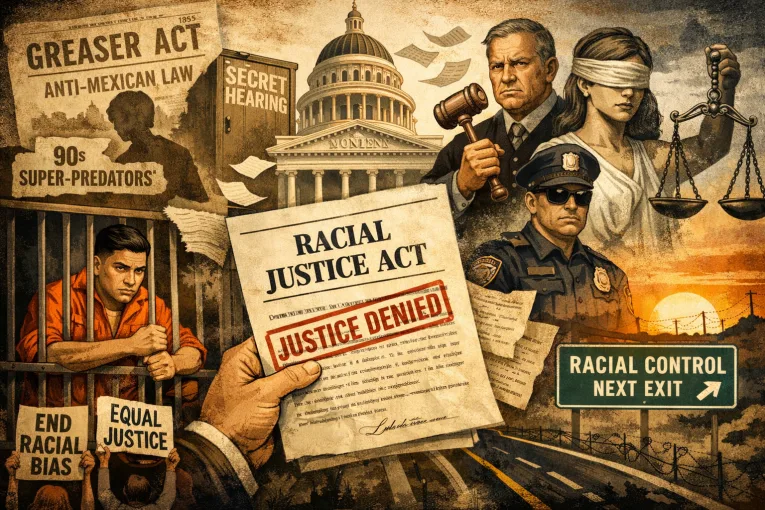
This is not an accident. It is part of a historical pattern stretching from the Greaser Act of 1855 to the super-predator era of the 1990s — and now to judicial resistance to the Racial Justice Act.
I. The Greaser Act: A Foundation of Legalized Racism in California
California’s Anti-Vagrancy Act of 1855 — commonly known as the Greaser Act
- was a legal instrument designed to criminalize, commodify, and control Mexican Americans, Native Americans, and Chinese immigrants.
The law:
- Defined “vagrants” to include people of “Spanish and Indian blood,”
- Allowed arrest based on subjective assessments of “quietness,”
- Enabled forced labor contracts,
- Fueled widespread lynchings and mob violence, and
- Served as a legal pretext for seizing land and suppressing cultural identity.
This statute was not merely racist in effect — it was racist by design. It encoded hierarchy into California’s legal architecture. Courts of the era did not dismantle it; by enforcing and upholding it, they gave this racial hierarchy the force and legitimacy of law.
The insight from AB 1071 is that racism never left the law. It simply adapted.
II. The Super-Predator Myth: A 20th-Century Mutation
Fast forward 130 years. The overt racial language of 1855 had dissolved, but the logic of racial control remained. In the 1990s, the “super-predator” panic swept across the country — a myth that labeled Black and Latino youth as irredeemably violent. California responded with AB 560 and Proposition 21, which:
- Expanded juvenile transfers to adult court,
- Increased punitive sentencing,
- Collapsed rehabilitative frameworks, and
- Disproportionately targeted youth of color.
Even proponents now admit the super-predator theory was false. But the damage was done: generations of children — including myself at age 15 — were swept into adult court under a racially charged narrative that has since been repudiated by every other branch of government.
The Racial Justice Act was enacted precisely to confront these harms. But today, the judiciary is resisting that confrontation.
III. The Judiciary as Modern Stronghold: A Case Study in Procedural Evasion
The adaptive nature of racism is most visible not in laws explicitly naming race, but in the ways courts use procedure to avoid confronting racial injustice.
My own case illustrates this perfectly.
A Secret Hearing by a Conflicted Judge
On November 24, 2025, San Bernardino Juvenile Court Presiding Judge Lynn M. Poncin — who spent fourteen years as a career prosecutor in the same District Attorney’s Office challenged in my RJA claim — used her position of power to reassign my case from a neutral judge to herself without notice or opportunity to be heard, and conducted a clandestine, off-calendar hearing.
The Juvenile Court’s own minute order confirms:
- “PEREZ, JESSE NOT PRESENT IN COURT.”
- “IN CUSTODY AT STATE PRISON.”
- “KIANA FARZAD PRESENT REPRESENTING THE STATE.”
- “DISCUSSION HELD OFF THE RECORD.”
Petitioner’s Racial Justice Act motions denied.
- No notice.
- No counsel.
- No appearance.
- No record.
This was not adjudication — it was administrative exorcism.
Mischaracterization by Judge Gregory S. Tavill
Months earlier, Superior Court Judge Gregory S. Tavill denied a habeas petition by deliberately mischaracterizing its claims:
- A contract claim was recast as a “conflict-of-interest theory,”
- An Equal Protection claim was reframed as comparing “open and closed cases,”
All in direct violation of Court of Appeal, Division One’s binding, precise
claim-framing. Tavill even acknowledged he reviewed the appellate directive — then refused to follow it.
This misconduct created the procedural vacuum that allowed Judge Poncin’s secret hearing to occur.
Appellate Enablement
The Court of Appeal, Fourth District, Division Two, refused to correct the error:
- No briefing ordered,
- Only one sub-claim addressed,
- Mischaracterizations left intact,
- Law-of-the-case violations ignored.
This abdication allowed inferior courts to believe they were free to evade the RJA. Whether or not any individual judge subjectively intended discrimination, the combined effect of these actions is to protect a conviction obtained under a repudiated, racially charged regime from meaningful review.
Modern Judicial Racism
This is systemic racism in 2025:
- It does not use slurs.
- It does not need explicit racial statutes.
- It appears as routine procedure: reassignment abuses, secret hearings, silence in the record, strategic mislabeling, and appellate indifference.
The function is the same as in 1855: to shield racially tainted outcomes from scrutiny.
IV. Procedural Barriers as the New Armor of Racial Control
Racism evolves. Its tools change shape.
- In the 1800s, the pretext was “vagrancy.”
- In the 1990s, the pretext was “super-predators.”
- Today, the pretext is “procedure.”
Judge Poncin’s invocation of administrative authority to reassign my case to her chambers and hold a secret hearing mirrors the same logic: use legal form to mask racial function. Judge Tavill’s refusal to follow appellate directives mirrors another longstanding pattern: use hierarchy and “finality” to insulate past racial injustice.
These are not neutral errors. They are the modern vocabulary iteration of systemic racism. As AB 1071 warns, courts that recognize only its historic forms allow its current manifestations to thrive.
V. Racism and Oligarchy: Mutually Reinforcing Systems of Power
The persistence of racial injustice in California’s courts cannot be fully understood without confronting a parallel reality: the United States increasingly operates under
oligarchic conditions, where wealth, institutional power, and elite continuity dominate outcomes despite formal democratic structures and mandates.
Racism and oligarchy are not separate pathologies. They are mutually reinforcing systems.
Historically, racial hierarchy has functioned as a stabilizing mechanism for concentrated power. From the Greaser Act forward, racialized criminalization has served not only to subordinate targeted communities, but also to legitimate coercive institutions, suppress dissent, and normalize extreme exercises of state authority. Those practices protected economic and political elites by directing social control downward rather than upward.
As overtly racist statutes became unacceptable, racial control did not disappear — it migrated. In the super-predator era, fear-based narratives justified punitive expansions that insulated prosecutors, courts, and carceral institutions from democratic accountability. Youth of color absorbed the cost; institutions accrued power, deference, and permanence.
Today, that same dynamic operates through judicial procedure.
Modern oligarchy does not announce itself by rejecting law. It preserves itself by controlling interpretation, access, timing, and remedy. Courts are uniquely positioned to perform this function. By narrowing standing, redefining claims, invoking finality, or declining review, judicial actors can neutralize democratically enacted reforms without openly defying them.
Racial justice statutes are particularly vulnerable to this form of containment. They threaten not only past outcomes, but institutional legitimacy, resource allocation, and professional hierarchies built atop those outcomes. Procedural evasion thus becomes a rational response — not to lawlessness, but to perceived institutional risk.
In this context, racism functions as both justification and camouflage. Those most burdened by procedural barriers are historically racialized communities. Their
marginalization makes resistance less costly, exclusion easier to normalize, and claims easier to dismiss as “technical” or “untimely.”
Oligarchic power, in turn, benefits from racism’s persistence. It narrows the class of people whose grievances threaten institutional equilibrium and concentrates corrective pressure among those with the least leverage to enforce it.
Thus, when courts resist the Racial Justice Act through silence, mislabeling, or administrative maneuver, they are not merely avoiding racial accountability. They are preserving a broader power arrangement in which democratic correction is formally acknowledged but functionally denied.
This explains why the pattern is durable across centuries. It is not driven by individual animus alone, but by institutional incentives aligned with elite preservation. Racism adapts because it remains useful. Procedure shields it because procedure shields power.
Understanding this interaction clarifies what is at stake in the judiciary’s response to AB 1071. The question is not only whether courts will confront racial bias — but whether they will accept the People’s authority to dismantle power arrangements that have long relied on that bias for stability.
VI. The Adaptive Nature of Racism in the Judicial Branch
Racism’s survival depends on institutions willing to adapt its mechanisms:
- When explicit statutes become unacceptable, procedure becomes the weapon.
- When slurs fall out of fashion, silence in the record replaces them.
- When legislatures demand accountability, judicial avoidance becomes the last stronghold.
The Greaser Act criminalized existence. The super-predator myth criminalized adolescence. Today’s judiciary, through procedural evasion, criminalizes accountability. This is the continuity AB 1071 commands courts to confront.
VII. Codified Canons, Judicial Lawlessness, and Democratic Power
What is unfolding in California’s courts is not merely a disagreement over statutory interpretation. It is a constitutional crisis rooted in the judiciary’s refusal to obey legislatively enacted rules of interpretation — rules that derive directly from the People’s sovereign authority and are now embodied in the Welfare and Institutions Code and AB 1071.
This is not a novel claim. It is now explicitly supported by leading constitutional and statutory scholars. In Codified Canons and the Common Law of Interpretation, Yale Law scholar Jacob Scott documents a foundational truth that courts routinely ignore: interpretive canons are no more than judge-made rules, but when legislatures enact and codify interpretive rules, those codified canons are positive law that displace contrary judge‑made canons. Courts are not free to “balance” them against their preferred methods; they are required to apply them when the statute so directs.
Daniel B. Listwa, writing in the Yale Law Journal, makes the same point even more starkly:
“While the invocation of a common-law canon typically requires weighing various potentially applicable canons, a legislated canon — like any statutory provision — ought to be applied whenever so required by its own terms. From this perspective, the Court’s failure to abide by legislated canons — including ones that repudiate standard interpretive methods — borders on lawlessness.”
Taken together, Scott and Listwa describe exactly what happens when courts cling to inherited canons like Estrada while ignoring legislatively enacted directions about how current law must operate. In California’s juvenile and RJA framework, the Legislature has done precisely what Scott and Listwa describe. Through the Welfare and Institutions Code, the Penal Code, and now AB 1071, the People have
enacted binding instructions about how courts must construe juvenile jurisdiction, retroactivity, and racial‑justice claims, including:
- Provisions that treat the WIC as a restatement and integration of existing juvenile law, not a series of isolated enactments.
- Mandatory rules that pending proceedings conform to current juvenile standards, including continuing jurisdiction over youth whose conduct occurred as minors.
- Explicit mandatory commands about construction and temporal reach — using “shall” to require that protections apply to past and future cases, and directing courts to remove “procedural barriers” that insulate racially tainted convictions from review.
These provisions are not aspirational. They are operational law. When courts ignore these provisions and instead reach for judge‑made canons like Estrada to defeat jurisdiction or retroactivity, they are not exercising interpretive discretion. They are nullifying law. In the abstract, this might sound like academic debate. In the real world, it produces concrete, devastating harm. Here, the refusal to apply legislated canons has kept a person sentenced at age fifteen under a repudiated super‑predator regime imprisoned decades later, despite initiatives, statutes, and realignment measures aimed at correcting precisely that kind of outcome.
California’s Constitution is explicit: “All political power is inherent in the people… and they have the right to alter or reform [government] when the public good may require.” When the People alter the law — and the Legislature codifies how that law must be interpreted — the judiciary’s role is to implement those choices. To do otherwise is to invert democracy.
Scott and Listwa did not write about my case. But my case is the proof of their warning. When legislated canons are ignored, separation of powers collapses not in theory but in lived consequence. Liberty is lost, accountability is evaded, and racism — once codified in acts like the Greaser law and later in super‑predator transfer regimes — finds refuge in judicial resistance instead of statutes.
VIII. Conclusion: The Judiciary Must Choose Its Legacy
From the Greaser Act to the super-predator myth to Judge Poncin’s secret hearing, the arc of California law has too often been bent to preserve racial hierarchy under the guise of neutrality. We are now at a crossroads. Will California’s judiciary continue to provide refuge for racism’s adaptive forms — protecting old injustices through new procedural tactics? Or will it embrace the Legislature’s clear command to confront both historic and modern manifestations of racial bias?
The judges in this case — Poncin, Tavill, and those on the appellate panels who refused correction — are now part of the historical record. Their decisions, omissions, and evasions will be studied as either: the last gasps of a dying paradigm, or the obstacles that forced California’s next civil rights transformation.
The law has evolved. The Legislature has acted. The question now is whether the judiciary will continue to be racism’s last stronghold — or finally, its great dismantler. In any event, the citizenry is wise to pay heed, as history shows how racism and oligarchy find ways to preserve themselves and thrive when these dynamics go unchecked, threatening both democracy and the People’s sovereignty, freedom, and core power.
Jesse Perez is both a System Impacted Youth, college graduate, author, litigator and Political Prisoner belonging to a vulnerable and/or politically unpopular class — the 14-15 year old cohort that continues to be disproportionally punished under the racist, publicly repealed and repudiated Super-predator laws of the 1990’s hyper-punitive era. He is currently held in Kern Valley State Prison, his contact information is Jesse Perez, K-42186 P.O. Box 5102 Delano, CA 93216.
Follow the Vanguard on Social Media – X, Instagram and Facebook. Subscribe the Vanguard News letters. To make a tax-deductible donation, please visit davisvanguard.org/donate or give directly through ActBlue. Your support will ensure that the vital work of the Vanguard continues.
