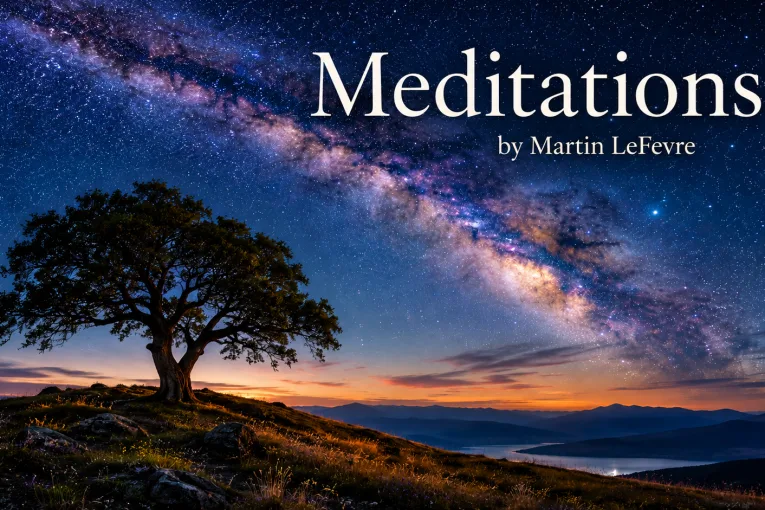
Color as thick as the clouds themselves suffuses massive, multi-layered cumulus. The color appears almost solid, so that the substance of the clouds seems to be color itself.
After the squalls that rolled through during the day, the smell of earth, new growth and browning grass are strong and sweet. Swallows play on the air and swerve close; they are the essence of joy without fear.
I catch a glimpse of a falcon as it disappears behind a tree. But just as I get up to confirm it, the sun emerges with almost painful brilliance, and there’s no possibility of verifying the kite by its fluttering flight pattern.
To die daily as easily as a sunset, with silent fire and blazing color, is the meaning to me of a good life and a good death. There is no separate ‘Creator;’ the universe is an expression of an infinite, indivisible intelligence. One can come into fleeting contact with that perpetual mystery however, and still not understand death.
Is the death of psychological thought (that is, of the continuity of memory, identity and the past) the beginning of an awareness that does not die when we expire?
It follows, given that the universe is permeated by an inseparable intelligence, which we can only see and feel when thought is completely still. Is a human being fully awakening and psychologically dying while fully alive a new node of awareness in the universe?
The notion of an afterlife pertains to the continuity of the self, which, as neuroscientists have shown, is a construct of thought. There may be some kind of continuity of egoic consciousness after an individual’s death, but that is not death. Indeed, to my mind it’s a fate worse than death.
The essential thing is to psychologically die while fully alive. Of course that is precisely the thing we fear the most—the death of ‘MY SELF.’ But I fear the opposite—the continuity of myself in some form after death.
Especially AI people equate immortality with the continuity of the self and thought, and speak of uploading our personal consciousness into the cloud. That sounds like a pretty good definition of hell to me.
Immortality has nothing to do with memory or being remembered, but comes with the complete ending of self and thought, allowing merging with the cosmic intelligence that never dies.
The continuity of self after death is the nightmare of neverending thought. Of course those who believe there is nothing but thought and self don’t go near these questions because they don’t want to confront the fear of nothingness.
The belief that there is no intelligence in the universe except in humans is the flipside of the belief in a Creator. Just as the idea that there is nothing but the meaning our minds invent is the flipside of the notion that “Jesus has a place for me in heaven.” Both give primacy to the self, just in opposite ways.
So the essential thing is to die while fully alive. Then, when one physically expires, does awareness die, or just the body? And is that what Jesus meant when he said, “Whoever seeks to gain his life will lose it, but whoever loses his life will preserve it?”
One cannot fool death. However, one can psychologically die and transcend death, though that is the hardest thing for us as humans to do. It happens temporarily in the meditative state. Can it happen irrevocably, so that one completely leaves the stream of content-consciousness while fully alive? Is that illumination?
To embrace death when one’s time comes, without fear, regret or unfinished business, is the mark of a good life. Perhaps it is the mark of greatness in a human being. That doesn’t require illumination, and though exceptional, it’s more common than those left behind realize.
Ordinary human beings are capable of greatness. And we can grow into synapses of awareness in the cosmic mind.
It’s a strange thing how beauty, love and death go together. Not in any morbid sense, when one is sick or on one’s deathbed. Nor as ideals, Platonic or otherwise, but as essences. They flow together, and are actually a single movement, which we can see, feel and actualize when fully alive.
With deepening understanding, the thing we think we want—the continuity of the self—is what we would rightly fear. And what we fear—the ending of the self—is what we would truly want.
To comment please go to one of these social media platforms:
Facebook: https://www.facebook.com/DavisVanguard
LinkedIn: https://www.linkedin.com/company/peoples-vanguard-of-davis-inc/
Instagram: https://www.instagram.com/davisvanguard/
X: https://x.com/davisvanguard
Bluesky: https://bsky.app/profile/vanguardnewsgroup.bsky.social
Subscribe to the Vanguard News letters. To make a tax-deductible donation, please visit davisvanguard.org/donate or give directly through ActBlue. Your support will ensure that the vital work of the Vanguard continues.