
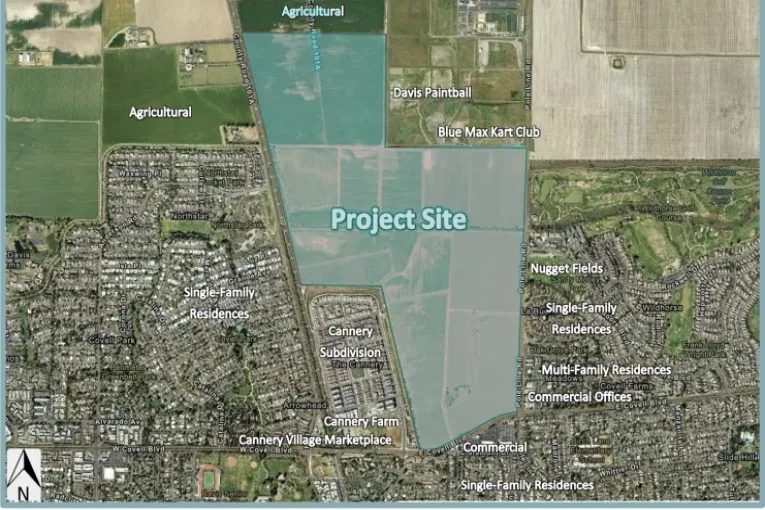
- Davis City Council to consider draft Affordable Housing Project Individualized Plan.
- Plan requires 262 affordable housing units as part of Village Farms Davis development.
- The plan includes a $6 million contribution to the city’s Housing Trust Fund.
The Davis City Council is scheduled to consider a draft Affordable Housing Project Individualized Plan for the proposed Village Farms Davis development following weeks of negotiations between city staff, a council subcommittee and the applicant aimed at formalizing how hundreds of affordable housing units would be delivered as part of the project.
The draft plan was prepared after the City Council voted in December to approve the developer’s initial affordable housing proposal and directed staff to work with the developer on additional safeguards to ensure the units are built on schedule.
According to the Affordable Housing Project Individualized Plan, the Village Farms Davis proposal includes more than 1,800 residential units across multiple housing types.
The document states, “The project consists of the following residential components,” before outlining a mix of single-family and multifamily housing. Based on those components and calculations under the Davis Municipal Code, the plan states, “As calculated under the Davis Municipal Code, the project would require the following affordable housing units,” culminating in a “Total Affordable Housing Requirement: 262 units.”
To meet that requirement, the draft plan proposes a combination of land dedication, deed-restricted housing construction and a direct financial contribution to the city. Central to the proposal is the dedication of land for affordable housing development.
“The Developer proposes to dedicate approximately 16 acres of land to the City, which will be developed in partnership with one or more qualified affordable housing developers selected by the City,” the plan states.
The document specifies that the land dedication sites would be delivered to the city as fully improved parcels.
“At the time of dedication to the City, the sites will be fully improved with infrastructure, frontage improvements (i.e., curb, gutter, walk), paved street access, and utility (i.e., water, gas, sewer, and electric) service connections stubbed to the property lines,” according to the plan. It further states that the land would be delivered in no more than four parcels, each with a minimum size of 2.5 acres, with the timing and configuration determined through the large lot tentative map process.
The affordable housing to be built on the land dedication sites would be permanently deed restricted.
The plan states that “the affordable housing to be developed on the land dedication site will be permanently affordable in accordance with the requirements of the Davis Municipal Code,” with final housing types determined by the city in consultation with selected affordable housing developers.
The plan outlines an affordability mix that exceeds the project’s baseline inclusionary requirement.
It states that the land dedication sites would accommodate “280 units reserved for very low and low-income households” and “80 units for moderate income households.”
For the very low- and low-income units, the plan specifies, “A minimum of 50% of the units will be affordable to very low-income households (≤50% of Area Median Income)” and, “The remaining units will be affordable to low-income households (≤80% of Area Median Income).”
For the moderate-income units, the plan states, “All units will be affordable to moderate income households between 80% and 120% of Area Median Income.”
In addition to the land dedication, the draft plan includes a monetary contribution to support affordable housing delivery.
“In addition to the contributions listed above, Developer will contribute $6,000,000 directly to the City’s Housing Trust Fund,” the plan states. Those funds are intended to support the development of affordable housing on the land dedication sites, although the plan allows flexibility if sufficient funding is secured through other sources.
“The funds contributed to the Housing Trust Fund shall be used to support the development of affordable housing on the land dedication sites within the project,” the plan states, adding that the funds may be used for other purposes consistent with the municipal code if adequate construction funding has already been obtained.
The draft plan also establishes a phased contribution schedule tied to development milestones. It states that the first $2 million payment will be made “concurrently with dedication of the first land dedication site,” followed by a $1 million contribution prior to issuance of the first building permit in Phase 2 and a $3 million contribution prior to issuance of the first building permit in Phase 3.
A central feature of the draft plan now before the council is its implementation timeline and enforcement structure. The staff report explains that following the Dec. 16 council action, staff worked with the City Attorney, the applicant and a council subcommittee to add conditions designed to ensure that affordable housing construction proceeds alongside the broader project.
Under the draft language summarized in the staff report, no building permits for Phase 3 would be issued until construction of at least 100 affordable housing units has commenced on the land dedication sites. The plan also establishes a four-year timeframe for the city to enter into a partnership with a qualified affordable housing developer. If that does not occur, the city would be required to meet and confer with the developer to identify a path forward.
The staff report further states that if the City Council determines it cannot build the affordable housing units, the developer may exercise fallback rights. Those rights could include providing “100 or more affordable housing units” directly or negotiating the return of land or cash to facilitate their development, with any units delivered credited toward the city’s affordable housing requirements for the project.
According to the staff report, negotiations are ongoing regarding the timeline for lifting restrictions on Phase 3 building permits. The report also notes that at the time the agenda packet was published, the applicant was not in agreement with the revised draft and expressed a preference to revert to the version of Exhibit E approved by the council in December.
City staff are asking the council to review the drafted affordable housing plan and provide final direction, which would be incorporated into materials for the full Village Farms Davis project review scheduled for a Jan. 20 public hearing.
Follow the Vanguard on Social Media – X, Instagram and Facebook. Subscribe the Vanguard News letters. To make a tax-deductible donation, please visit davisvanguard.org/donate or give directly through ActBlue. Your support will ensure that the vital work of the Vanguard continues.

Where did that graphic come from? It doesn’t even have the street names right.
Not that anyone really cares: look at all that parking… ugly VMT-creating parking. Everyone with a window wants to hear cars coming and going. So many people are going to drive everywhere and expect parking downtown. Maybe add some rainbows. We’re paying a bunch of so-called professionals several million dollars a year to check off that this is a good job.