
News Flash: “Veronika, a 13-year-old brown Swiss pet cow, picks up a broom with her tongue, then twists around and uses it to scratch the bits of her body she could otherwise not reach. The blunt end of the broom is used for the sensitive skin on her belly, while the bristly end is reserved for the thicker skin on her upper back and buttocks.”
That’s right, a tool-using cow. Science writers, apparently lacking an inner life of their own, are proclaiming, “There is no doubt that cows are complex creatures with rich inner lives.” God help us.
I’ll believe a tool-using cow scratching its butt with a big brush has a rich inner life when she uses the brush to paint a sunset.
Veronika has become the latest animal in the tool-using menagerie knocking down the straw man of human specialness and superiority. Who believes that anymore?
“One by one,” we’re told, “features that we once thought of as uniquely human, such as tool use, complex communication and culture, have toppled like dominos.”
Many scientists and science writers are bent on blurring the line between humans and nature in a misbegotten attempt to prove that we aren’t actually separate from nature. They conveniently ignore the steepening arc of man’s destructiveness, which has no parallel in nature, and which makes humans very different, but hardly special.
All creatures on earth except humans and domesticated animals live within an ecological niche. With the domestication of fire more than a million years ago, ancient humans began to break the bonds of niche. Modern humans, emerging over 100,000 years ago, began to exploit their environments and spread to every continent except Antarctica.
Therefore human alienation from nature didn’t begin with agriculture and the first cities. Rather, psychological separation began when people first subconsciously felt they were no longer inextricably part of nature, which was a very long time ago. Later, with the full emergence of symbolic thought, prehistoric peoples evolved myths and traditions that reminded them that separation is an illusion.
Now, at the terminus of man, we can no longer conceal the chasm between the way humans operate, which is fragmenting the earth all to hell, and the seamless wholeness within which the rest of the animal kingdom functions.
In short, the quest to end man’s alienation and fragmentation cannot be achieved by erasing the difference between Homo sapiens and nature. Trying to redress man’s destruction of the earth by battling against former attitudes of specialness and superiority is as foolish as talking about the inner lives of cows.
The philosophical conundrum is much subtler and more difficult. Jane Goodall not only observed the first use of tools by our primate cousins, the chimpanzees, but she also observed, to her horror, a four-year campaign of genocide by one troop against another.
From 1974 to 1978 in Gombe Tanzania, Goodall watched as a troop of chimps split into two factions, a northern group and a southern group. The northern group clearly premeditated and planned attacks on the southern group, eventually killing all the males of the southern group, absorbing the females into their group, and taking over their enemy’s territory. Sound familiar?
Initially, scientists dismissed Goodall’s observations, but subsequent studies showed that “chimpanzees in their natural state engage in lethal intergroup conflict [aka war] to gain territory and resources.”
The genocide in Gaza proves we humans have not evolved, and indeed, that there is no such thing as psychological evolution.
It also attests that the horrors of history, including the ongoing genocide in Gaza, must be understood without confining ourselves to the political level, with its ever-shifting divisions, warring groups and political machinations.
Though the obscurers of the distinction between man and nature have it very wrong, genocide by chimpanzees demonstrates that man’s genocidal tendencies run very deep. Since mystics across cultures and time confirm that life reflects cosmic order, beauty and immanence, how do we account for war and genocide, beginning with chimps?
I maintain that war and genocide have their roots in the evolution of ‘higher thought,’ which gave rise to identification with particular groups, the rudiments of which are shared with our closest evolutionary cousins, chimpanzees.
That insight would seem to make us prisoners of our evolution. But after essentially devoting my youth to inquiring into the human anomaly in nature, I came to a realization that provides a wellspring of compassion for what the American poet Robinson Jeffers called “the poor doll humanity.”
Simply put, it is that the evolution of so-called higher thought is both the threshold for direct awareness of beauty, essence and immanence, and the greatest impediment to realization. Thought must fall still in passive awareness and undirected attention for realization of our spiritual potential to flower.
Thus the ultimate paradox is resolved within us as non-divided individuals (a necessary redundancy), to allow the experiment in consciousness to be carried out on this, the most beautiful planet in our galaxy.
Genocide is the epitome of the wrong turning of man, but it has its roots in the first bipedal steps of proto-humans over 5 million years ago. (The human lineage [hominins] and chimpanzees diverged during the Miocene epoch, approximately 5-7 million years ago.) It is no coincidence that the only other animal capable of premeditated murder, and genocide, is man’s closest relative, the chimpanzee.
For romantics who proffer free-love bonobos (or peaceful pre-colonial indigenous peoples) as alternatives, the exceptions prove the rule and attest to the fact that the collective wrong turn of humankind was not inevitable, could have been corrected at any point, and must be corrected now in a globalized world.
Clearly, the fault lies both in our stars and in our selves, though the remedy lies within us.
Follow the Vanguard on Social Media – X, Instagram and Facebook. Subscribe the Vanguard News letters. To make a tax-deductible donation, please visit davisvanguard.org/donate or give directly through ActBlue. Your support will ensure that the vital work of the Vanguard continues.

“The northern group clearly premeditated and planned attacks on the southern group, eventually killing all the males of the southern group, absorbing the females into their group, and taking over their enemy’s territory. Sound familiar?”
Yeah. sounds like what Hamas did on October 7, 2023.
But why focus on Gaza? What about Southern Sudan where many more thousands have died since the cease fire in Gaza? Or what about Iran where thousands of protesters were killed by the government last week? Or what about the Holocaust, where the Nazi’s used all the tools of industrialization to murder millions, in the most famous genocide in the history of humanity while stealing the art collections of the victims?
Why do I mention stealing art? Since Goodall discovered a chimp MAKING a tool (not just using one like that cow) to get food from a termite hill we have had to re-think the uniqueness of what it means to be human because while humans are the most sophisticated tool makers Goodall showed we are not unique. So we then turned to art where once again we thought we were unique because humans use energy for no purpose at all something we thought was unique in the animal world. But then we see other animals also do this if provided the materials.
So what is unique about humans? We are the only primates that are bipedal. That’s it.
Goodall focused on Gaza at the end of her life
“But why focus on Gaza?”
A point I tried to make but wasn’t allowed.
No you were allowed but your manner of expression was not appropriate
You build a towering pile of gorilla dust and expect no one to notice the trick. The cow, the broom, the mystics, the chimps, the Miocene split, the poetry about consciousness, all of it functions as atmospheric cover. The structure looks grand and philosophical. The purpose stays small and tactical. You want one word planted as already decided. You want “genocide” attached to Gaza as a settled fact, not a contested legal and historical claim. The rest of the essay operates like stage fog so the audience does not watch the handoff.
You never argue the Gaza claim. You never define genocide under any legal or scholarly standard. You never test elements like intent, command structure, or classification under international law. You simply insert the label at the end, twice!, and keep moving, only mentioning two perpetrators of genocide: chimps & Jews. You route a disputed political conclusion through a meditation on cows and chimpanzees so it arrives wearing the costume of deep anthropology. But though you allude to genocides as part of the human condition, you leave out October 7th, the Holocaust, Sudan, Rwanda, Armenia, Iran, Cambodia, Bosnia, Darfur, the Yazidis in Iraq, the Anfal campaign against the Kurds, East Timor, the Guatemalan Maya, shall I go on . . . but you do mention one place and one perp, *twice* . . . hint: they rhyme with “plaza” and “news”, respectively.
The move is transparent. You posture above politics while smuggling in the most loaded political term available. You accuse others of blurring categories between humans and animals while you blur categories between metaphor and indictment. If the Gaza charge stands, let it stand on its own evidence and argument. It does not need a fog-of-war, or should I say war-of-fog, essay about tool use and cosmic awareness to sneak past scrutiny.
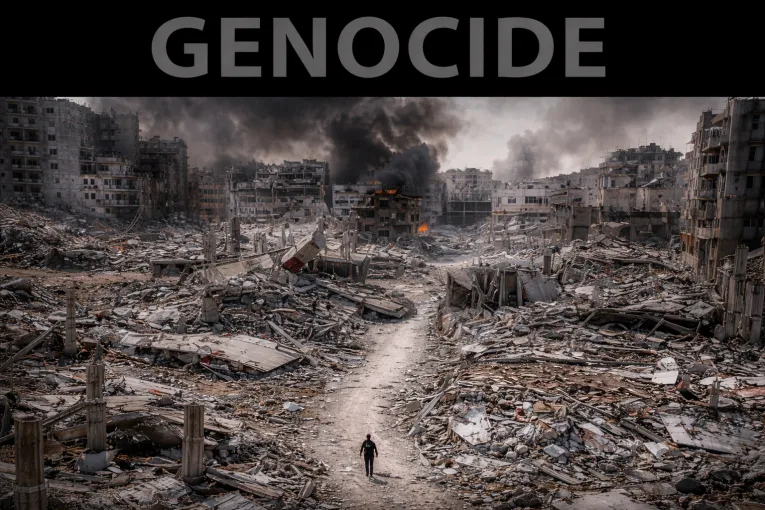
You say: “But after essentially devoting my youth to inquiring into the human anomaly in nature . . . ” While there, devoting your youth to inquiry about the nature of humans, did you ever take the time to self-examine your own nature, specifically your own biases and hidden bigotries? You meant to write an essay about Gaza, but this essay says more about you than it does about Gaza. Also, the dark illustration and provocative headline, which I assume are on DG, don’t help. I probably never would have got past the first paragraph and made it to the two “Gaza is Genocide” statements at then end if not for the headline and illustration.
Alan, I think your response misreads the purpose of the piece by treating it as an argument about Gaza rather than as a meditation on Goodall’s work and the broader question of human exceptionalism.
The essay’s focus is on how we explain away human violence by retreating into biology, mysticism, or abstraction, not on litigating international law or assembling a comprehensive catalogue of atrocities.
By zeroing in immediately on the Gaza reference, you effectively bypass the intellectual terrain the piece is actually exploring—how moral judgment is deferred or displaced when confronted with uncomfortable realities—and recast a reflective essay as a covert polemic.
(If you want to blame my image choice for that, okay, I can cop to that. I wasn’t that fond of the other alternatives.)
You’re free to disagree with the moral conclusion, but that disagreement doesn’t negate the genre or the intent of the work, which is to provoke reflection on human agency and responsibility through Goodall’s insights, not to adjudicate a legal case.
Ad hominem aside, David conveys the intent of the piece as well as I can. The piece is not about the factionalism and politics of the past or the present, whether against or by historical groups, but what we are as humans. We’re not just bipedal primates. We’re capable of unspeakable evil and total transcendence.
Gaza is the most glaring, painfully circular, and complicit example of genocide in recent years. The fact that genocide still exists is what we need to reflect on. Ideological reactions feed the beast within and without.
In her final months, Jane Goodall said, “the terrible, terrible, awful genocide in Gaza“ was keeping her awake at night. That should give us all pause.
You need Jane Goodall to give you pause about what happened in Gaza? Or Sudan? Or Iran, Or Alepo under Assad, or the Jews and gypsies of Europe in the 30’s and 40’s. Or the Japanese in Manchuria? Or the Kurds under Sadam Hussein? Or the Native Americans under every president from Washington to Cleveland?
Okay.
But forgive me for being skeptical when someone brings Gaza into anything these days.
“But forgive me for being skeptical when someone brings Gaza into anything these days.”
Exactly the point I tried to make.
“But forgive me for being skeptical when someone brings Gaza into anything these days.”
RG, and even more when they UNIQUELY bring in Gaza these days. So the Iranian regime kills half as many civilians in a couple of weeks as Hamas says were killed in over two years of war, and “Gaza is the most glaring, painfully circular, and complicit example . . . ” of something. Or is it because Gaza was on TV and the 30k bodies in Iran aren’t, and hating on Israel is the popular thing to do while hating on the Ayatollah isn’t? Strange, haven’t heard of one protest about the Iranian regime slaughter on or off campus.
And again with the G-word as a presupposition. It’s almost gotten boring as a strategy, but I’m still calling you out on it. Do some research and compare the Holocaust in Europe to the Gaza war. You might learn something.
“We’re not just bipedal primates.”
Funny you contradict your own thesis that other animals engage in similar behaviors as humans. Yes in a primitive way its true. So what does that leave us with that makes humans different? Being bipedal primates.
In nature, animals only fight over a few things; mates, territory, food (or resources), protection of young and social status. How many of these things was the October 7 War fought over? That humans engage in similar behaviors to others in the Animal Kingdom should surprise no one.
RG say, “How many of these things was the October 7 War fought over?”
1. mates – does rape count?
2. territory – does wiping Israel off the map count?
3. food (or resources) – I saw of vid of Gazans running over the border and looting a convenience store
4. protection of young – civilian children (except a few select Hamas leader’s families) were not allowed protection in the 500 miles of tunnels – an inversion of the purpose of most underground war infrastructure build for civilian protection.
5. social status – I understand martyrdom makes one very popular, and your family gets a payout
Wretched, heartless reasoning, which totally misses a consideration of the proposed insights