
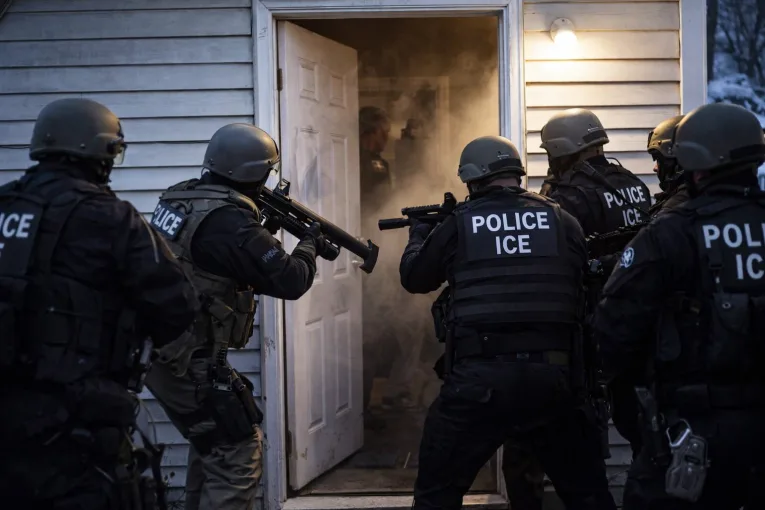
WASHINGTON — Federal immigration officers are asserting new authority to forcibly enter homes without a warrant signed by a judge under an internal Immigration and Customs Enforcement directive, even as a federal judge in Minnesota has ruled such conduct unconstitutional after officers broke into a family’s home armed only with an administrative warrant.
An Associated Press investigation reported that the internal memo authorizes ICE officers to use force when entering a residence based solely on an administrative warrant issued after a final order of removal, a move advocates say directly conflicts with Fourth Amendment protections and longstanding Supreme Court precedent.
According to the AP, the policy marks a sharp reversal of years of guidance instructing immigrant communities not to open their doors to immigration agents unless officers present a judicial warrant.
The shift coincides with an expansion of nationwide immigration arrests under the Trump administration, which has deployed thousands of officers under a mass deportation campaign that has already reshaped enforcement tactics in cities such as Minneapolis.
For decades, legal aid organizations, immigrant advocates and local governments have told residents that ICE may not enter a home without consent or a warrant signed by a judge, advice grounded in Supreme Court rulings that prohibit warrantless home entry absent judicial authorization.
That guidance has now been undercut by a memorandum signed by Acting ICE Director Todd Lyons and dated May 12, 2025, which states that the Department of Homeland Security Office of the General Counsel has “determined that the U.S. Constitution, the Immigration and Nationality Act, and the immigration regulations do not prohibit relying on administrative warrants for this purpose” when arresting people with final orders of removal in their homes .
The memo instructs officers that if entry is refused, they “should use only a necessary and reasonable amount of force to enter the alien’s residence,” provided they have announced their authority and intent.
Although addressed to “All ICE Personnel,” whistleblower disclosures submitted to Congress state that the memo has not been broadly distributed and instead has been shown selectively, often with supervisors directing employees to read it and return it immediately .
According to the disclosure, newly-hired ICE agents are being verbally trained to rely on Form I-205, a “Warrant of Removal/Deportation,” to enter homes without consent or a judicial warrant, even though DHS’s own written training materials state that such warrants “do NOT alone authorize a 4th Amendment search of any kind” .
The AP reported that it is unclear how widely the directive has been applied, but journalists witnessed ICE officers ramming through the front door of a Minnesota home with rifles drawn while executing an arrest based solely on an administrative warrant.
That raid became the basis for a federal court ruling issued Jan. 17, 2026, in which U.S. District Judge Jeffrey M. Bryan ordered the immediate release of Liberian national Garrison G., finding that ICE violated both federal regulations and the Fourth Amendment when agents forcibly entered his home without consent or a judicial warrant .
“This arrest violated the Fourth Amendment,” Bryan wrote, concluding that ICE agents “forcibly entered Garrison G.’s home without his consent and without a judicial warrant.”
The court found that Garrison G., who has lived in Minnesota for years under an Order of Supervision, had no criminal record and had “consistently complied with all conditions” of his release, including GPS ankle monitoring and regular check-ins with ICE, most recently on Dec. 29, 2025 .
In a sworn declaration filed with the court, Garrison G. described the early-morning raid as “traumatizing and illegal,” stating that ICE agents pounded on the door while his wife, children and relatives slept inside the home .
“I came to the door and demanded to see a warrant before I opened the door,” he wrote. “The agents left but returned later with a larger group.”
According to the declaration, agents deployed pepper spray toward neighbors who gathered outside, then “smashed open the door with a battering ram,” as armed officers entered the home despite repeated demands for a judicial warrant and warnings that children were inside .
“One agent repeatedly claimed ‘we’re getting the papers’ in response to his demand to see the warrant,” Garrison G. wrote. “But without showing a warrant, and apparently without having one, five to six agents moved in as if they were entering a war zone” .
Only after he was handcuffed did agents present his wife with documentation, which the court confirmed was an administrative warrant rather than a warrant issued by a judge .
Judge Bryan also found that ICE violated its own regulations governing the revocation of supervised release by failing to provide notice, explain any changed circumstances or conduct a required informal interview after detaining Garrison G. .
“Respondents have offered no reasons at all for revoking Garrison G.’s supervised release,” the court wrote, concluding that his re-detention was unlawful on multiple independent grounds .
The ruling came as scrutiny intensified over ICE’s reliance on Form I-205, which whistleblower disclosures emphasize is an administrative document signed by ICE supervisors, not “a neutral and detached magistrate” as required under Fourth Amendment precedent .
The disclosure cites DHS and ICE training materials dating back years stating that neither a Warrant for Arrest of Alien nor a Warrant of Removal “authorizes officers to enter the target’s residence or anywhere else where the target has a reasonable expectation of privacy” without consent or a judicial warrant .
Fourth Amendment scholar Orin Kerr, quoted by Wired, said ICE’s position conflicts with constitutional doctrine because “the executive branch can’t be in charge of deciding whether to give itself a warrant,” underscoring the requirement for judicial review before home entry.
After Judge Bryan ordered Garrison G.’s release, ICE agents detained him a second time during a routine check-in, before reversing course and releasing him again later that day, according to court filings and his declaration .
Garrison G. stated that during his initial detention, agents posed for “selfies” with detainees using their personal cell phones, conduct he described as humiliating and degrading .
Homeland Security spokeswoman Tricia McLaughlin told the AP that individuals served with administrative warrants have already received “full due process and a final order of removal,” and that officers issuing such warrants “also have found probable cause.”
Judge Bryan rejected that position, reaffirming that probable cause alone does not permit officers to cross the threshold of a private home without consent or a judicial warrant.
As enforcement operations continue nationwide, the ruling underscores that administrative immigration warrants do not override the Constitution’s protections of the home, even amid expanded deportation efforts.
Follow the Vanguard on Social Media – X, Instagram and Facebook. Subscribe the Vanguard News letters. To make a tax-deductible donation, please visit davisvanguard.org/donate or give directly through ActBlue. Your support will ensure that the vital work of the Vanguard continues.
