
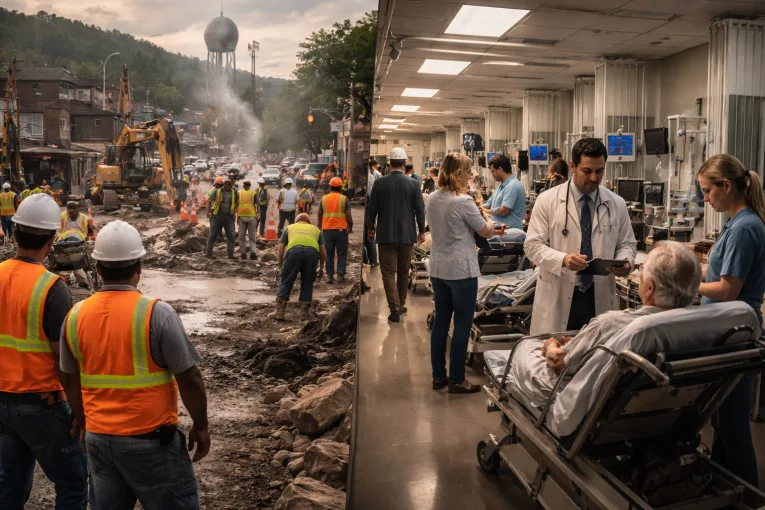
Princeton, W.Va. — At hospitals across southern West Virginia, staffing shortages are worsening as foreign-trained doctors and nurses reconsider plans to work in the United States amid tightening immigration policies, The New York Times reports, creating immediate pressures on rural health systems that were already stretched thin.
Hospital administrators told the Times that uncertainty around visas has already driven physicians to accept jobs in other countries, leaving rural hospitals struggling to replace critical staff and maintain essential services.
Nearly one in five nursing positions in West Virginia is vacant, according to the Times, compounding strain on an aging and medically vulnerable population.
What is unfolding in Princeton reflects a broader national shift. One year into President Trump’s immigration crackdown, communities across the country are beginning to feel the effects of reduced immigration and mass deportations, Lydia DePillis and Campbell Robertson report.
As visa fees increase, refugee admissions have dropped to near zero, and temporary legal protections granted under previous administrations have been rolled back or frozen, leaving hundreds of thousands of immigrants at risk of deportation.
Immigration has long been central to supporting rural and industrial regions, The New York Times reports.
Towns facing population decline have relied on an influx of newcomers to staff hospitals, stabilize school enrollment, sustain community institutions and fill sectors that struggle to attract the domestic workforce. As immigration slows, these communities are among the first to feel the consequences.
In Marshalltown, Iowa, where nearly one-fifth of residents are foreign-born, the Times reports that construction projects have been delayed, processing plants have been forced to let workers go as permits expire, and families have withdrawn children from school after hearing of mass immigration arrests.
Community leaders told the Times that the loss of immigrant workers has had deep and rapid consequences, affecting businesses, schools and local services alike.
The Times reports significant economic effects in labor-intensive industries. Construction wages have risen as deportations reduce the workforce, and landscaping firms anticipate labor shortages of up to 20 percent.
Supporters of immigration restriction argue that fewer newcomers will raise wages and reduce competition for critical sectors such as housing and jobs. Historical evidence from the immigration shutdown of the 1920s suggests wages for some U.S.-born workers briefly increased during past restrictive eras, economists cited by the Times said, but those gains were short-lived as labor shortages slowed broader economic activity. GV Wire
Economists who have studied past mass deportations and exclusionary policies, including those of the 1920s and 1930s, have found that labor shortages often depressed employment and wages for U.S.-born workers, reduced consumption in local economies and forced businesses to mechanize or contract, rather than hire native workers. GV Wire
The healthcare sector faces particularly acute consequences. Up to a third of Virginia’s physicians graduated from medical schools overseas, the Times reports, and hospitals are losing specialists they cannot easily replace.
Hospital administrators said reduced services and increased wait times have already begun affecting patients.
Beyond economics, communities are changing. Churches report lower attendance, cultural events are being canceled, and neighborhood sports leagues are struggling to field teams as families retreat from public life, DePillis and Robertson report.
In South Florida, a Venezuelan orchestra canceled its annual holiday concert after members expressed fear of leaving home, according to the Times.
Surveys of immigrant communities indicate rising worry about safety and economic stability, with significant shares of immigrants reporting negative impacts on housing, food security and employment since the administration stepped up enforcement. kff.org
Broader economic analysis suggests that deportations and restrictive policies are beginning to ripple through local economies beyond health care and construction, including agriculture, manufacturing and service sectors that depend heavily on immigrant labor. Research shows that previous waves of deportations reduced workforce participation and GDP growth, while creating inflationary pressures as labor shortages tighten supply chains. carsey.unh.edu
As legal pathways close, international students and entrepreneurs are increasingly choosing other countries. Business leaders warned that even if immigration policy shifts in the future, the reputation of the United States as a land of opportunity may be fundamentally damaged.
Some economists and community leaders argue that without a pathway to stable legal status for newcomers, demographic shifts and persistent labor shortages will challenge economic growth and strain public services in both urban and rural America in the years ahead.
Follow the Vanguard on Social Media – X, Instagram and Facebook. Subscribe the Vanguard News letters. To make a tax-deductible donation, please visit davisvanguard.org/donate or give directly through ActBlue. Your support will ensure that the vital work of the Vanguard continues.
