
- “The Trump administration is systematically lying to federal courts. The lies are being exposed, but not before they do immense damage in the court of public opinion and to the reputation and long-term effectiveness of the DOJ.” – David French
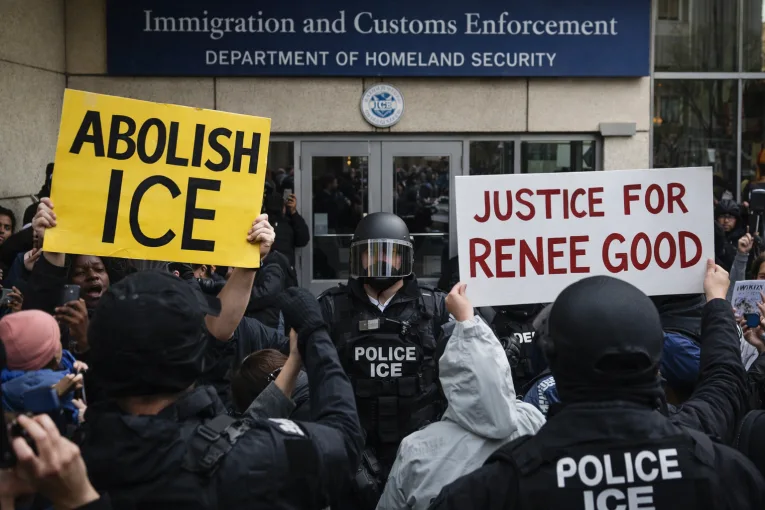
MINNEAPOLIS — ICE operations are facing intensifying scrutiny following the shooting death of Renee Nicole Good in Minneapolis, with newly-released data showing a sharp rise in immigration detention among people with no criminal record, and growing allegations that the Trump administration has misled courts and the public about the nature and scope of federal immigration enforcement.
ICE detention data released in recent weeks show the agency’s detained population has reached a record high of 68,990 people.
Analysts reviewing the figures say nearly all recent growth has occurred among immigrants with no criminal convictions and no pending criminal charges, contradicting repeated claims by the administration that enforcement efforts are focused on serious or violent criminals .
According to ICE’s own records, 92 percent of the growth in detention during fiscal year 2025 involved people without criminal convictions.
Charts included in the released data show detention of individuals with no criminal record rising sharply since late 2024, while detention of individuals with prior convictions increased at a far slower pace.
Analysts described the shift as historically significant and inconsistent with public messaging from federal officials .
The detention surge has unfolded amid heightened tensions in Minnesota following the Jan. 6 shooting death of Good, a 37-year-old mother who was killed by an ICE agent during a protest in Minneapolis.
Video footage of the encounter has circulated widely, prompting disputes over the federal government’s account of the incident.
Critics argue the images undermine claims made by Trump administration officials that Good posed a threat to officers or attempted to run one down, while supporters of ICE have defended the agent’s actions .
Rep. Ro Khanna, D-Calif., has called for criminal accountability and legislative reforms in response to the shooting. Khanna said the killing reflected a broader breakdown in oversight and restraint within federal immigration enforcement.
“It was a shameful act to kill a 37-year-old mom, leaving her 6-year-old boy an orphan,” Khanna said. “That’s why I have called for the arrest and prosecution of that ICE agent. ICE has gone rogue. We need accountability.”
Khanna also urged Congress to pass legislation he is co-sponsoring with Rep. Jasmine Crockett, D-Texas, that would require ICE agents to wear body cameras, prohibit the use of masks, mandate visible identification and place the agency under independent oversight by the Justice Department.
Khanna said his concerns extend beyond Minnesota. He described conditions he said he personally observed during a recent visit to the California City Immigration Detention Facility, where he met with dozens of detainees.
“I met with 47 detainees, and I was horrified by their condition,” Khanna said. “Some had rocks in their food. Some were shivering because they didn’t have clothes, long sleeve clothes to wear at night, and one gentleman who had blood in his urine had not seen a doctor for seven days.”
Khanna said the conditions he observed violated basic human rights standards and underscored the need for meaningful federal oversight of immigration detention facilities.
“We need to hold ICE accountable and we need to uphold human rights in ICE facilities,” Khanna said. “This is the time for Americans to speak up.”
Minnesota lawmakers have echoed those concerns. Rep. Ilhan Omar, D-Minn., rejected the Trump administration’s characterization of the Good shooting in a public statement on social media, disputing claims that the agent faced imminent danger.
“You’re lying,” Omar wrote. “There was no attempt to run the officer over and no ICE agents appear to be hurt. Get out of our city.”
Civil rights advocates and legal observers say the shooting is part of a broader pattern of aggressive enforcement tactics that have expanded under the Trump administration.
Accounts documented describe ICE agents stopping people of color in Minneapolis neighborhoods to demand identification, detaining individuals without warrants, and entering homes without judicial authorization.
Some reports allege that U.S. citizens have been detained or arrested during enforcement actions, forcing them to prove their citizenship after the fact .
Residents and community groups in Minneapolis have responded by organizing neighborhood monitoring efforts to observe and document federal enforcement actions.
David Brauer, a Minneapolis-based journalist and media critic, said the scope of ICE enforcement in Minneapolis has moved beyond immigration and into broad constitutional violations.
“You need to know that whether you’re a Republican, Independent or Democrat, the Constitution is being violated by our federal government.”
He said the actions are not narrowly targeted and instead affect entire communities, including U.S. citizens.
Advocates note that such observation is legal as long as it does not interfere with law enforcement operations.
According to accounts, ICE agents have increasingly attempted to disrupt those efforts, including breaking car windows, pulling observers from vehicles, and detaining individuals for filming enforcement actions in public spaces .
“This is not about catching criminals, or evenv deporting people. It is about punishing an entire state, including citizens, for not supporting the president.”
Brauer described widespread fear among residents of color, including citizens, who have altered daily routines to avoid federal agents.
“Americans of color are staying home, afraid to go to work, school, to grocery shop, or fill their cars with gas.”
He said community members who legally monitor ICE activity have increasingly been targeted following the killing of Renee Good.
“Yet since ICE killed Renee Good, they are increasingly stopping this observation, breaking car windows and pulling observers out, in one case unconscious, merely for watching what they are doing.”
The broader controversy has also drawn attention to the Trump administration’s relationship with the federal courts.
Legal commentators argue the administration has repeatedly made misleading or false claims in court filings and public statements, with corrections or debunkings often receiving far less public attention than the original allegations.
“The Trump administration is systematically lying to federal courts. The lies are being exposed, but not before they do immense damage in the court of public opinion and to the reputation and long-term effectiveness of the DOJ,” said David French, a legal commentator.
Critics warn that this pattern risks long-term damage to the credibility and effectiveness of the Justice Department and the rule of law .
Some commentators have focused their criticism on Congress, arguing that the GOP-controlled legislature has failed to exercise basic oversight responsibilities.
Analysts contend that oversight hearings would serve the public regardless of outcome, either by clearing the administration if allegations are unfounded or by establishing grounds for impeachment if wrongdoing is confirmed.
Doing nothing, they argue, represents a dereliction of constitutional duty.
“If Congress had the slightest courage or self-respect, they’d launch oversight hearings of these allegations,” said columnist Jonah Goldberg. “If the allegations are false or overstated they’d be helping the administration and the country by clearing the air. If they are found to be true, and part of administration policy, impeachment proceedings of those responsible should be launched. But not caring either way and doing nothing is flatly a violation of their oaths.”
The detention data have added urgency to those concerns.
Analysts point out that ICE records the first reported detention death of 2026 occurred as the detained population reached its current peak.
Critics argue that rapid expansion of detention, particularly among people with no criminal history, increases the risk of medical neglect, abuse and death inside facilities already criticized for poor conditions and inadequate healthcare .
“Data released by ICE shows that virtually the entire growth of detention in the last few months has been among people with no criminal record at all — no criminal convictions and no pending criminal charges,” said Aaron Reichlin-Melnick.
Observers say the administration’s messaging on immigration enforcement often emphasizes public safety while minimizing or ignoring data that show a growing focus on civil immigration violations.
According to analysts, this disconnect fuels public confusion and hardens political divisions, particularly when enforcement actions are accompanied by high-profile violence or visible use of force against protesters and bystanders.
“But the images do not match the rhetoric. Her death fits a pattern of tragic, seemingly inevitable violence arising from confrontations between protesters and masked immigration officers fanned out across American cities,” read a report in the Economist.
The controversy has also reignited debate over the future of ICE itself. Civil liberties groups argue that the normalization of masked federal agents, large-scale interior enforcement and detention of people without criminal records reflects a shift away from traditional law enforcement norms. They warn that such practices risk creating a parallel federal police force operating with limited transparency and accountability .
As investigations, litigation and congressional proposals continue, advocates say the stakes extend beyond immigration policy alone. They argue that unchecked enforcement power, combined with misleading public narratives and congressional inaction, threatens constitutional protections and erodes public trust in democratic institutions.
Whether Congress moves to assert oversight authority or enact reforms, critics say, will signal how seriously those risks are being taken .
“The country should be alarmed — they won’t stop with us,” David Brauer warned.
Follow the Vanguard on Social Media – X, Instagram and Facebook. Subscribe the Vanguard News letters. To make a tax-deductible donation, please visit davisvanguard.org/donate or give directly through ActBlue. Your support will ensure that the vital work of the Vanguard continues.
