
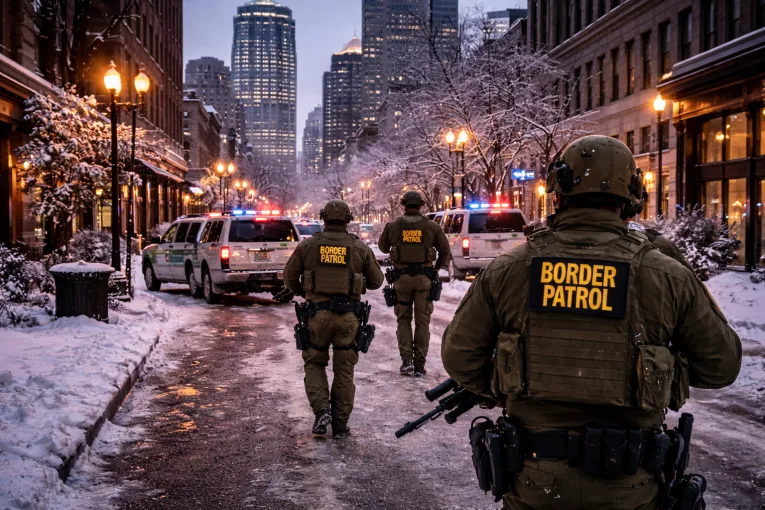
MINNEAPOLIS — What began as a federal immigration operation in south Minneapolis has spiraled into a national reckoning over force, authority and accountability, leaving two people dead, thousands in the streets and a state government openly rebuking Washington.
To Bill Conroy, a veteran investigative journalist who has spent decades tracking the darker corners of U.S. law enforcement, the violence and unrest unfolding in Minnesota were not shocking. They were inevitable.
“I could see this coming a mile away,” Conroy said in an interview with the Vanguard, arguing that the turmoil is not the result of a single tragic encounter but the product of long-standing structural failures inside federal immigration enforcement.
Bill Conroy is an independent investigative journalist whose work has focused on the drug war, law enforcement corruption and national security for more than two decades, including reporting for the Narco News Bulletin. His forthcoming book, The Great Pretense, examines U.S. intelligence and law enforcement operations in Latin America and along the U.S.-Mexico border.
The immediate spark came Jan. 7, when 37-year-old Renée Good was fatally shot by an agent from U.S. Immigration and Customs Enforcement during an enforcement action in south Minneapolis.
Video of the shooting spread rapidly, igniting public outrage.
Minneapolis Mayor Jacob Frey rejected parts of the federal account as “garbage,” while Gov. Tim Walz condemned the presence of federal agents operating in city neighborhoods.
Within days, protests surged, evolving into mass marches and a statewide “economic blackout” that drew labor unions, clergy, students and community organizations into the streets.
Less than three weeks later, on Jan. 24, federal law enforcement officers shot and killed another Minneapolis resident during what authorities described as a related operation. Officials said the man was armed.
Community members and local leaders saw something else: a pattern.
At least one protester had already been shot in the leg during demonstrations.
For many Minnesotans, the question sharpened into something more fundamental: Why were federal immigration agents operating like a paramilitary force in the middle of an American city?
Conroy traces the answer back to the chaotic birth of modern immigration enforcement following the Sept. 11 attacks.
“ICE has only been around since right after 9/11, when they created the Department of Homeland Security,” he said. “And it was created after they got rid of a really problematic Immigration and Naturalization Service.”
ICE, he explained, was assembled from the investigative remnants of the former INS and the U.S. Customs Service, the country’s oldest federal law enforcement agency, dating to the late 18th century. What emerged, he said, was not a coherent institution but a forced merger of rival bureaucracies with incompatible cultures.
“Customs didn’t have a lot of respect for INS, and INS didn’t have a lot of respect for Customs,” Conroy said. “And suddenly they’re working together.”
From the start, he argued, the agency was marked by weak leadership, internal dysfunction and a tolerance for abuse. That culture, Conroy said, became unmistakable in his reporting on ICE operations in Mexico, culminating in the case known as the “House of Death.”
In that case, ICE agents allowed a confidential informant to participate in at least a dozen murders in Ciudad Juárez in 2003 and 2004 as part of a cartel investigation.
“They knew in advance about the murders,” Conroy said. “But they kept this informant going.”
According to Conroy, agents instructed the informant to stop recording the killings after the first taped murder, but to continue participating and reporting back.
“By the time the case blew up, there were at least a dozen dead folks buried in the backyard of this house,” he said. “They just didn’t care.”
That indifference, Conroy argues, never disappeared. Instead, it metastasized as ICE’s mission shifted away from complex investigations toward mass immigration enforcement as many experienced agents left and institutional memory collapsed.
“What serious investigative agent wants to spend their time picking people up off the street for immigration violations?” Conroy asked.
At the same time, the agency embarked on a rapid expansion that Conroy described as reckless.
“They’re trying to almost triple the size of this agency,” he said. “Training was cut from five months to 47 days, and then they’re thrown out on the street with guns and all this tactical gear.”
The result, he said, is an enforcement force increasingly indistinguishable from U.S. Border Patrol, which he characterized as explicitly paramilitary and historically confined to border regions.
“Border Patrol is trained as paramilitary,” Conroy said. “They are not supposed to be operating this far in the interior because they’re not police.”
Having spent years reporting along the U.S.-Mexico border, Conroy said the culture of impunity that flourished there is now migrating northward.
“When you bring this paramilitary force into the interior of the country,” he said, “and you apply those rules to cities, you get what you see in Minnesota.”
In Conroy’s view, the shootings in Minneapolis are not anomalies but predictable outcomes of a system that treats constitutional protections as disposable.
“The only way to do these mass roundups is to infringe on constitutional rights,” he said. “That’s what they’re doing.”
The enforcement actions unfolded amid viral online videos alleging child care fraud by Somali immigrants in Minnesota. While those allegations triggered investigations and harassment, Good’s killing quickly eclipsed them, deepening mistrust and intensifying racialized narratives.
Conroy said racism has long been embedded within federal immigration agencies, pointing to lawsuits filed by Latino and Black agents alleging systemic discrimination.
“At the very top leadership of these agencies, it was these old white guys,” he said. “And none of the Latinos and Black agents were getting promoted.”
That culture, he said, has been further emboldened by political leadership that frames immigration enforcement as existential combat. He pointed to the influence of Stephen Miller in shaping the current strategy.
“When you’re so anti-immigrant that you don’t really care if they live or die,” Conroy said, “what do you call that? I call it racism.”
As Minnesota officials resist expanded cooperation and protesters demand ICE’s removal, Conroy sees a deeper vacuum.
“Who is watching these guys?” he asked. “Who is holding them to account for their actions?”
With civil remedies narrowing and the Department of Justice unwilling to police federal agents aggressively, he said, accountability has effectively vanished.
“Right now, it’s nobody,” Conroy said.
For Conroy, Minnesota is not an outlier, but a preview of what’s to come.
“I think this is a plan for the whole country,” he said. “Not just Minnesota.”
Follow the Vanguard on Social Media – X, Instagram and Facebook. Subscribe the Vanguard News letters. To make a tax-deductible donation, please visit davisvanguard.org/donate or give directly through ActBlue. Your support will ensure that the vital work of the Vanguard continues.
