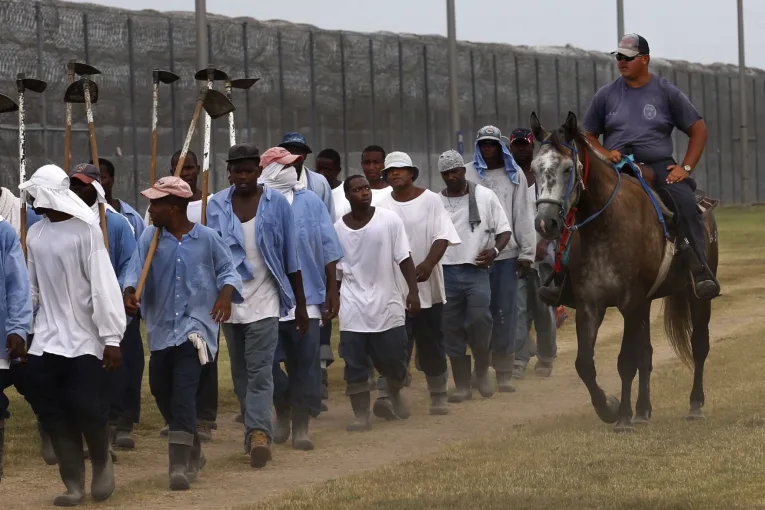
Alabama is advertising a crime on a billboard next to the highway. “Clean record,” it reads. “Free room and board.” “Work release.” The language is clean. Sanitized. It sounds like a job fair. But underneath the sterile text, the smell of the auction block rises up. We are not witnessing a return to tradition. We are witnessing the continued existence of the plantation.
The modern corporation loves a bargain. McDonald’s, Wendy’s. KFC. They build empires on efficiency. They cut costs wherever they can find a blade. But the cuts made in Alabama are not to the budget. They are to the soul. These franchises are filling their fryers and their supply chains with bodies who cannot say no. People working for pennies while the state steals the rest. This is not “cheap labor.” It is a return to the only economic model the South has ever truly mastered. The theft of Black life.
The numbers do not lie. Black people make up roughly twenty-seven percent of the state’s population. Yet they fill over half of the prison cells. They are more than twice as likely to be imprisoned as their white neighbors. This is not a statistical anomaly. It is target practice. The system is working exactly as it was designed to work. It is catching the people it was built to catch.
And once caught, the gag is forced in tight. A felony conviction in Alabama does not just steal your labor. It steals your voice. You lose the right to vote. You lose the ability to challenge the lawmakers who sold you. You lose the power to vote out the sheriffs who leased you. The state ensures that the victims of this machine cannot use the ballot box to dismantle it. It protects the profit margin by dismantling the political power of the worker. The plantation is expanding. It has just moved from the cotton field to the prison cell.
We have to look at the history to see the present clearly. The Thirteenth Amendment did not abolish slavery. It did not liberate anyone. It carved out a loophole the size of a prison cell. It kept the practice legal for anyone convicted of a crime. Alabama has spent the last century and a half widening that hole until it swallowed the state whole.
The system is not a relic. It is the blueprint. After the Civil War, the South did not let go of the free labor. It invented a new way to steal it. Vagrancy laws. Pig laws. If a Black person was found without a job, they were a criminal. If they were loud, they were a criminal. The state arrested them. The state leased them out to private companies. The state pocketed the profit. They called it “convict leasing.” It was slavery by another name. It was brutal. It was deadly.
The whip was replaced by the pistol. The overseer was replaced by the warden. The work is the same. Picking cotton. Tending fields. Working in kitchens. Building railroads. The difference is only in the accounting. The state no longer has to pay for the upkeep of the slaves. The “convicts” pay for it themselves with their labor.
This is the operating system of Alabama justice today. The Department of Corrections does not oversee rehabilitation. It oversees a supply chain. They are not preparing people for release. They are preparing them for the shift. We see the invoices. We see the corporations. They are buying human beings who are legally prohibited from asserting their humanity. This is the magic of the market. If you can eliminate the cost of decency, you maximize the profit.
The theft is mathematical. Alabama takes forty percent of the wages. That is not a tax. That is a ransom. It is the cut the pimp takes from the girl on the street. The state is the pimp. The prison is the corner. The franchise is the trick.
The parole board acts as the enforcement arm. They do not review behavior. They review productivity. If a person works in the fields, they might see freedom. If they complain, if they get sick, if they slow down, they stay in the cage. The length of the sentence is determined by the profit margin. This is not justice. It is labor discipline enforced by the threat of indefinite confinement.
We must stop pretending this is an accident of bureaucracy. This is a feature of the design. The Southern economy was built on stolen labor. When that labor was taken away by force, the South found a way to steal it back through the law. The names changed. The uniforms changed. The structure remained.
Calling this state-sponsored theft is not an accusation. It is a diagnosis. It is a continuation of the centuries-long project of extracting value from Black bodies. It is the same engine. It is just burning a different kind of fuel. The only thing that has changed is the logo on the uniform.
The chain is still there.
You just have to look a little harder to see it.
Follow the Vanguard on Social Media – X, Instagram and Facebook. Subscribe the Vanguard News letters. To make a tax-deductible donation, please visit davisvanguard.org/donate or give directly through ActBlue. Your support will ensure that the vital work of the Vanguard continues.