
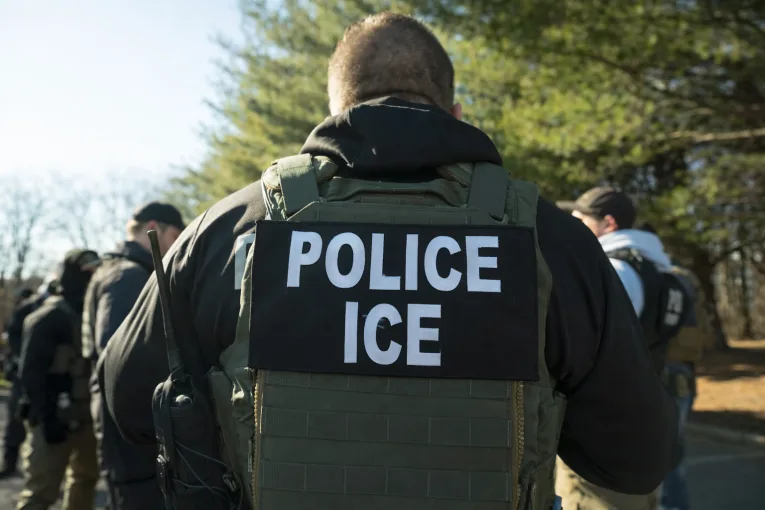
In an extraordinary and deeply unsettled moment, federal authorities are declining to allow routine state investigations into shootings by federal immigration agents, leaving local prosecutors to weigh whether — and how — to hold federal officers accountable in a system where Washington controls most of the levers of power.
In roughly half of recent cases involving on-duty federal immigration agents who shot and killed or injured people, local law enforcement agencies have not opened independent investigations, exposing a fragile balance between federal supremacy and state responsibility.
In an interview with the Vanguard, ProPublica reporter Andy Mannix described how his reporting began in Minneapolis, where he has covered law enforcement for most of his career.
The reporting followed a series of high-profile shootings involving federal immigration agents and what he described as an unprecedented effort by federal authorities to block state investigators from examining the scenes.
“We’ve seen something that who’s covered law enforcement for most of his career have never seen before, which is you had federal agents blocking state investigators from investigating, from entering crime scenes, from collecting evidence, that kind of thing,” Mannix said .
Minnesota, he explained, created a Bureau of Criminal Apprehension unit in 2020 that reviews every instance of deadly force by law enforcement, regardless of whether the shooting appears suspicious.
The goal, he said, is to promote transparency and public faith in the system. Past incidents involving federal agents had proceeded without conflict. This time, however, the posture changed.
“Seeing the federal government take a different posture on this one, turning away state investigators even with a warrant was kind of unprecedented,” Mannix said .
The shift prompted a broader investigation. Mannix and his colleagues sought to determine whether similar dynamics were occurring in other states and whether any functional system exists to hold federal immigration agents accountable when deadly force is used.
Another factor that drew attention, Mannix said, was the speed with which Trump administration officials publicly framed the incidents.
“Within hours of the shooting, fatal shooting, non-fatal, what have you, you have Trump officials going on live television and giving a narrative of events that’s entirely premature from any kind of investigation,” he said .
In some cases, he said, those narratives later proved inconsistent with available video evidence. That dynamic further heightened concerns over whether federal officials could objectively investigate their own agents.
The legal question at the heart of the issue is whether the federal supremacy clause shields federal agents from state scrutiny. Mannix acknowledged that the clause grants federal agents priority and protection when acting lawfully within the scope of their duties.
“The federal supremacy clause gives the federal government’s agents priority and basically says that as long as they’re acting within the scope of their duties, they’re acting lawfully, there’s not much that local police can do,” he explained .
However, he added that the clause does not eliminate state authority in situations where there are legitimate questions about whether federal officers acted legally or reasonably. “Local law enforcement has every legal right to investigate if that question is not clear,” he said .
Beyond constitutional doctrine, Mannix pointed to practical and cultural barriers. Many local agencies work in joint task forces with federal authorities, from drug enforcement to counterterrorism.
Those relationships may discourage local prosecutors and police from aggressively investigating federal partners. He also cited what he described as a “blue line” code, an informal norm against interfering with other law enforcement officers.
Despite those headwinds, Mannix emphasized that local authorities often have jurisdiction over shootings that occur within their borders and that parallel investigations are legally possible.
In Minnesota, he noted, state prosecutors could pursue state-level charges such as murder or manslaughter even while federal authorities consider civil rights violations.
Recent history provides at least one example of parallel prosecutions.
In the killing of George Floyd, the involved officers were convicted in state court on murder and manslaughter charges and separately convicted in federal court of depriving Floyd of his civil rights. The dual-track approach underscores that state and federal jurisdictions are not mutually exclusive.
When asked whether state authorities have recently charged federal agents in similar circumstances, Mannix said his reporting uncovered few contemporary examples.
“We didn’t see a lot of really recent examples,” he said, noting that such cases appeared more common decades ago .
The absence of a modern playbook, he added, makes it a heavy lift for state prosecutors contemplating action.
In Hennepin County, which includes Minneapolis, County Attorney Mary Moriarty has publicly reviewed evidence in recent cases involving federal agents.
Mannix said prosecutors routinely confront noncooperative parties in criminal cases and that lack of federal cooperation would not necessarily preclude state charges.
“They get cases every day where people aren’t cooperating,” he said, adding that prosecutors can rely on video evidence, witnesses and medical examiner findings .
The more difficult question, Mannix acknowledged, is what would happen if state charges were filed and federal authorities refused to produce the agents.
He described that scenario as “really unprecedented” and said he does not know how it would ultimately unfold .
However, a president cannot simply erase state charges through a federal pardon.
“It’s not a situation where the president could pardon them if they’re facing state charges,” he said .
The broader political environment further complicates matters.
Mannix described what one observer called an “inverted civil rights moment,” in which local officials are now being asked to protect residents from federal overreach — a reversal of the 1960s dynamic, when federal authorities intervened against recalcitrant states.
Minnesota, he said, has felt especially targeted in recent months.
Federal immigration agents have maintained a visible presence in Minneapolis, and high-profile rhetoric from President Donald Trump has intensified local tensions. Mannix noted that Minnesota officials, including Gov. Tim Walz and Attorney General Keith Ellison, have repeatedly challenged federal actions in court.
He also described internal turmoil within the U.S. attorney’s office in Minnesota, where some attorneys reportedly left in protest over directives related to politically sensitive investigations.
While much remains uncertain, Mannix said the core issue is accountability.
If federal investigations are perceived as insufficient or biased, state and local authorities may represent the only meaningful alternative.
Whether they are willing to assert that authority in the face of legal complexity, institutional culture and political risk is now an open question.
For Mannix, the reporting underscores how unsettled the landscape has become.
“It’s again, another just bizarre moment and this very unpredictable political landscape we’re in,” he said .
The coming weeks may clarify whether local prosecutors step forward — and whether the delicate balance between federal supremacy and state sovereignty is tested in courtrooms rather than press conferences.
Follow the Vanguard on Social Media – X, Instagram and Facebook. Subscribe the Vanguard News letters. To make a tax-deductible donation, please visit davisvanguard.org/donate or give directly through ActBlue. Your support will ensure that the vital work of the Vanguard continues.
